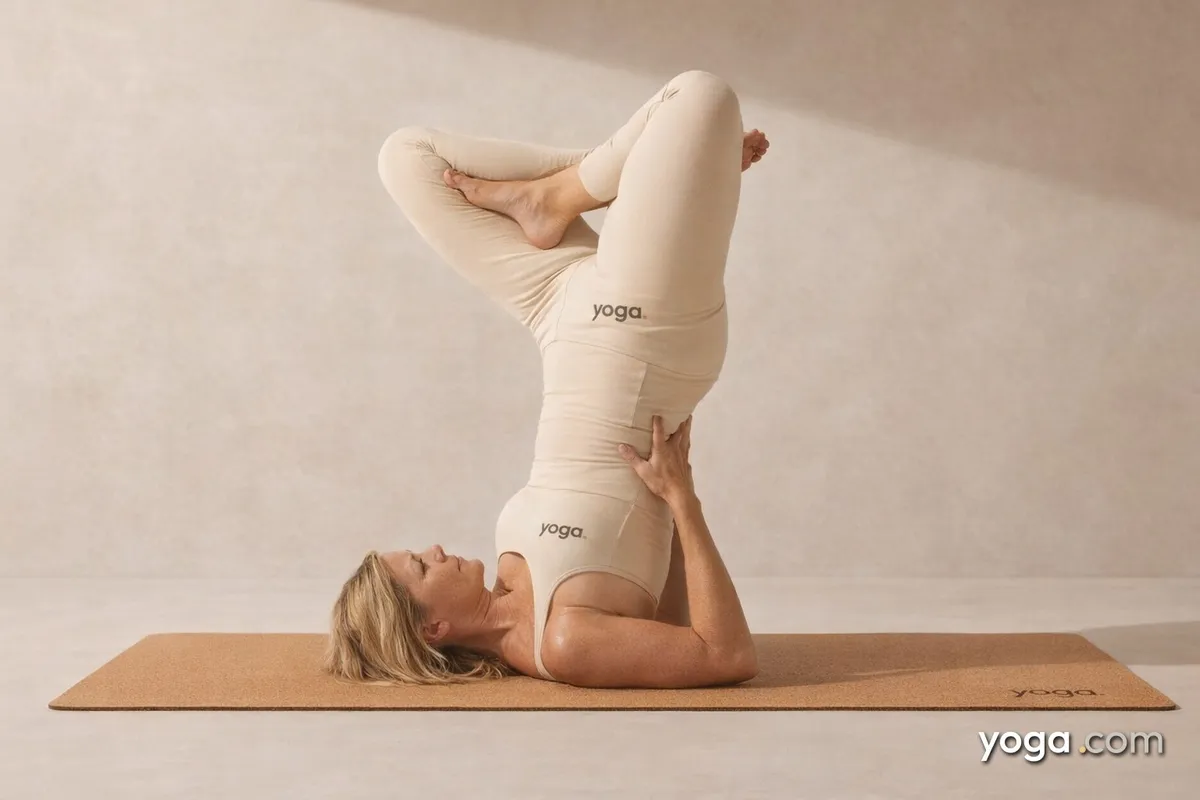
Ūrdhva Padmāsana (in Sarvāṅgāsana, advanced) - literally "upward lotus pose in shoulderstand" - combines the full inversion of Shoulderstand (Sarvāṅgāsana) with the crossed-leg bind of Lotus (Padmāsana), suspending the hips and pelvis above the shoulders while the legs form a compact lotus wheel. It typically appears near the peak of an Ashtanga or Iyengar-influenced practice, after the spine has been warmed and the hips thoroughly opened.
At a Glance
- Level: Advanced
- Type: Inversion
- Targets: Hips and hip rotators, spine extensors, shoulder girdle, core stabilizers
- Good for: Building shoulder and upper-back stability, deepening hip external rotation, developing balance in the inverted position
How to Do Lotus in Shoulderstand (Advanced)
- Lie on your back with a folded blanket supporting your shoulders; your head rests on the mat, the blanket edge at the base of your skull. Press your arms alongside your torso.
- On an exhale, swing your legs overhead and come into Shoulderstand: press the backs of your upper arms into the blanket, bend your elbows, and walk your hands up your back toward the shoulder blades. Stack hips over shoulders, elbows pressing down, legs reaching straight up, toes pointing at the ceiling.
- Stabilize here for several breaths. Firm your outer upper arms into the blanket, lengthen the back of your neck, and draw your lower ribs in so your torso stays vertical rather than arching.
- Bend your right knee and cross the right foot to the top of your left thigh, drawing it into half-lotus. Then bend your left knee and bring the left foot to the top of your right thigh, settling both feet into full Lotus. Take your time; forcing the knees in an inverted position carries real risk.
- Once in Lotus, you may keep your hands on your back, or - for the advanced expression - extend your arms along the mat and balance freely on the tops of your shoulders, using core and hip-flexor engagement to maintain height.
- Hold for 5-10 steady breaths, keeping your gaze toward your feet or the ceiling. Avoid turning your head.
- Coming out: Re-support your back with both hands. Uncross your legs in reverse order (left leg releases first, then right), returning to straight-leg Shoulderstand.
- Lower your legs slowly over your head into Plow, then roll your spine to the mat one vertebra at a time. Rest in Corpse Pose for at least 10 breaths.
Benefits
- Strengthens the muscles of the upper back, posterior shoulders, and neck stabilizers under load.
- Deepens external rotation of both hip joints, lengthening the piriformis and deep lateral rotators.
- Engages and tones the spinal extensors and core to hold the torso vertical in the inverted position.
- Coordinates hip-flexor and abdominal strength needed to manage the asymmetric weight of the lotus legs overhead.
- Builds proprioceptive awareness and balance with the body fully inverted and the base of support limited to the shoulders and upper arms.
Common Mistakes and Alignment Cues
- Forcing the lotus while inverted: If either knee resists, stop and come down. Only attempt the crossed-leg position once you can hold a comfortable, pain-free Lotus on the ground.
- Collapsing the upper back: Keep pressing the backs of your upper arms into the blanket and move your hands higher up the back to support the thoracic spine - don't let the torso sag toward horizontal.
- Jutting the lower ribs forward: Draw the front ribs in and lengthen the tailbone toward the ceiling so the torso forms one straight line rather than an arch.
- Turning the head: Fix your gaze on the ceiling or your feet and keep the chin slightly away from the sternum. Rotating the neck in full inversion stresses the cervical spine.
- Rushing into the free-arm variation: Only release your hands from your back once your Shoulderstand base is rock-solid. Premature removal of hand support dumps weight into the neck.
Modifications and Props
- Blanket under shoulders: Always use at least one firm, folded blanket. This raises the shoulders and protects the cervical curve - non-negotiable for safe shoulderstand practice.
- Wall for balance: Practice your Shoulderstand with the soles of the feet resting lightly against a wall until the vertical alignment feels stable before adding the Lotus legs.
- Half Lotus only: If full Lotus causes any knee discomfort, stop at half-lotus (one leg bent, one straight) to build familiarity without compromising the joint.
- Supported Shoulderstand with a chair: Rest the backs of your thighs on the seat of a chair behind you to reduce load on the neck while you develop hip mobility for the lotus position.
Cautions
- Avoid this pose if you have a neck, cervical spine, or disc injury, or if you experience pain, tingling, or numbness in the neck or arms during Shoulderstand.
- Do not practice if you have a recent or unstable knee injury; the torque required to settle both feet into full Lotus is significant even when upright, and increases when inverted.
- Avoid during menstruation, according to some traditional teachings; those with high blood pressure, glaucoma, or detached retina should not practice unsupported inversions.
- Do not turn your head or hold a conversation while in the pose - any rotation of the cervical spine under the body's weight is unsafe.
If you're working with an injury or a medical condition, check with a qualified professional before practicing.
Related Poses
- Plow Pose - an essential preparation and transition into and out of Shoulderstand.
- Ear Pressure Pose - a natural counter and progression from Plow that keeps the spine flexed after the inversion.
- Easy Plow Pose - a supported variation that warms the posterior chain before entering full Shoulderstand.
- Bridge Pose - a preparatory backbend that opens the chest and activates the shoulder girdle before the inversion.
- Corpse Pose - the recommended counter-pose to rest the nervous system and release the neck after any inversion.
For gentler sequencing ideas, see A Gentle Yoga Routine for Tired, Low-Energy Days and A 10-Move Chair Yoga Sequence for a Midday Reset.