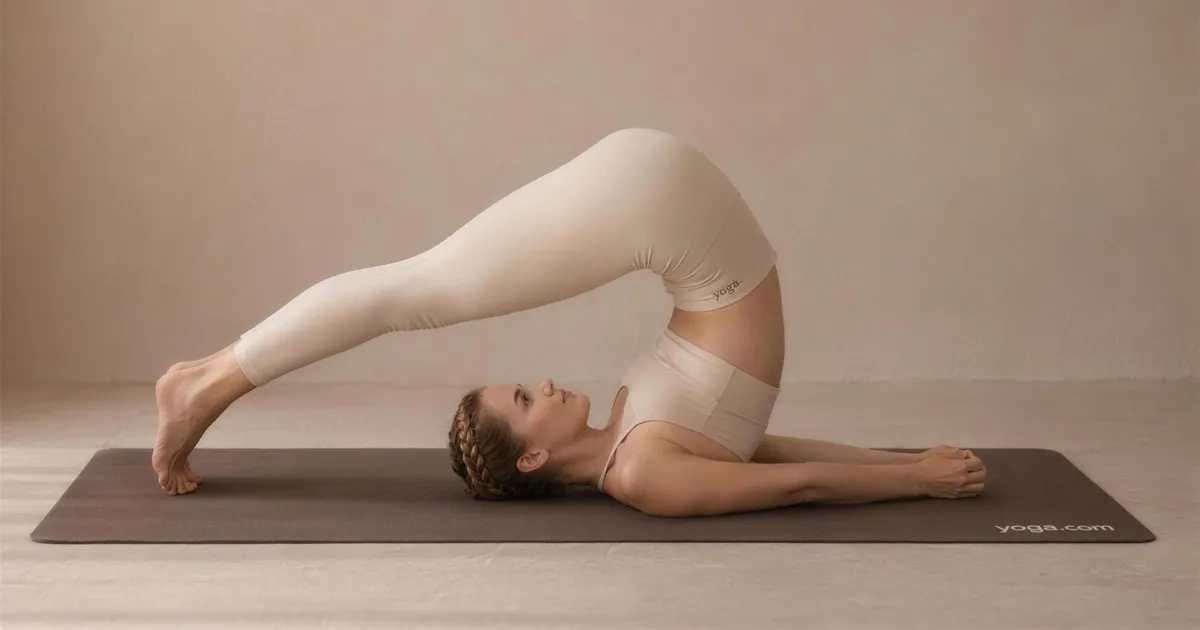
Plow Pose, or Halāsana (from the Sanskrit hala, meaning "plow," and āsana, meaning "seat" or "posture"), is a supine inversion in which the legs sweep up and over the head until the toes rest on the floor behind you. It typically follows Shoulder Stand in a classical sequence and serves as both a deepening posture and a natural transition toward the floor before rest.
At a Glance
- Level: Intermediate
- Type: Inversion
- Targets: Cervical and thoracic spine, hamstrings, shoulders, upper back
- Good for: Lengthening the posterior chain, building spinal mobility, calming the nervous system
How to Do Plow Pose
- Lie on your back with your arms alongside your body, palms pressing down. Draw your knees toward your chest.
- Press your palms firmly into the mat and use your core to lift your hips, swinging your legs up and over your head in a controlled arc - the same action used to enter Shoulder Stand.
- Once your hips are stacked above your shoulders, bring your hands to your lower back, fingers pointing upward, to support your spine. Keep your elbows no wider than shoulder-width.
- Slowly lower your legs toward the floor behind your head. If your toes reach the mat, let them rest there lightly - avoid dumping your weight into the neck. If they don't reach, that's fine; keep supporting the back with your hands.
- Straighten your legs actively: press through your heels, engage your quadriceps, and lift your sit bones toward the ceiling so the spine stays long rather than rounding heavily.
- Option: interlace your fingers on the mat behind your back and roll your outer shoulders under, broadening your collarbones. Gaze softly up toward the ceiling - do not turn your head.
- Hold for 5-15 breaths, breathing smoothly. To come out, place your hands back on your lower back for support, then slowly and with control roll your spine down to the mat one vertebra at a time, lowering your legs last.
- Rest in Corpse Pose for several breaths before continuing.
Benefits
- Stretches the hamstrings and calves through a full range of motion.
- Lengthens the muscles of the upper back and the ligaments along the posterior cervical spine.
- Strengthens the core muscles required to control spinal flexion under load.
- Builds shoulder and upper-arm stability as the arms anchor the inversion.
- Improves spinal mobility, particularly through the thoracic and lumbar segments.
Common Mistakes and Alignment Cues
- Collapsing onto the neck: If you feel pressure concentrated in the cervical spine, re-engage your hands on your lower back and lift the hips higher to redistribute weight into the shoulders and upper arms.
- Elbows splaying wide: Keep your elbows drawn toward each other - no wider than your shoulders - so your upper arms form a stable base and don't destabilize the pose.
- Passive, rounded spine: Rather than hanging in the shape, actively lengthen: press your heels away, lift your sit bones, and imagine drawing your lower ribs away from your hips.
- Forcing the feet to the floor: If your hamstrings or back are tight, forcing contact compresses the neck. Work with a folded blanket under your shoulders or keep your hands on your back until flexibility develops naturally.
- Turning the head in the pose: Once you are in Plow, keep your gaze fixed and your head absolutely still. Rotating the cervical spine under load risks injury.
Modifications and Props
- Blanket under shoulders: Place one or two folded blankets under your shoulders (edges at the tops of the shoulders, head on the mat). This lifts the shoulder girdle and reduces the angle of cervical flexion, protecting the neck - highly recommended for most practitioners.
- Chair for foot support: If your feet don't reach the floor, set a chair behind you at the appropriate height and rest your toes on the seat. This lets you hold the pose with a supported spine rather than straining.
- Hands on back throughout: You don't need to interlace your fingers on the floor. Keeping both hands on your lower back is a safe, stable option at any level of experience.
- Easy Plow Pose: Keep the knees bent and rest them beside your ears rather than straightening the legs - a gentler version that reduces hamstring and spinal demand.
Cautions
- Avoid this pose if you have a neck injury or have been advised to limit cervical flexion.
- Use caution during menstruation; many teachers recommend avoiding deep inversions at that time.
- Those with high blood pressure, glaucoma, or detached retina should avoid inversions unless cleared by a healthcare provider.
- If you experience any sharp pain, tingling, or numbness - particularly in the neck, arms, or hands - come out of the pose slowly and carefully.
If you're working with an injury or a medical condition, check with a qualified professional before practicing.
Related Poses
- Bridge Pose - an accessible preparation that warms up the spine and shoulders in a similar posterior-chain position.
- Easy Plow Pose - a bent-knee variation that introduces the shape with less demand on the hamstrings and neck.
- Ear Pressure Pose - the natural next step from Plow, deepening the spinal flexion with knees drawn toward the ears.
- Corpse Pose - the ideal counter-pose after any inversion sequence, allowing the spine and nervous system to settle.
Looking for a gentle practice context? See A Gentle Yoga Routine for Tired, Low-Energy Days or try A 10-Move Chair Yoga Sequence for a Midday Reset for accessible movement ideas.