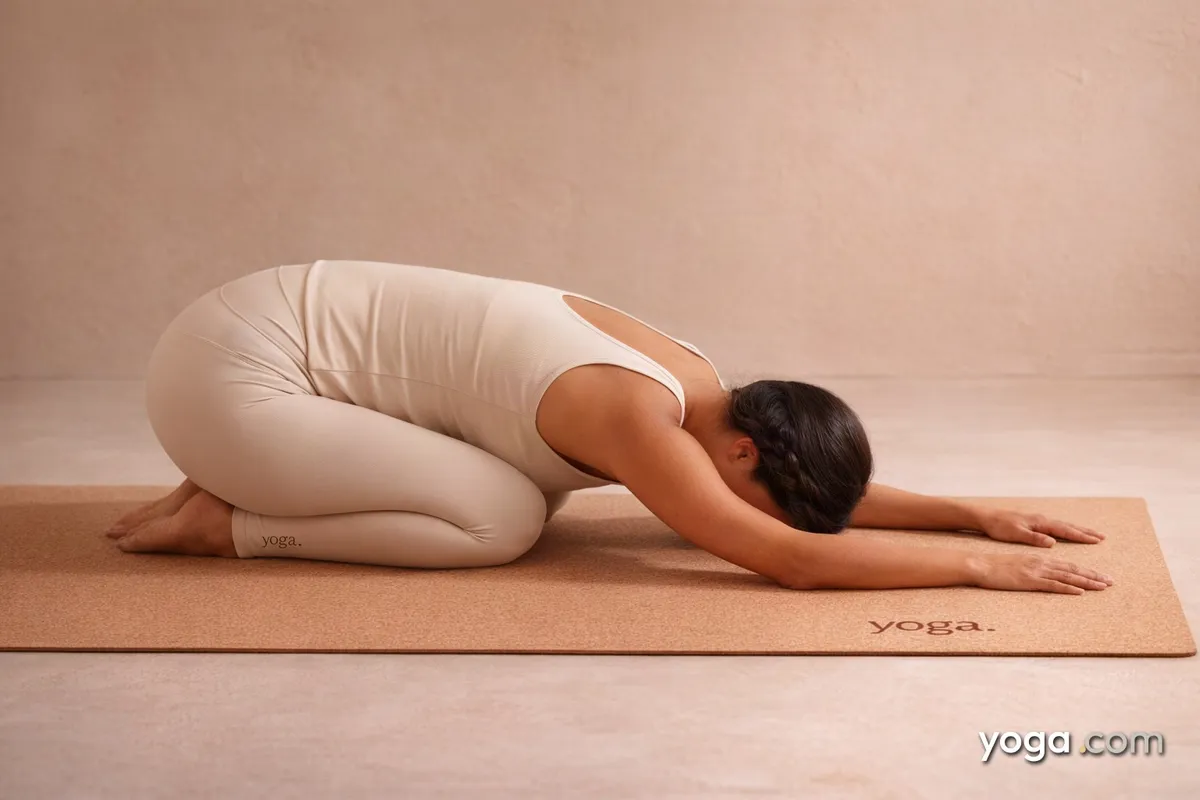
Child's Pose - Bālāsana, from the Sanskrit bāla (child) and āsana (seat or posture) - is a kneeling forward fold that brings the torso down toward the floor with the arms either extended forward or resting alongside the body. It serves as a foundational resting posture, used between more demanding poses, at the start of practice to settle the breath, or any time you need to pause and reset.
At a Glance
- Level: Beginner
- Type: Restorative
- Targets: Hips, knees, lower back, shoulders
- Good for: Lengthening the spine, releasing tension across the upper back, grounding the breath
How to Do Child's Pose
- Begin in a tabletop position on hands and knees, with your wrists stacked under your shoulders and your knees under your hips.
- Bring your big toes to touch and widen your knees to roughly hip-width apart - or wider if it suits your hips better.
- On an exhale, send your hips back toward your heels, letting your torso fold forward between your thighs.
- Extend your arms forward along the mat, shoulder-width apart, pressing your palms lightly into the floor; or, if you prefer a passive variation, rest your arms alongside your body with palms facing up.
- Lower your forehead gently to the mat. If your forehead doesn't reach, let it rest on stacked fists or a block.
- Allow your lower back to soften and broaden, your shoulder blades to drift apart, and the weight of your torso to settle naturally toward the floor with each exhale.
- Stay for 5 to 20 breaths, or as long as feels right.
- To come out, walk your hands back under your shoulders, press into your palms, and slowly rise back to tabletop on an inhale.
Benefits
- Stretches the hip flexors, inner thighs, and gluteal muscles through the wide-knee position.
- Lengthens the muscles of the lower back and decompresses the lumbar spine in a supported position.
- Stretches the tops of the feet and ankles through sustained plantar flexion.
- Builds awareness of three-dimensional breathing by letting you feel the back body expand on each inhale.
- Broadens and gently stretches the muscles between and around the shoulder blades when arms are extended forward.
Common Mistakes and Alignment Cues
- Hips floating far from the heels: Place a folded blanket between your thighs and calves to give the hips a surface to settle onto rather than hanging in space.
- Neck compressed or cranked to one side: Center your forehead directly on the mat - or on a prop - so the cervical spine stays in a neutral, long line from the base of the skull.
- Shoulders creeping toward the ears: Slide the shoulder blades gently down the back and let them widen apart; there should be no gripping or bracing in the upper traps.
- Holding the breath: Let the belly release completely. Each exhale, invite the belly to drop a little heavier toward the floor; each inhale, feel the back ribs expand outward like an accordion.
- Arms strained or overreaching: Your hands don't need to press actively - think of them as resting forward, not pulling the torso longer.
Modifications and Props
- Blanket under the knees: If the bare mat is hard on the knee joints, fold a blanket and place it beneath your knees for cushioning.
- Block under the forehead: If your forehead doesn't comfortably meet the mat, rest it on a block at any height so the neck stays relaxed rather than straining.
- Blanket between thighs and calves: Roll a firm blanket and tuck it into the back of the knees; this closes the gap when hips are tight and lets you fully let go.
- Arms alongside the body: If the shoulders are uncomfortable with arms extended, bring your arms back beside your torso, palms facing up, for a fully passive variation.
Cautions
- Knee discomfort: If you feel sharp or pinching pain in the knee joints (not just the sensation of stretch), come out of the pose and use a blanket between thighs and calves, or practice a supine hip-opener instead.
- Pregnancy: In later trimesters, a wide-knee version with ample space for the belly is essential; check with your care provider about forward-fold postures as pregnancy progresses.
- Recent ankle or knee injury: Sustained plantar flexion and deep knee flexion may aggravate these areas; modify the range of movement or choose an alternative resting posture.
- Dizziness when rising: Come out of the pose slowly, returning to tabletop first and pausing a breath or two before moving upright.
If you're working with an injury or a medical condition, check with a qualified professional before practicing.
Related Poses
- Cat Pose - a natural warm-up that mobilizes the spine before folding into Child's Pose.
- Downward-Facing Dog Pose - a common counterpart; Child's Pose often follows or precedes it in a flow sequence.
- Reclining Bound Angle Pose - a supine restorative alternative that opens the inner hips when kneeling is not accessible.
- Corpse Pose - the deeper resting posture that Child's Pose can transition into at the close of practice.
See Child's Pose in a full sequence context: A Gentle Yoga Routine for Tired, Low-Energy Days and A 10-Move Chair Yoga Sequence for a Midday Reset.