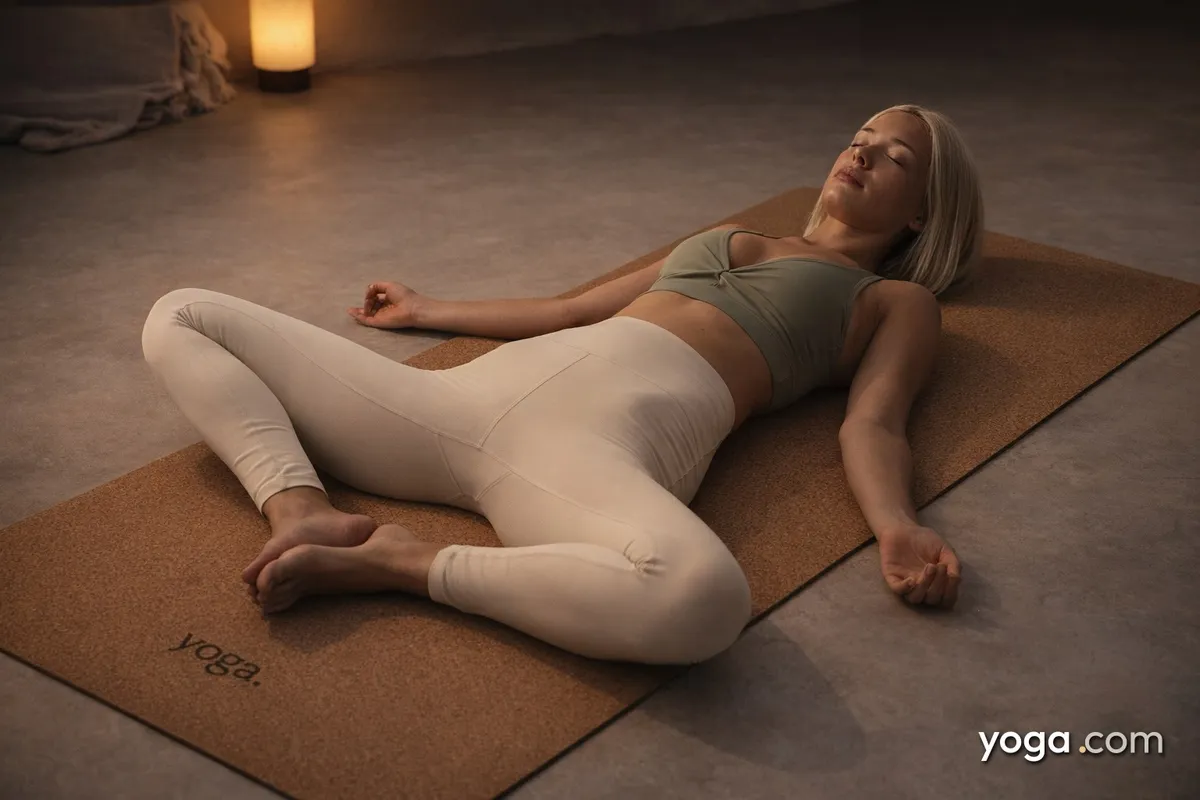
Reclining Bound Angle Pose is a supine hip-opening posture known in Sanskrit as Supta Baddha Koṇāsana - literally "reclining bound angle pose" (supta = reclining, baddha = bound, koṇa = angle). It brings the soles of the feet together and lets the knees fall wide while the back rests fully on the floor. You'll typically find it near the end of a practice, as a transition into Savasana or as a standalone restorative hold.
At a Glance
- Level: Beginner
- Type: Restorative
- Targets: Inner thighs (adductors), hip flexors, groin, chest and shoulders
- Good for: Deepening diaphragmatic breathing, releasing passive tension in the hips, calming the nervous system
How to Do Reclining Bound Angle Pose
- Sit on your mat with your knees bent and feet flat on the floor, then bring the soles of your feet together and let your knees drop out to either side - this is Baddha Koṇāsana. Slide your feet in toward your pelvis until you feel a comfortable stretch in the inner thighs, not a strain.
- Place your hands just behind your hips and lean back slowly, walking your forearms to the mat one at a time. Keep control through the lower back - avoid flopping back suddenly.
- Lower your head and torso all the way to the floor. If your lower back arches sharply away from the mat or your chin juts up, add support (see Modifications below) before settling.
- Rest your arms on the floor with palms facing up, angled slightly away from your body at roughly 45 degrees. Let your shoulders melt down and away from your ears.
- Soften the muscles of your face, jaw, and belly. Allow gravity to do the work of releasing the inner thighs; resist the urge to actively push the knees toward the floor.
- Breathe naturally and hold for 1-5 minutes, letting each exhale deepen the passive opening.
- To come out: Draw your knees together over your chest with your hands, then roll gently to one side. Use your hands to press yourself back up to sitting.
Benefits
- Stretches the adductors, inner groin, and hip flexors passively over time.
- Opens the chest and broadens the collarbones when the arms rest open at the sides.
- Encourages full diaphragmatic breathing by releasing the abdomen and ribcage.
- Gently lengthens the muscles of the pelvic floor.
- Provides a passive counterpose to standing and forward-folding work earlier in practice.
Common Mistakes and Alignment Cues
- Mistake: Forcing the knees toward the floor. Cue: Let gravity do the work - active pressing tightens the very muscles you're trying to release.
- Mistake: Excessive lumbar arch. Cue: If your lower back lifts sharply off the mat, place a folded blanket under your sacrum or use a bolster under the spine to restore a neutral curve.
- Mistake: Chin pointing up, throat gripping. Cue: Slide a folded blanket under your head so the forehead is level with or slightly above the chin, softening the throat and neck.
- Mistake: Feet too far from the pelvis. Cue: A longer "diamond" shape in the legs reduces inner-thigh sensation; draw the feet closer for more stretch, but only to the point of mild, tolerable sensation.
- Mistake: Holding the breath. Cue: This is a signal the pose is too intense - add props until you can breathe slowly and evenly throughout.
Modifications and Props
- Blocks under the thighs: Place a yoga block (or folded blanket) under each outer thigh to give the knees a resting surface. This is the single most effective modification for tight hips and is appropriate for most beginners.
- Bolster under the spine: Position a bolster lengthwise under the spine, from the sacrum to the head, for a gentle chest-opening variation. This is the classic restorative version of the pose.
- Strap around the hips and feet: Loop a strap around your sacrum, thread it over each inner thigh, and under the feet to create a loose "hammock." This holds the shape without muscular effort - ideal for longer holds.
- Against the wall: Press the soles of your feet into the baseboard of a wall to limit how far the feet slide and give proprioceptive feedback through the feet.
Cautions
- Hip or groin injury: Avoid this pose or use generous block support under both thighs so the range of motion stays pain-free.
- Knee discomfort: If you feel pinching or pressure in the knee joint (not just inner-thigh stretch), support the thighs on blocks until the sensation is fully in the groin and inner thigh.
- Pregnancy (second and third trimester): Use a bolster under the entire spine and head rather than lying flat; consult your care provider before practicing.
- Low-back sensitivity: Ensure the sacrum and lower back maintain gentle contact with the floor or bolster; come out immediately if sharp discomfort arises.
If you're working with an injury or a medical condition, check with a qualified professional before practicing.
Related Poses
- Bridge Pose - a complementary supine posture that strengthens the posterior chain before or after this passive hip opener.
- Child's Pose - another restorative resting shape; use it earlier in practice before settling into longer supine holds.
- Corpse Pose - the natural next step after Reclining Bound Angle, moving from passive opening into complete stillness.
- Cat Pose - a gentle warm-up for spinal mobility that prepares the body for floor-based restorative work.
Put this pose to use in a full practice: A Gentle Yoga Routine for Tired, Low-Energy Days or try it as part of A 10-Move Chair Yoga Sequence for a Midday Reset.