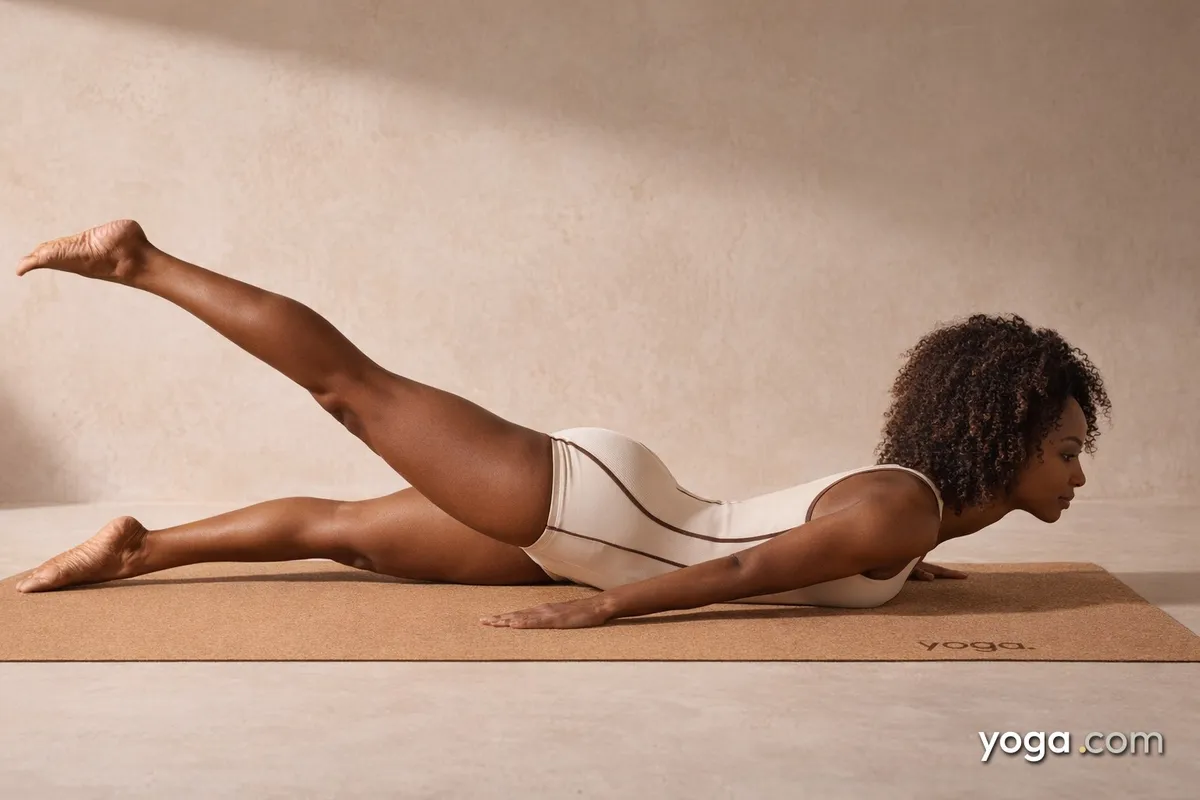
Locust Pose with Right Leg Up is a unilateral prone backbend that lifts one leg at a time, making the fuller Śalabhāsana (right leg up) - Sanskrit for "locust pose" - more accessible and easier to learn with precision. Isolating the right leg trains spinal extension and glute activation on one side before the body takes on the symmetrical full version. It fits naturally into the early portion of a prone backbend sequence, after the spine has warmed up and before more demanding lifts.
At a Glance
- Level: Beginner
- Type: Prone
- Targets: Lower back extensors, right gluteus maximus, hamstrings, abdominals
- Good for: Building posterior chain strength, improving spinal extension awareness, developing hip stability
How to Do Locust Pose with Right Leg Up
- Lie face down on your mat with your legs extended straight, feet hip-width apart and the tops of your feet pressing into the mat.
- Rest your forehead lightly on the mat, or turn your chin down so the back of the neck stays long. Extend your arms alongside your body, palms facing down or resting on your outer thighs.
- Press the front of your pelvis firmly into the mat and draw the lower abdominals in gently - this protects the lumbar spine and gives the lift a stable foundation.
- On an inhale, firm the right glute and lift the right leg straight up from the hip. Keep the right knee fully extended and the foot flexed or pointed - whichever keeps the leg engaged. Aim to lift the thigh, not just the foot.
- Keep both hip bones pressing evenly into the mat; resist the urge to roll the pelvis to the left to gain height on the right side.
- Hold for 3-5 breaths. Gaze stays down toward the mat to keep the cervical spine neutral. Breathe steadily - don't hold your breath.
- To come out, exhale and lower the right leg with control, returning it softly to the mat.
- Rest briefly in Reverse Corpse Pose or turn your head to one side, then repeat on the left leg if this is part of a paired practice.
Benefits
- Strengthens the erector spinae and multifidus muscles along the lumbar spine.
- Activates and builds endurance in the right gluteus maximus and hamstring.
- Trains the deep abdominals to stabilize the pelvis during unilateral hip extension.
- Improves awareness of pelvic alignment by making rotation visible and correctable on one side at a time.
- Prepares the body for the symmetrical demands of full Locust Pose.
Common Mistakes and Alignment Cues
- Rotating the pelvis to gain height: Both hip bones should stay level on the mat. If the left hip lifts, lower the right leg slightly until you can hold the pelvis square.
- Bending the lifted knee: Keep the right leg straight by engaging the quadriceps. A bent knee shifts the work away from the glute and hamstring.
- Crunching the neck: Keep the forehead down or the chin just barely off the mat. The gaze is directed toward the floor, not forward.
- Gripping the floor with the toes of the grounded foot: Let the left foot rest passively. Over-gripping the non-working leg creates unnecessary tension through the hip flexors.
- Holding the breath: The lift should happen on the inhale, but maintain easy, rhythmic breathing throughout the hold.
Modifications and Props
- Folded blanket under the pelvis: Place a folded blanket under your hip bones if the pressure of the floor is uncomfortable. This is especially useful for practitioners with sensitive anterior hip bones.
- Arms forward: Extend both arms in front of you along the mat (like a Superman position) to shift more load into the upper back and reduce pressure on the hands and wrists.
- Reduced range of motion: Lift the right leg only a few inches off the mat. Precision and pelvic stability matter far more than height.
- Rolled towel under the ankles: If the tops of the feet feel strained on the mat, tuck a small rolled towel under both ankles for support.
Cautions
- Lumbar disc issues: Active spinal extension can compress the posterior discs. Move slowly, keep the lift modest, and stop if you feel any sharp or radiating sensation.
- Pregnancy: Prone poses are generally avoided after the first trimester; consult your care provider and a prenatal-trained teacher.
- Recent abdominal surgery: The mild abdominal compression of lying face down may be uncomfortable or contraindicated; get clearance first.
- Sacroiliac joint sensitivity: Keep the lifted leg in a neutral position - avoid internal or external rotation that could stress the SI joint.
If you're working with an injury or a medical condition, check with a qualified professional before practicing.
Related Poses
- Reverse Corpse Pose - rest pose before and after prone backbends
- Crocodile Pose - grounding warm-up that familiarizes the body with the prone position
- Locust Pose with Left Leg Up - the paired opposite-side variation, practiced together for balanced training
- Locust Pose - the natural progression once unilateral stability is established
This pose works well in a gentle prone sequence. See A Gentle Yoga Routine for Tired, Low-Energy Days and A 10-Move Chair Yoga Sequence for a Midday Reset for practice ideas.