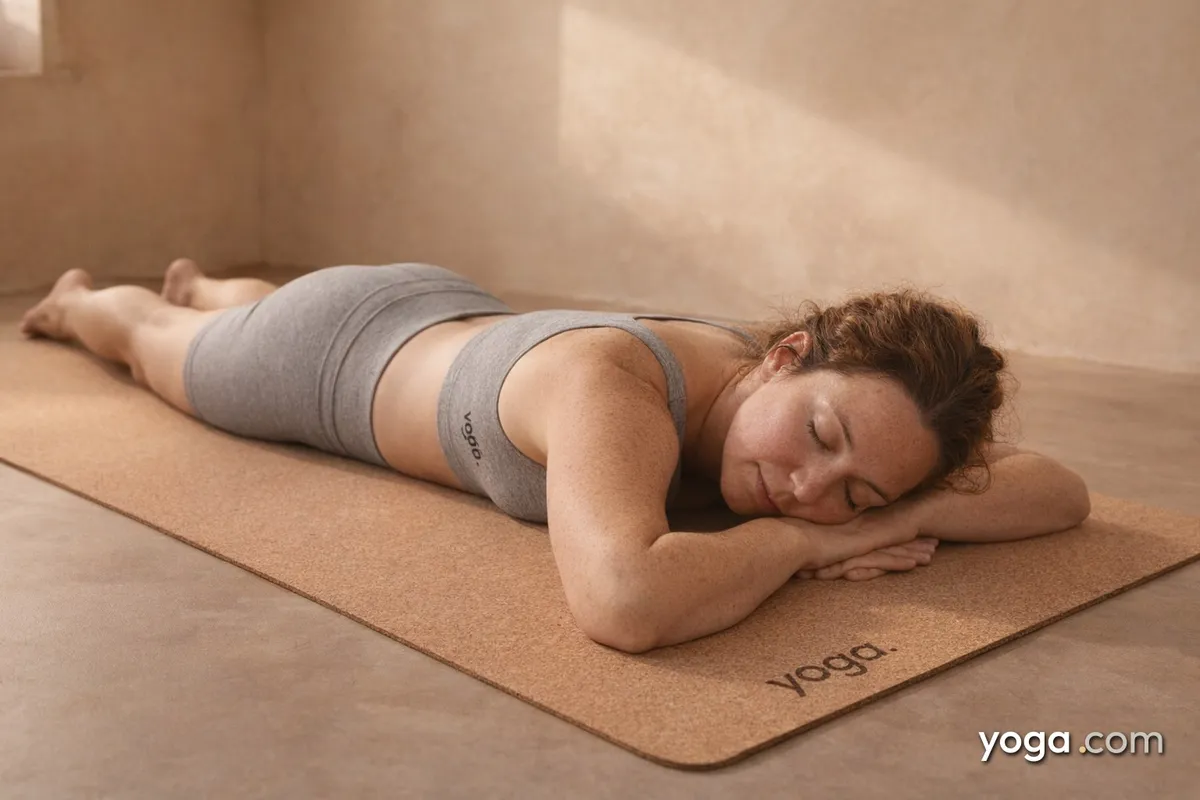
Crocodile Pose (Makarāsana - literally "crocodile posture") is a deeply restful prone position in which you lie face-down and allow the spine to decompress naturally. It sits at home at the opening or close of a floor-based practice, offering a neutral resting shape between more demanding backbends or prone strengthening poses.
At a Glance
- Level: Beginner
- Type: Prone
- Targets: Lumbar spine, thoracic spine, diaphragm, posterior shoulder girdle
- Good for: Deepening diaphragmatic breathing, releasing tension across the upper back, establishing a calm baseline for prone sequences
How to Do Crocodile Pose
- Lie face-down on your mat with your legs extended behind you, feet roughly hip-width apart or slightly wider, toes pointing outward naturally.
- Stack your forearms in front of you - right hand gripping the left elbow, left hand gripping the right elbow - forming a triangular frame on the mat.
- Rest your forehead on the top of the forearm stack (or lower your chin if the back of the neck feels compressed at the forehead).
- Let your belly release fully toward the floor. On each inhale, feel the abdomen expand downward into the mat; on each exhale, allow the body to soften a little more.
- Draw the shoulders very slightly away from the ears so the back of the neck stays long. Keep the jaw and facial muscles soft.
- Close your eyes and stay for 10-20 slow breaths, or as long as the practice calls for.
- To come out: Slide both arms alongside the body, turn the head to one side, and rest for a breath or two in Reverse Corpse Pose before pressing up to all fours or rolling to one side.
Benefits
- Lengthens the erector spinae along the full length of the spine in a passive, supported position.
- Encourages full diaphragmatic breathing by providing gentle resistance as the abdomen presses into the mat.
- Stretches the posterior deltoids and upper trapezius through the supported forearm position.
- Allows the thoracolumbar fascia to release passively, complementing active prone backbends in the same sequence.
- Cultivates proprioceptive awareness of the breath cycle, useful as a grounding exercise at the start of practice.
Common Mistakes and Alignment Cues
- Mistake: Elbows set too far forward, collapsing the chest downward and rounding the thoracic spine. Cue: Walk the elbows back toward the shoulders so the upper arms are roughly perpendicular to the mat and the chest lifts clear of the floor.
- Mistake: Feet together and toes pointed, which rotates the pelvis and compresses the lumbar facet joints. Cue: Let the heels fall apart and the toes splay outward so the gluteal muscles disengage and the sacrum can broaden.
- Mistake: Chin jutting forward or neck hyperextended when the forehead rests high on the arm stack. Cue: Lower the hand placement so the forehead contacts the forearms with the cervical spine in a neutral line, gaze downward.
- Mistake: Breath held or restricted, defeating the pose's primary intention. Cue: Soften the abdomen completely and breathe slowly and fully, letting the belly expand into the mat on every inhale.
Modifications and Props
- Folded blanket under the abdomen: Place a folded blanket beneath the lower belly if pressure on the hip bones is uncomfortable, or if you are pregnant (first trimester only - consult your provider).
- Bolster under the chest: Slide a bolster lengthwise under the sternum and forearms to raise the upper body, reducing compression in the lumbar area for students with tight hip flexors.
- Arms extended overhead: For students who find the forearm stack uncomfortable at the shoulders, simply cross the arms on the mat and rest the forehead on the wrists, keeping the same leg position.
- Height adjustment for the head: Stack an additional folded blanket on top of the forearms to raise the resting surface if your forehead does not comfortably reach the arm shelf without strain.
Cautions
- Recent abdominal surgery or hernia: Avoid direct pressure on the abdomen; work with your healthcare provider before attempting prone poses.
- Pregnancy (second and third trimester): Lying face-down is contraindicated; choose a supported side-lying rest position instead.
- Acute neck or cervical spine injury: Be conservative with head placement; avoid rotating or extending the neck beyond neutral.
- Wrist or elbow discomfort: Adjust the forearm position or use the extended-arms variation to remove load from the joints.
If you're working with an injury or a medical condition, check with a qualified professional before practicing.
Related Poses
- Reverse Corpse Pose - the most neutral prone resting alternative; use it as a transition into or out of Crocodile.
- Locust Pose - the natural active progression from this resting shape, strengthening the posterior chain that Crocodile passively releases.
- Left Turn Crocodile Pose - a directional variant that introduces a lateral rotation to the basic form.
- Upward-Facing Dog Pose - a counter-pose that explores active thoracic extension after the passive release of Crocodile.
You'll also find Crocodile Pose woven into A Gentle Yoga Routine for Tired, Low-Energy Days and A 10-Move Chair Yoga Sequence for a Midday Reset.