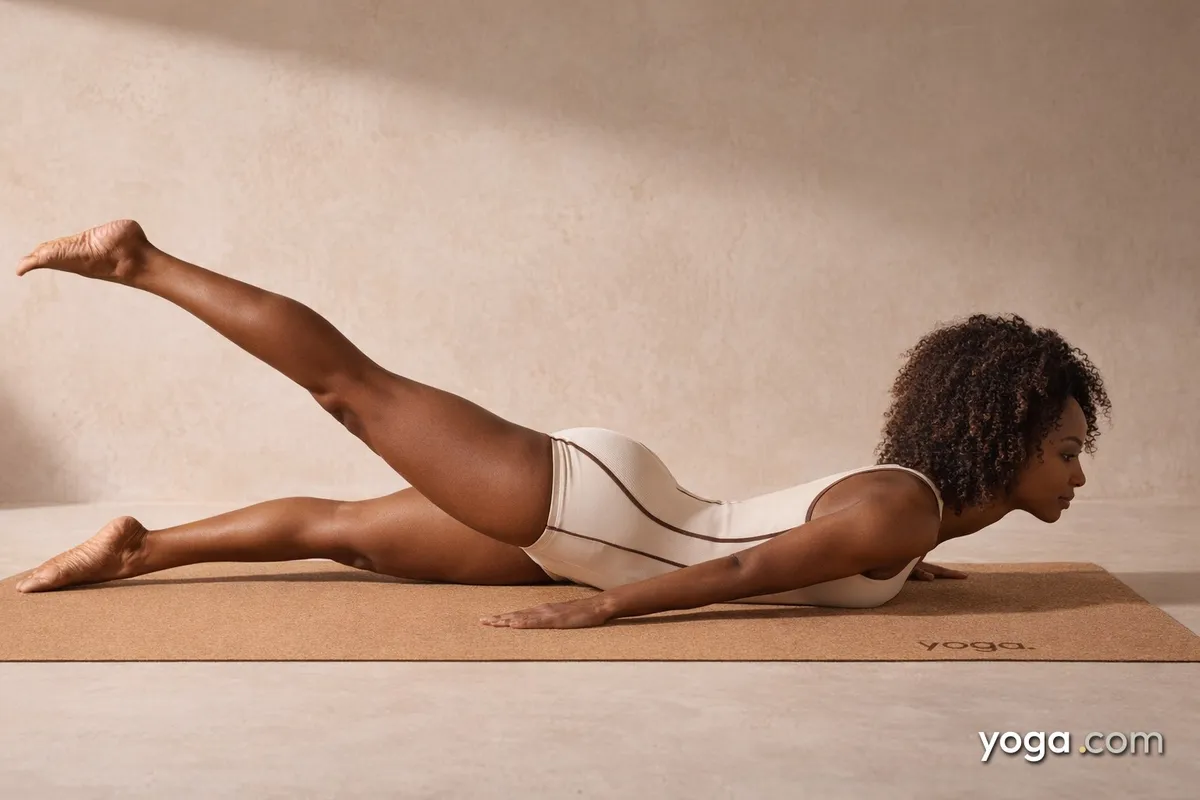
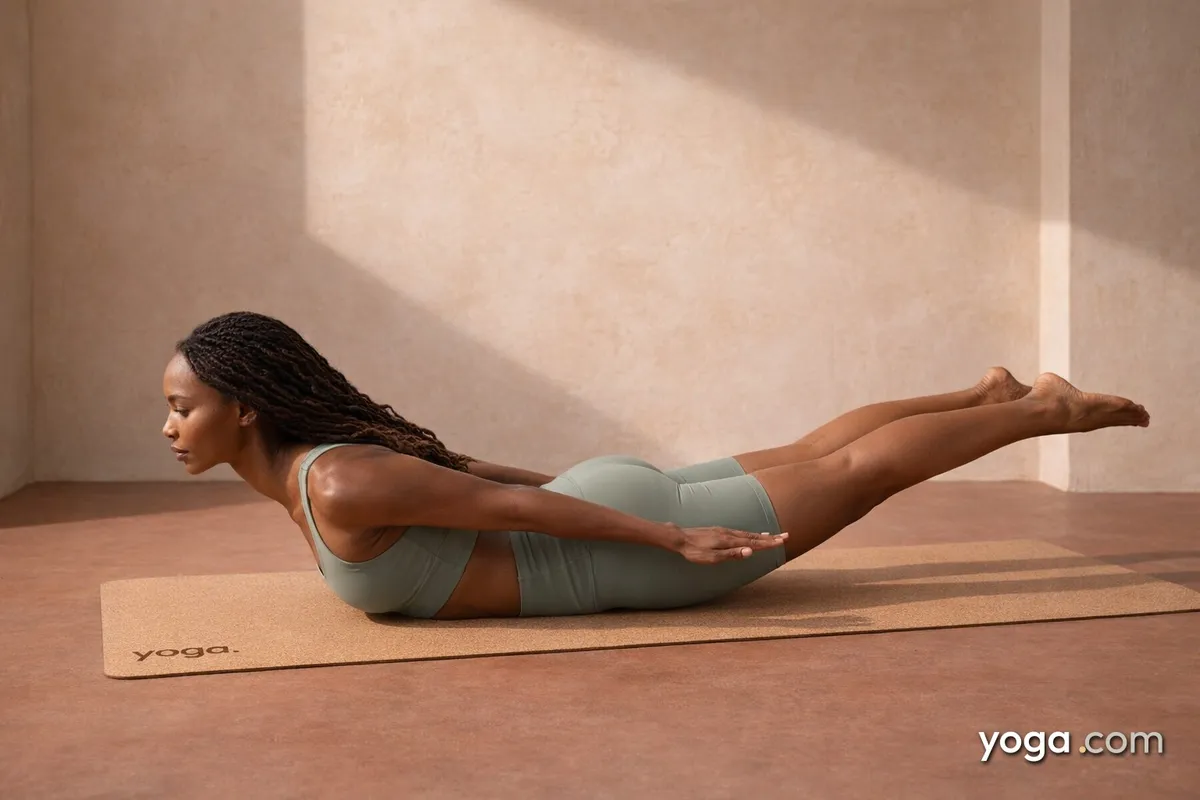
Locust Pose (Śalabhāsana - from Sanskrit śalabha, meaning "locust" or "grasshopper") is a prone backbend that lifts the chest, arms, and legs simultaneously off the floor. It belongs to a family of belly-down postures that build posterior-chain strength and prepare the spine for deeper backbends. You'll typically find it in the middle of a floor sequence, after the spine has been warmed and before more demanding backbends like Bow or Wheel.
At a Glance
- Level: Beginner
- Type: Prone
- Targets: Spinal extensors, glutes, hamstrings, upper back
- Good for: Building posterior-chain strength, improving thoracic extension, developing body awareness in backbends
How to Do Locust Pose
- Lie face-down on your mat with your legs hip-width apart, tops of the feet pressing into the floor. Rest your forehead lightly on the mat.
- Extend your arms alongside your body, palms facing down (or up, for less shoulder engagement). Draw your shoulder blades gently toward each other and down away from your ears.
- Press your pelvis and lower abdomen into the mat. Engage your inner thighs, drawing them slightly toward each other without squeezing the glutes hard yet.
- On an inhale, simultaneously lift your head, chest, arms, and legs away from the floor. Reach your arms back toward your feet, keeping them roughly parallel to the floor.
- Lengthen through the crown of the head and through the toes at the same time - think long rather than just high. Gaze is slightly forward and down, keeping the back of the neck long.
- Hold for 3-5 breaths. Keep the breath steady; if you're holding it, ease off slightly in the lift.
- To come out, exhale and lower your chest, arms, and legs back to the floor with control. Turn your head to one side, rest, and notice the pulse of sensation in the back body before repeating or moving on.
Benefits
- Strengthens the erector spinae and multifidus muscles along the entire length of the spine.
- Activates and builds endurance in the gluteus maximus and hamstrings.
- Stretches the front of the torso, including the abdominal muscles and hip flexors.
- Builds shoulder stability and scapular retraction strength in the mid and lower trapezius.
- Develops coordination of the posterior chain as a single kinetic unit - a foundation for more complex backbends.
- Increases proprioceptive awareness of spinal extension, which transfers to standing and seated postures.
Common Mistakes and Alignment Cues
- Crunching the neck back: Students often gaze straight up, compressing the cervical spine. Keep the gaze slightly forward so the back of the neck stays as long as the rest of the spine.
- Squeezing the glutes at the expense of length: Hard glute contraction can jam the sacroiliac joint. Focus on lengthening the legs away from the pelvis first; let the lift follow from that length.
- Holding the breath: The pose requires muscular effort that invites breath-holding. Cue slow, even breathing - if you can't breathe, reduce the height of the lift.
- Legs splaying wide: Hip-width or slightly narrower is the target. Cue a gentle inner-thigh draw to keep the legs tracking parallel.
- Shoulders hiking toward the ears: Actively slide the shoulder blades down the back before and during the lift to keep the neck free and the upper back working.
Modifications and Props
- Lift upper body only: Keep the legs down and focus solely on lifting the chest and arms. This reduces spinal load while still building thoracic extension strength.
- Lift lower body only: Keep the chest and arms down and lift only the legs. This isolates the glutes and hamstrings and is useful when the lower back needs a gentler introduction.
- Blanket under the hip bones: If the pelvis digs uncomfortably into the mat, fold a blanket under the lower abdomen and hip crests to cushion the contact.
- Arms alongside versus interlaced: Interlacing the hands behind the back and pressing the knuckles toward the heels adds a chest-opening component and can make the lift feel more accessible for some students.
Cautions
- Recent or acute back injury: The compressive load on the lumbar spine increases with the height of the lift. Work with the single-limb variations or skip the pose until the spine has been assessed.
- Pregnancy (second and third trimester): Lying prone is contraindicated as the belly grows; substitute supported alternatives.
- Neck issues: Keep the gaze neutral and avoid any version of the pose that produces sharp or radiating sensation in the neck.
- Rib or sternal injury: Direct contact with the floor combined with the press of the lift can aggravate healing ribs; use a folded blanket for padding and reduce the range of motion.
If you're working with an injury or a medical condition, check with a qualified professional before practicing.
Related Poses
- Crocodile Pose - a natural preparatory rest between prone backbends, letting the spine decompress.
- Locust Pose with Left Leg Up and Locust Pose with Right Leg Up - single-leg variations that build toward the full expression.
- Upward-Facing Dog Pose - a natural progression once spinal extension strength and confidence are established.
Locust Pose fits well inside a restorative or moderate-energy flow. See it in action in A Gentle Yoga Routine for Tired, Low-Energy Days and A 10-Move Chair Yoga Sequence for a Midday Reset.