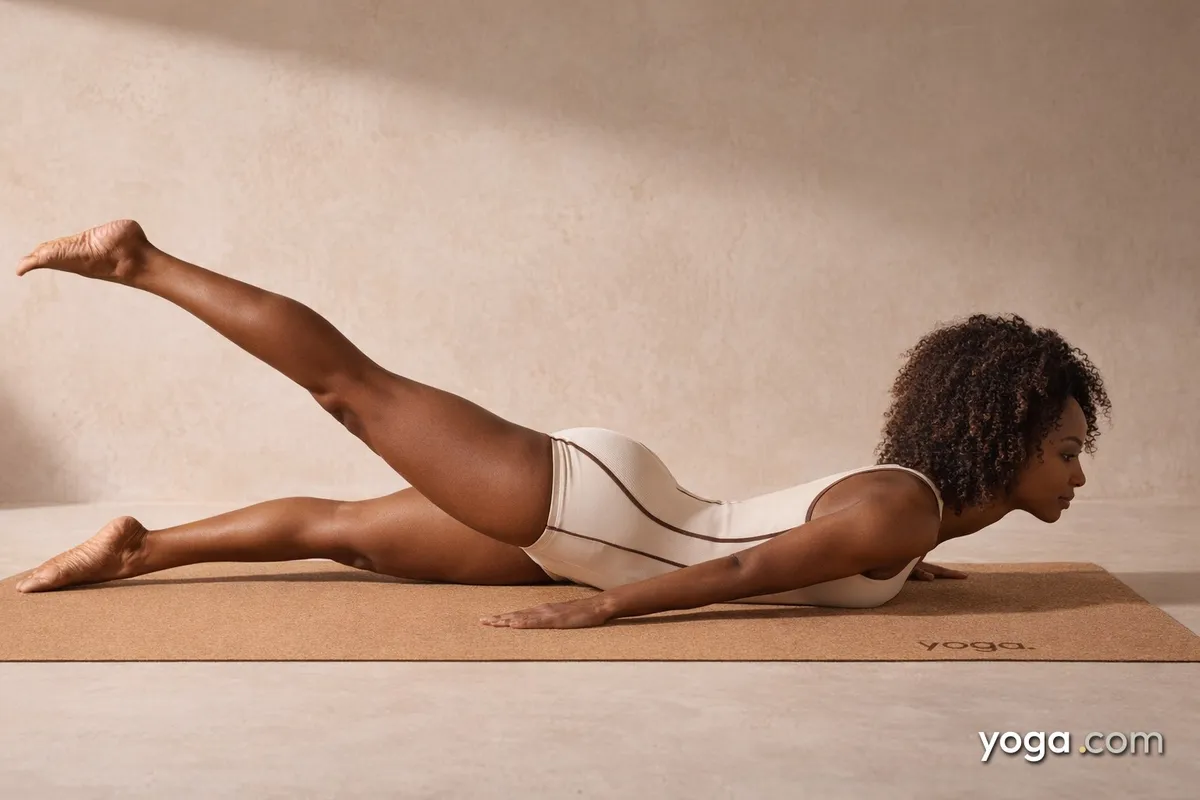
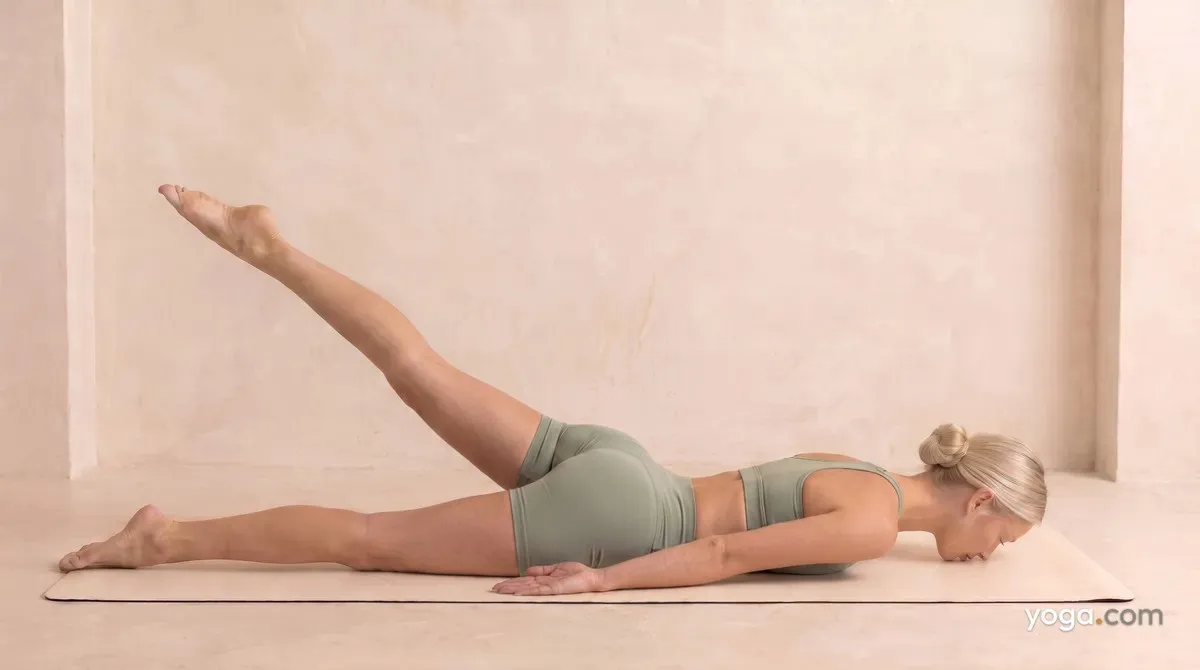
Locust Pose with Left Leg Up is a unilateral prone backbend that asks you to lift only the left leg while the rest of the body stays grounded, making it an accessible entry point into the broader Eka Pāda Śalabhāsana family - śalabha meaning "locust" in Sanskrit. Working one side at a time lets you tune into left-right asymmetries in hip extension and spinal stability before tackling the full bilateral version. It fits naturally early in a backbend sequence, after the spine is warm but before deeper extension poses.
At a Glance
- Level: Beginner
- Type: Prone
- Targets: Gluteus maximus, lumbar erectors, hamstrings, posterior hip stabilizers
- Good for: Building unilateral hip extension, developing lower-back strength, improving body awareness in prone positions
How to Do Locust Pose with Left Leg Up
- Lie face-down on your mat with your legs hip-width apart, the tops of your feet pressing evenly into the floor. Rest your forehead or chin lightly on the mat.
- Place your arms alongside your body, palms facing down or up - whichever feels more stable. Alternatively, rest your hands beneath your hip creases to cushion the pelvis.
- On an inhale, draw your lower belly gently inward and press the right hip firmly into the mat to anchor the pelvis.
- Keeping the left knee straight and the foot actively flexed or pointed, exhale and lift the left leg away from the floor. Lead with the back of the thigh, not by hiking the hip up toward the ear.
- Hold the pelvis level: the left hip should stay even with the right, not rotating upward. Engage your left glute rather than gripping the lower back.
- Lengthen the left leg back and away from the tailbone, creating space in the lumbar spine rather than crunching it. Your gaze rests softly forward or slightly down - neck long.
- Hold for 5-8 steady breaths, maintaining even pressure through both hip bones.
- On an exhale, lower the left leg with control. Rest in Reverse Corpse Pose for a breath or two, then repeat on the same side or transition to the right leg.
Benefits
- Strengthens the gluteus maximus and posterior hip muscles through active hip extension.
- Builds tone in the lumbar erector spinae and multifidus muscles.
- Stretches the hip flexors of the lifted leg's hip, particularly the iliopsoas.
- Trains the pelvis to stay neutral under load, reinforcing lumbopelvic stability.
- Develops body-side awareness that carries over into balancing and standing poses.
Common Mistakes and Alignment Cues
- Mistake: Rotating the pelvis so the left hip lifts toward the ceiling. Cue: Press the left hip gently toward the mat and imagine keeping both hip points at the same height.
- Mistake: Bending the lifted knee. Cue: Extend actively through the left heel, as if pressing against a wall behind you.
- Mistake: Crunching the lower back instead of lengthening it. Cue: Reach the left leg long before you lift - length first, then height.
- Mistake: Holding the breath. Cue: Soften the jaw and let the exhale be as full as the inhale; the lift comes from muscular engagement, not breath-holding.
- Mistake: Tensing the neck and shoulders. Cue: Keep the shoulders drawn away from the ears and the back of the neck long throughout.
Modifications and Props
- Blanket under the hips: Fold a blanket and place it under the pelvis to cushion the hip bones and reduce lower-back compression, especially helpful on a hard floor.
- Reduce range of motion: Lift the leg only a few inches - even a small lift builds the necessary strength without strain. Height is less important than alignment.
- Hands beneath hips: Slide your stacked hands under the front of the pelvis to tilt the hip bones slightly and create more space in the lumbar region.
- Strap around the lifted ankle: If you want tactile feedback on the leg's direction, loop a strap around the ankle and hold the tail lightly - it helps you sense whether the leg is drifting outward.
Cautions
- Avoid this pose or proceed very carefully if you have a recent herniated disc or acute lower-back pain; the prone position itself may be uncomfortable.
- If you are pregnant (beyond the first trimester), prone backbends are generally not appropriate - consult your care provider.
- Those with a sacroiliac joint injury should move slowly and keep the lift small, as unilateral hip extension can stress the SI joint if the pelvis shifts.
- If you feel sharp pain, pinching in the lower back, or tingling down the leg, release immediately and rest.
- If you're working with an injury or a medical condition, check with a qualified professional before practicing.
Related Poses
- Reverse Corpse Pose - use it as a neutral resting position between legs.
- Crocodile Pose - a preparatory prone position that settles the breath and warms the hips.
- Locust Pose with Right Leg Up - the natural counterpart; practice both sides in the same session.
- Locust Pose - the full bilateral progression once each side feels stable.
See this pose in context: A Gentle Yoga Routine for Tired, Low-Energy Days and A 10-Move Chair Yoga Sequence for a Midday Reset.