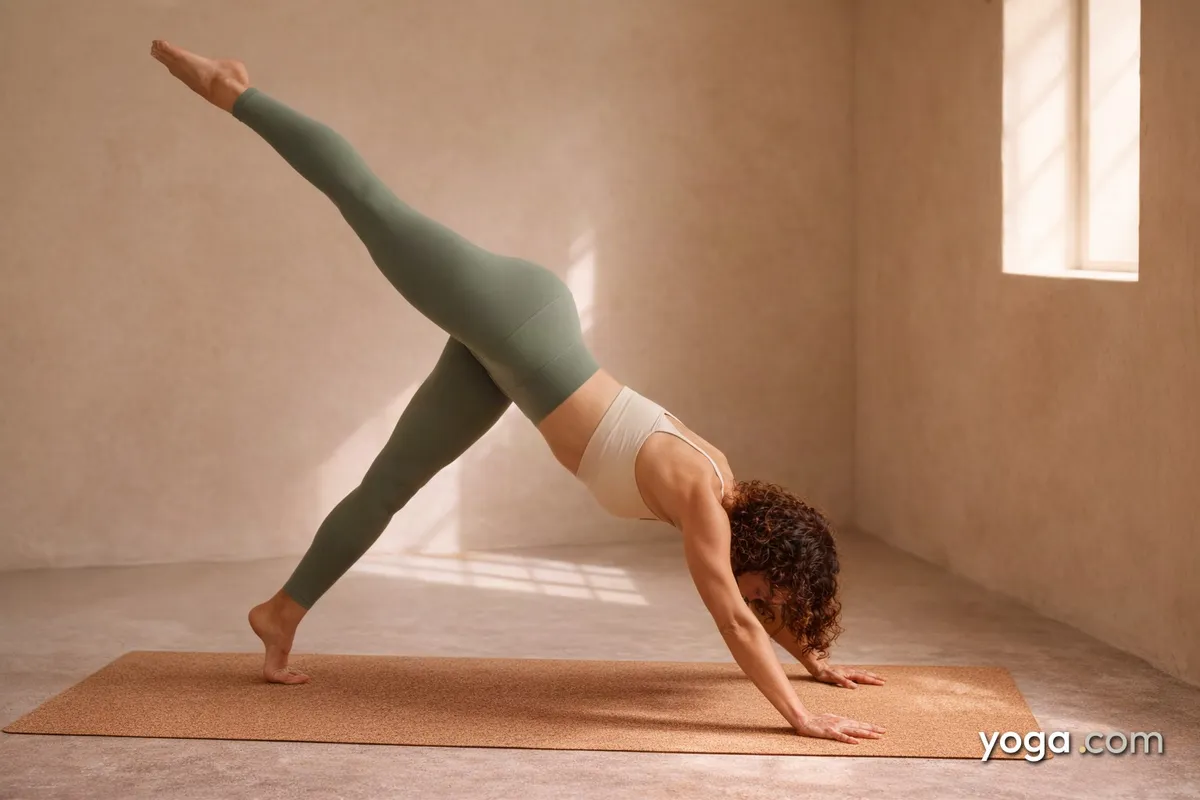
Downward-Facing Dog Pose with Right Leg Up is a single-leg extension of the foundational inverted-V shape, known in Sanskrit as Adho Mukha Śvānāsana (right leg raised) - literally "downward-facing dog pose with the right leg lifted." It bridges the steadiness of a standing sequence with the opening demands of deeper inversions, making it a natural bridge pose in flows that move toward hip openers or balancing postures. You'll find it frequently cued in vinyasa and power yoga as a transition or as a held position in its own right.
At a Glance
- Level: Intermediate
- Type: Inversion
- Targets: Shoulders and upper back, hamstrings and calves (standing leg), hip flexors and glutes (lifted leg), core
- Good for: Building single-leg stability, lengthening the posterior chain, developing shoulder girdle strength
How to Do Downward-Facing Dog Pose with Right Leg Up
- Begin in a standard Downward-Facing Dog: hands shoulder-width apart, feet hip-width apart, hips lifted high. Press all ten fingers evenly into the mat and rotate your upper arms outward so your elbow creases face forward.
- Establish a long, neutral spine - let your head hang between your upper arms without forcing your chin to your chest. Draw your low belly gently in and up.
- On an inhale, shift a small amount of weight into your left foot and press that heel firmly toward the mat.
- Keeping your right hip level with your left hip, lift your right leg straight back and up, reaching through the heel. Flex the foot so the toes point toward the floor - this helps keep the pelvis square.
- Stack your right hip directly over the left hip. If the right hip opens toward the ceiling, internally rotate the right thigh slightly until both hip points face down.
- Hold for three to five full breaths. Keep your arms straight and shoulders drawing away from your ears.
- To come out, exhale and lower the right foot back to the mat, landing with control beside the left foot. Re-establish both feet evenly before moving on.
Benefits
- Stretches the hamstrings, calves, and plantar fascia of the standing (left) leg under full load.
- Strengthens the glutes and hip extensors of the lifted (right) leg.
- Builds shoulder stability and serratus anterior engagement as the upper body works to maintain a level foundation on one side.
- Develops core and oblique activation needed to keep the pelvis square against the rotational pull of the raised leg.
- Reinforces proprioception and single-leg balance in a partially weight-bearing context, preparing the body for standing balances.
Common Mistakes and Alignment Cues
- Hip stacking/opening: The lifted-side hip rotates open toward the sky, misaligning the pelvis. Cue: internally rotate the right thigh and picture both hip bones facing straight down toward the mat.
- Bent standing-leg knee: The left knee bends as the right leg rises, shortening the hamstring stretch and destabilizing the base. Cue: straighten the left leg fully and press the heel toward - not necessarily to - the floor.
- Collapsing into the shoulder: Weight dumps into the right shoulder as the right leg lifts. Cue: press equally through both palms and think of pushing the floor away with both hands simultaneously.
- Raised leg too high: The leg climbs past the point where the pelvis stays neutral, causing the low back to arch. Cue: lift only as high as the hip can remain level, even if that means a modest height.
- Tension in the neck: The head cranes upward toward the lifted leg. Cue: let the head hang heavy, ears in line with the upper arms.
Modifications and Props
- Blocks under hands: Place a block under each hand to reduce the demand on tight wrists and shoulders, giving you more room to focus on hip alignment.
- Wall support: Practice with hands on a wall at hip height to experience the spinal lengthening and leg-lift mechanics with far less upper-body load - useful if wrist or shoulder sensitivity is present.
- Bent lifted knee: Bend the right knee and point the sole of the foot toward the ceiling ("flipped dog" variation) to reduce hamstring load on the lifted side while still practicing hip extension and pelvic stability.
- Strap around standing-leg thigh: Loop a strap around the left thigh and anchor it to a wall behind you to cue the leg to press back, helping you feel the grounding action without muscular guesswork.
Cautions
- Wrist sensitivity: Distribute weight across all finger pads and avoid sinking into the heel of the hand; come to fists or use a wedge if discomfort persists.
- Shoulder or rotator-cuff issues: The single-arm weight-shift can stress an already compromised shoulder; use the wall modification or reduce the height of the lifted leg.
- Hamstring strain: Do not force the standing heel to the floor; a microbend in the left knee is safer than a strained tendon.
- High blood pressure or glaucoma: Inversions increase intraocular and cranial pressure; limit your time in the pose and come out slowly.
- If you're working with an injury or a medical condition, check with a qualified professional before practicing.
Related Poses
- Downward-Facing Dog Pose - the essential foundation to establish before adding the leg lift.
- Upward-Facing Dog Pose - a natural counter-pose that opens the front body after repeated posterior-chain work.
- Cat Pose - a gentle preparation for spinal mobility and shoulder activation.
- Headstand Preparation Pose I - the next progression deeper into the inversion family once single-leg Dog is stable.
Build the shoulder and core strength this pose demands with A Gentle Yoga Routine for Tired, Low-Energy Days, or weave it into a midday practice with A 10-Move Chair Yoga Sequence for a Midday Reset.