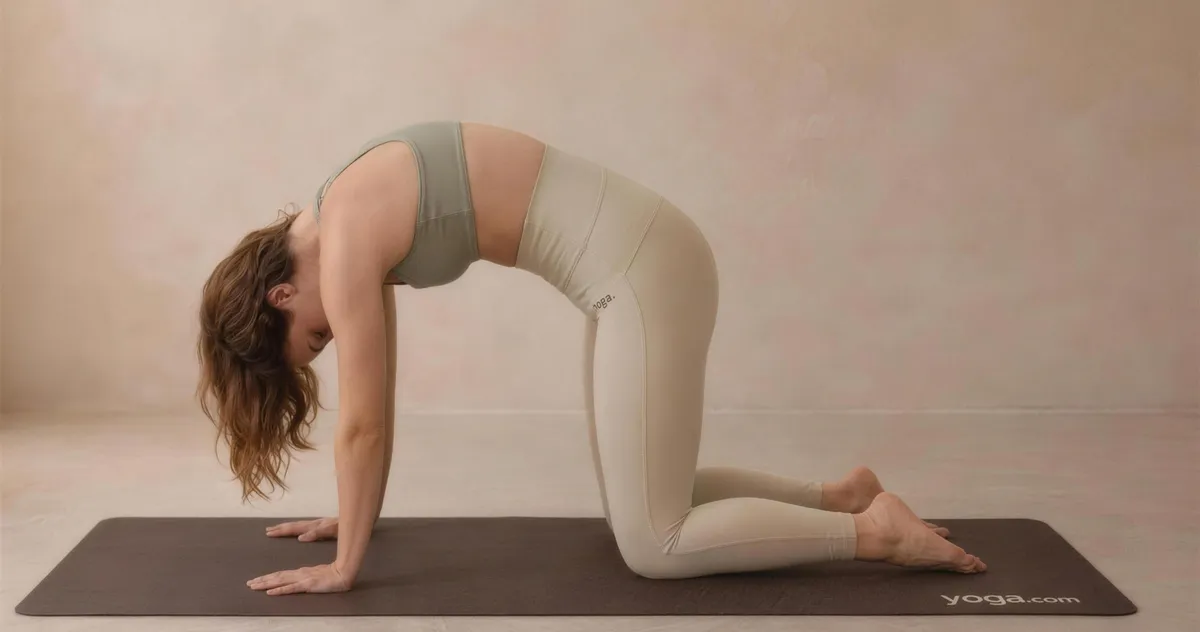
Cat Pose, known in Sanskrit as Mārjārāsana - literally "cat pose" from mārjāra, meaning cat - is a foundational spinal-flexion shape practiced on all fours. It pairs almost universally with Cow Pose to form the Cat-Cow warm-up, and it appears at the start of most practice styles as a way to mobilize the spine before deeper work.
At a Glance
- Level: Beginner
- Type: Kneeling
- Targets: Thoracic and lumbar spine, abdominals, neck
- Good for: Spinal mobility, abdominal engagement, breath coordination
How to Do Cat Pose
- Begin in Table Pose: stack your shoulders over your wrists and your hips directly over your knees. Spread your fingers wide, press all four corners of each hand firmly into the mat, and keep your spine neutral.
- Set your gaze softly toward the floor between your hands so your neck is in line with the rest of your spine.
- On an exhale, press both hands evenly into the mat and begin to round your spine upward toward the ceiling, starting the movement from your lower back.
- Draw your navel in and up toward your spine as the mid-back follows, then let the upper back round fully so the space between your shoulder blades widens.
- Allow your head to release down naturally, following the curve of the spine. Your chin may move toward your chest, but avoid forcing it; let the head be heavy rather than actively tucking.
- Hold the shape for one full breath, maintaining the press of the hands and the lift through the center of your back.
- To come out, exhale completely, then begin to inhale as you release the rounding and return to a neutral Table Pose. From here you can move into Cow Pose or rest.
Benefits
- Mobilizes the thoracic and lumbar vertebrae through spinal flexion.
- Strengthens and actively engages the rectus abdominis and deep core stabilizers.
- Stretches the muscles of the upper and mid-back, including the erector spinae in their lengthened position.
- Widens and mobilizes the scapulae, building awareness of serratus anterior engagement.
- Coordinates breath with movement, reinforcing the exhale-to-flex pattern used throughout many styles of practice.
- Develops proprioceptive awareness of neutral versus flexed spinal positions.
Common Mistakes and Alignment Cues
- Mistake: Initiating the rounding from the shoulders rather than the lumbar spine. Cue: Think of your tailbone dropping first; let the wave of rounding travel upward from the sacrum to the crown of your head.
- Mistake: Collapsing weight into the wrists by letting the arms go soft. Cue: Keep a firm, active press through the base of each finger and the heel of each hand throughout the shape.
- Mistake: Forcing the chin to the chest aggressively. Cue: Let your head hang freely from the top of the spine - gravity does the work; you do not need to pull the chin in.
- Mistake: Holding the breath or breathing shallowly at the top of the shape. Cue: The full rounding happens on the exhale; stay curious about finding a little more length in the back body as the last of the breath leaves.
- Mistake: Hips drifting back toward the heels as the back rounds. Cue: Keep your hips stacked directly over your knees and your thighs vertical throughout.
Modifications and Props
- Tender wrists: Place a folded blanket under the heels of your hands to reduce wrist extension, or make fists and take the pose on your knuckles.
- Sensitive knees: Fold a blanket in half and place it beneath your knees for cushioning, or practice on a thicker mat.
- Limited range in the upper back: Place a yoga block lengthwise under your sternum in Table Pose; as you round into Cat, focus on lifting away from the block in the thoracic region before removing it when the movement becomes clearer.
- Wrist or hand injury: Lower to your forearms in a tabletop position on the forearms, keeping elbows under shoulders, then round in the same sequence from the low back upward.
Cautions
- Recent or acute wrist injury: Weight-bearing on the hands may be uncomfortable; use the forearm variation above.
- Knee sensitivity or injury: Use adequate padding and avoid sitting back on the heels between repetitions.
- Neck injury or instability: Keep the head in a more neutral position rather than releasing it fully downward, and avoid any sudden or forceful movement through the cervical spine.
- Spinal disc issues in the lumbar or cervical region: Move slowly and stay within a range that produces no sharp or radiating sensation.
If you're working with an injury or a medical condition, check with a qualified professional before practicing.
Related Poses
- Table Pose - the neutral starting position for Cat Pose
- Cow Pose - the spinal extension counterpart, typically paired with Cat
- Hare Pose - a deeper forward rounding from a kneeling base
- Diamond Pose - a resting kneeling shape to follow an active Cat-Cow sequence
See Cat Pose in context in A Gentle Yoga Routine for Tired, Low-Energy Days, and learn how foundational shapes like this one developed over time in The History of Yoga: From Ancient Roots to Modern Practice.