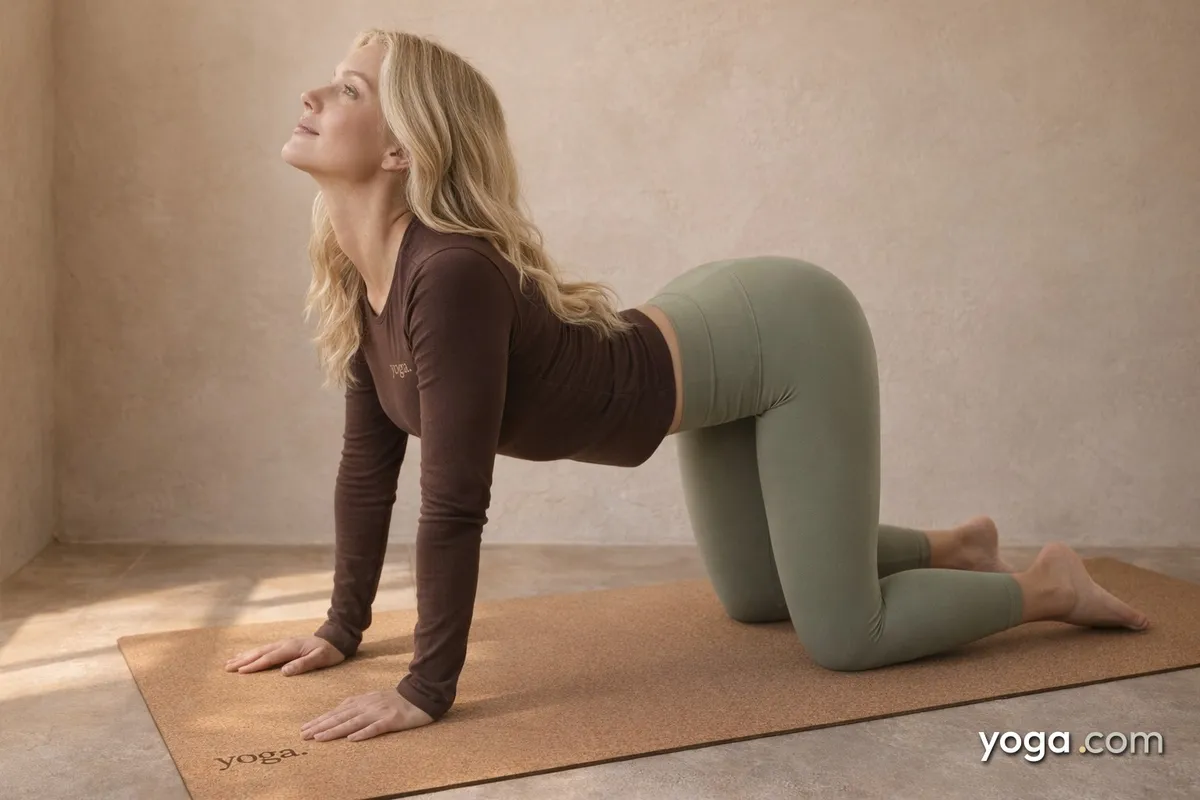
Cow Pose (Bitilāsana, from the Sanskrit bitila, meaning "cow") is a simple spinal extension performed on all fours. Paired almost universally with Cat Pose, it forms one of yoga's most foundational spinal warm-ups. Its gentle backbend makes it a natural opening move for any practice, from a vigorous flow to a quiet restorative session.
At a Glance
- Level: Beginner
- Type: Kneeling
- Targets: Spine, abdomen, chest, neck
- Good for: Spinal mobility, core awareness, breath coordination
How to Do Cow Pose
- Begin in Table Pose - hands directly under your shoulders, knees directly under your hips, spine neutral, and the tops of your feet flat on the mat.
- Spread your fingers wide and press evenly through all ten knuckles and the heel of each hand.
- On an inhale, drop your belly toward the mat, letting the lower back arch naturally.
- Broaden across your collarbones, draw your shoulder blades gently together and down your back, and lift your chest forward and up.
- Lift your tailbone toward the ceiling to encourage the full length of the spinal curve.
- Raise your gaze softly - look forward or slightly upward without crunching the back of your neck.
- Hold for the full inhale, feeling the belly and ribs expand.
- To come out, exhale and return to a neutral Table Pose, or continue directly into Cat Pose by rounding the spine on the exhale.
Benefits
- Extends the thoracic and lumbar spine, countering the flexion of sitting.
- Stretches the front of the torso, including the abdominal muscles and hip flexors.
- Opens the chest and the front of the shoulders.
- Strengthens the muscles that support spinal extension (erector spinae).
- Coordinates breath with movement, reinforcing the inhale-expand pattern.
- Warms the wrists and prepares the hands for weight-bearing poses.
Common Mistakes and Alignment Cues
- Collapsing into the lower back only. The arch should travel the full length of the spine. Draw the chest forward first, then let the tailbone rise - this distributes the extension rather than concentrating it in the lumbar.
- Shrugging the shoulders toward the ears. Actively draw the shoulder blades down the back before you lift your chest. Keep length in the neck.
- Cranking the head back sharply. Let the gaze lead the neck into a gentle, continuous curve. Think "long" at the back of the neck, not compressed.
- Hands splaying or wrists rolling outward. Press firmly through the index finger and thumb side of each hand to protect the wrists and keep the forearms engaged.
- Knees drifting wider than hips. Keep the knees hip-width apart and feet parallel so the pelvis stays neutral before the tilt begins.
Modifications and Props
- Sensitive wrists: Place a folded blanket under the heels of the hands to reduce wrist extension, or make fists and press through the knuckles.
- Tender knees: Fold your mat or add a blanket under your knees for extra padding.
- Limited range of motion in the spine: Work with a smaller range - just a subtle lift of the tailbone and chest counts. Avoid forcing a deep arch.
- Neck sensitivity: Keep the gaze down toward the mat rather than lifting the chin, maintaining length along the back of the neck throughout.
Cautions
- Wrist issues: Avoid full weight-bearing on the hands if you have acute wrist pain or injury; use the fist or forearm modification instead.
- Knee discomfort: If there is pain in the knees during kneeling, add significant padding or skip the pose until the discomfort is addressed.
- Neck injury: Keep the gaze neutral - do not lift or drop the head beyond comfortable range.
- Recent back surgery or acute spinal conditions: Approach spinal extension with care and move within a pain-free range only.
If you're working with an injury or a medical condition, check with a qualified professional before practicing.
Related Poses
- Table Pose - the starting position and foundation for Cow Pose.
- Cat Pose - the natural counter-pose, pairing spinal flexion with Cow's extension.
- Upward-Facing Dog Pose - a progression that deepens the spinal extension in a prone position.
- Hare Pose - a complementary kneeling pose that counters backbending with forward flexion.
Practice Cow Pose in context: A Gentle Yoga Routine for Tired, Low-Energy Days and A 10-Move Chair Yoga Sequence for a Midday Reset.