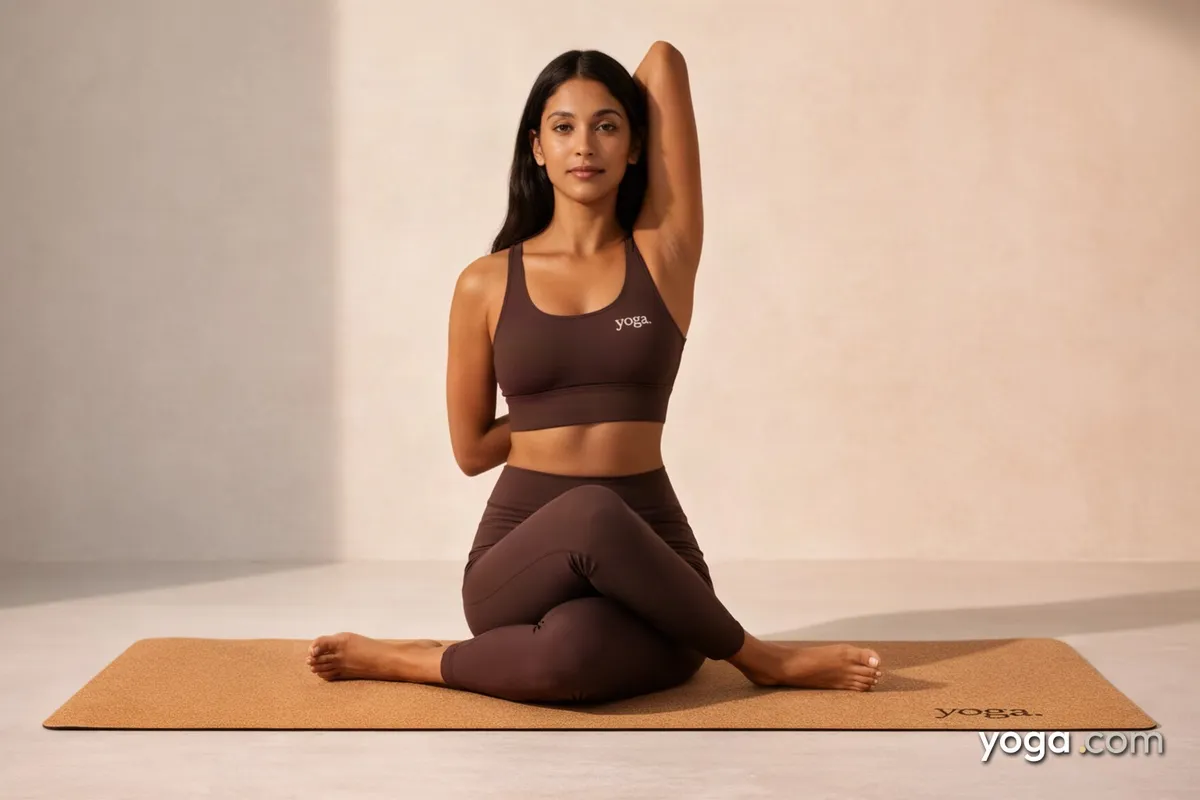
Cow Face Pose, Gomukhāsana (right leg, left arm up) - from the Sanskrit go (cow), mukha (face), and āsana (seat) - stacks the knees deeply while drawing one arm overhead and the other behind the back to clasp fingers at the spine. This specific variant places the right leg on top and the left arm reaching up, making it a distinct half of the full bilateral pose. It typically appears in the seated section of a practice, after the hips and shoulders have been warmed through standing or dynamic work.
At a Glance
- Level: Intermediate
- Type: Seated
- Targets: Outer hips and glutes, hip flexors, chest and anterior shoulder, triceps and posterior shoulder
- Good for: Deepening external hip rotation, building shoulder flexibility across opposing ranges of motion, lengthening the side body
How to Do Cow Face Pose (Right Leg and Left Arm Up)
- Set your base. Sit on the floor with your legs extended. Bend your left knee and slide your left foot toward your right hip, so the left shin angles under your body.
- Stack the right leg. Bend your right knee and lift it over the left, drawing the right foot toward your left hip. Work toward stacking the right knee directly above the left knee at the centerline. Both feet point back, heels equidistant from the hips.
- Level the sitting bones. If one hip lifts off the floor, sit on a folded blanket or block to bring both sitting bones evenly down. Keep the spine long rather than forcing the knees lower.
- Raise the left arm. On an inhale, sweep your left arm up alongside your ear, bend the elbow, and let the left hand drop down between your shoulder blades, palm facing the spine.
- Bring the right arm behind. Extend your right arm out to the side, rotate it inward so the palm faces back, then sweep it behind you and bend the elbow, sliding the back of the right hand up the spine toward the left hand.
- Clasp the fingers. If the hands meet, interlace the fingers or hold each other firmly. Keep both shoulders drawing back and down - avoid letting the left shoulder hike toward the ear or the right shoulder round forward.
- Hold and breathe. Stay for 5-10 breaths. Keep the chin level, gaze soft forward, and the lower ribs gently drawing in to prevent the low back from arching.
- Come out with control. Release the arm bind first, lowering both arms. Uncross the legs slowly, returning to Dandasana (Staff Pose), and take a breath or two before switching to the opposite side.
Benefits
- Stretches the external rotators of the right hip, including the piriformis and deep gluteal muscles.
- Lengthens the left triceps and the posterior capsule of the left shoulder joint.
- Stretches the right shoulder's anterior deltoid and pectoral fibers as the arm internally rotates behind the back.
- Builds passive flexibility through opposing shoulder ranges simultaneously - useful for overhead and behind-back mobility.
- Encourages axial elongation of the spine when the arms are bound and the torso remains upright.
- Strengthens the postural muscles of the mid-back as they work to keep the chest open against the pull of the bind.
Common Mistakes and Alignment Cues
- Knees not stacking: If the top knee sits far to one side, the hip stretch is reduced. Ease the top foot closer to the opposite hip until the knees are more directly vertical.
- One hip floating: A lifted sitting bone tilts the pelvis and compresses the lower back. Sit on a prop until both hips ground evenly.
- Left shoulder hiking toward the ear: The upper elbow should point straight up, not flare. Gently draw the left shoulder blade down the back.
- Torso leaning forward or collapsing: The fold happens in the hips, not the spine. Keep the sternum lifted and the lower ribs neutral rather than jutting forward.
- Forcing the clasp: Gripping a strap between the hands allows the shoulders to work without the chest collapsing or the neck straining.
Modifications and Props
- Blanket or block under the hips: Elevating the seat encourages both sitting bones to ground and reduces strain on the outer knee of the lower leg.
- Strap for the arm bind: Hold one end of a strap in each hand if the fingers can't reach. Walk the hands gradually closer over time as shoulder flexibility increases.
- Leg modification: If knee discomfort prevents stacking, sit in a simple cross-legged position and work only the arm bind, or practice the arm position standing against a wall.
- Seated on a chair: Sit at the edge of a chair seat with both feet flat; cross the right knee over the left and perform the arm bind - this reduces demand on the knees while still addressing the shoulders.
Cautions
- Knee discomfort or injury: Any sharp pain in either knee as the legs stack is a signal to reduce the overlap or sit higher on a prop. Do not force the knees toward the floor.
- Hip joint conditions: Significant tightness or structural issues in the hip may make full stacking unavailable; work with the modification described above rather than pushing range.
- Shoulder impingement or rotator cuff issues: The combined overhead and internal rotation of the arms places significant demand on both shoulders. Use a strap and avoid any pinching sensation in the shoulder joint.
- Neck or cervical concerns: Keep the head neutral and avoid cranking the neck to look around during the bind.
If you're working with an injury or a medical condition, check with a qualified professional before practicing.
Related Poses
- Cow Face Pose (Left Leg and Right Arm Up) - the direct counterpart; always practice both sides.
- Bound Angle Pose - an accessible seated hip opener that prepares the external rotators before stacking the knees.
- Lotus Pose - a natural progression for practitioners with open hips and knees ready for deeper external rotation.
- Downward-Facing Dog Pose - a useful counter-pose to open the shoulders and lengthen the spine after the deep bind.
See this pose in context: A Gentle Yoga Routine for Tired, Low-Energy Days and A 10-Move Chair Yoga Sequence for a Midday Reset.