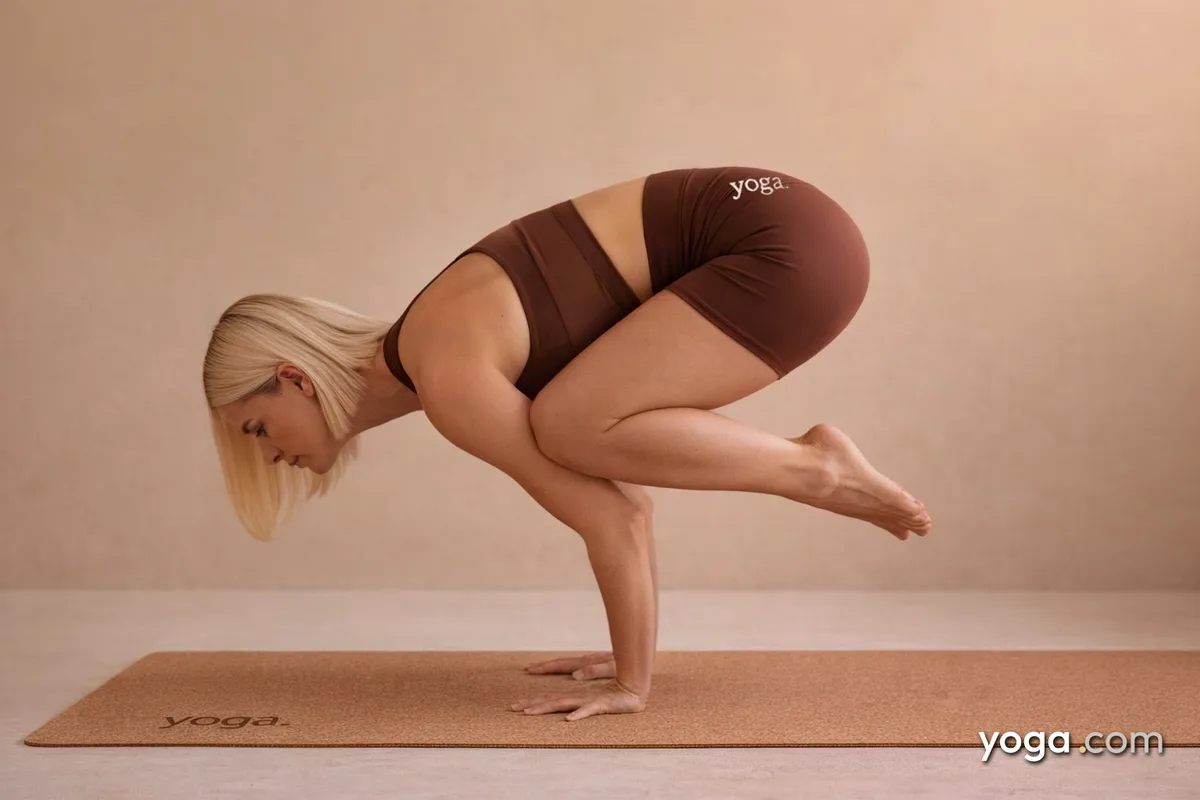
Easy Crow Pose - Bakāsana (Sanskrit: baka, crane or heron; āsana, seat or posture) - is the most accessible entry point into arm balancing. By keeping the knees resting on the upper arms rather than stacking them at the armpits, you reduce the demand on shoulder stability and wrist strength, making your first lift-off feel genuinely within reach.
At a Glance
- Level: Beginner
- Type: Arm Balance
- Targets: Wrists, forearms, core, hip flexors, inner thighs
- Good for: Building confidence in arm balances, wrist and core conditioning, developing body-awareness in an inverted load
How to Do Easy Crow Pose
- Set up your foundation. Begin in a low squat (Malasana) with your feet hip-width apart or slightly wider. Place your palms flat on the mat, shoulder-width apart, fingers spread wide and pointing forward. Press evenly through all four corners of each hand.
- Position your knees low on the arms. Bend your elbows to about 90 degrees, creating a shelf. Rest your knees on the backs of your upper arms, low - near the elbows rather than high near the armpits. This is the key difference from full Crane Pose and what makes the balance more approachable.
- Round and engage your spine. Draw your navel up and in, and dome your upper back toward the ceiling. Think of the shape of Cat Pose - this spinal flexion is structural, not incidental. A flat back here makes the pose significantly harder.
- Lean forward. Shift your weight slowly into your hands until your shoulders stack over your wrists - or even slightly in front of them. Keep your gaze about six inches in front of your fingertips, not straight down. Your neck stays long.
- Lift one foot, then the other. As your weight transfers forward, one heel will naturally float. Let it. Then draw the second foot up. Keep your feet active - press your big toes together or flex through the soles. There is no need to straighten the arms; bent elbows are correct here.
- Hold and breathe. Maintain the rounded spine, active hands, and forward gaze. Aim for three to five full breaths. Resist the urge to hold your breath - it tightens the core in an unproductive way.
- Come down with control. To exit, shift your weight slightly back and lower one foot, then the other, returning to your squat. Rest in Child's Pose or shake out your wrists as needed.
Benefits
- Wrist and forearm strength: Bearing body weight through the palms builds the grip and forearm endurance that underpins most arm balancing work.
- Core engagement: Sustaining the rounded spine and lifted feet recruits the deep abdominal muscles and hip flexors in an integrated way.
- Hip flexor activation: Drawing the knees toward the arms and holding them there requires active hip flexion against resistance.
- Proprioceptive awareness: Balancing on two hands recalibrates your sense of where your center of mass is - a skill that transfers directly to other balancing poses.
- Shoulder stability: Pressing the floor away and maintaining the arm shelf develops the serratus anterior and stabilizing musculature around the shoulder girdle.
Common Mistakes and Alignment Cues
Knees creeping too high up the arms Slide your knees back toward the elbows. The lower placement is intentional - it shortens the lever and makes balance easier to find. Flat or extended spine If your back is flat, the pose becomes a very different (and harder) challenge. Actively round through the thoracic spine before and during the lift. Looking straight down A downward gaze shifts weight back and promotes collapse. Keep your eyes focused on a point on the mat several inches ahead of your hands. Gripping only with the palm center Spread all ten fingers and press down through the fingertip pads. This protects the wrists by distributing load and gives you fine-grained control over balance. Holding the breath Breath-holding creates global tension that destabilizes the balance. If you cannot breathe steadily, come down, reset, and try again with a lighter effort.
Modifications and Props
Block under the forehead: Place a block or folded blanket under your forehead while you practice the hand and knee placement on the ground. This removes the fear of falling and lets you focus on the arm shelf and spinal shape.
Block under the feet: Elevating your feet on a block before you lean forward reduces the distance your weight needs to travel, making the forward shift less intimidating.
Folded blanket under the wrists: If wrist extension is uncomfortable, a thin folded blanket under the heel of the hand reduces the angle and eases pressure.
Spot yourself with a wall: Practice facing a wall with your head a few inches away. Knowing you will not pitch forward removes the mental barrier for many students.
Cautions
Avoid or modify Easy Crow Pose if you have a wrist, elbow, or shoulder injury. Those with carpal tunnel syndrome should approach with care and may need to skip wrist-loading poses entirely. This pose places compressive load on the wrists and isometric demand on the shoulders - do not practice through sharp or shooting pain. If you're working with an injury or a medical condition, check with a qualified professional before practicing.
Related Poses
- Plank Pose - builds the wrist tolerance and shoulder stability that arm balances require.
- Crane Pose - the full expression of this shape, with knees higher and arms straighter.
- Crane Pose with Head on the Mat - a supported variation that removes balance as a variable while you groove the shape.
- Downward-Facing Dog Pose - a foundational pose for conditioning the hands, wrists, and shoulders before arm balancing.