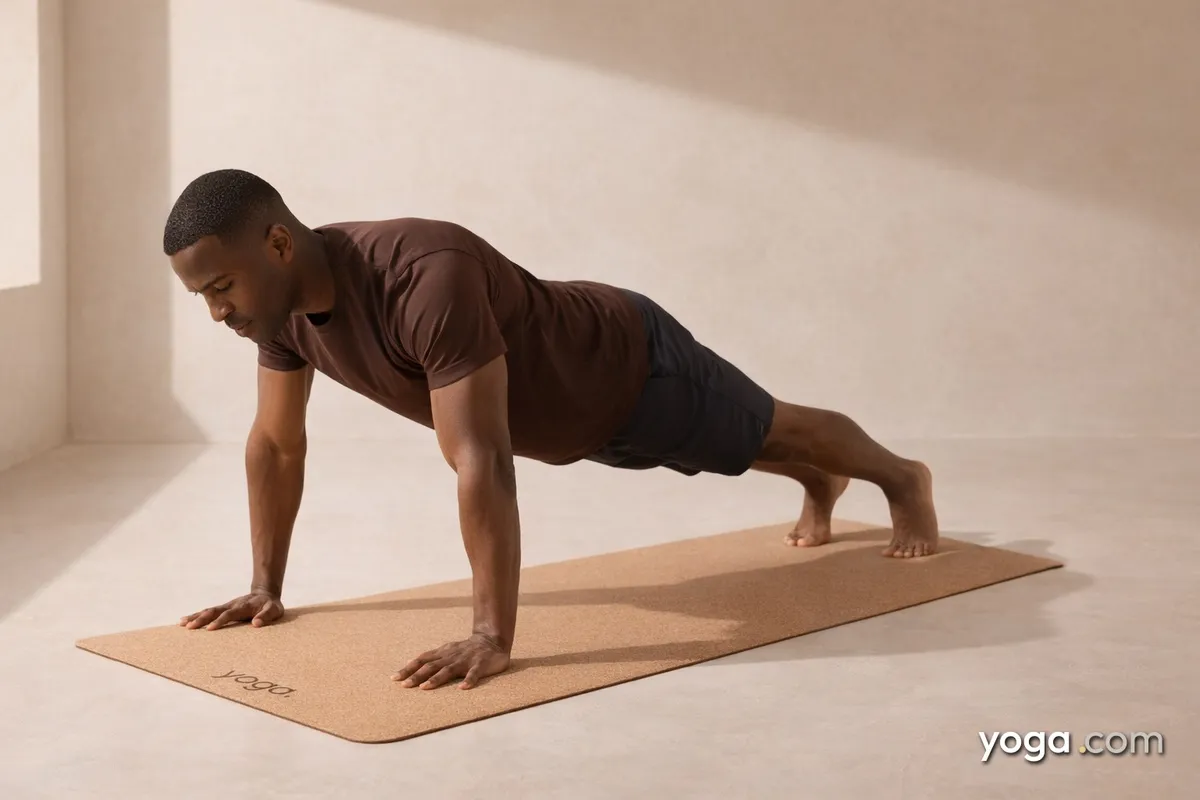
Plank Pose - Phalakāsana, from the Sanskrit phalaka (plank or bench) and āsana (seat) - is a full-body holding position in which the body forms one straight line from crown to heels. It sits at the heart of Sun Salutations and vinyasa transitions, making it one of the most frequently visited shapes in a modern yoga practice. Though classified as an arm balance, its accessibility and foundational nature make it the entry point for the entire arm-balance family.
At a Glance
- Level: Beginner
- Type: Arm Balance
- Targets: Core (anterior and posterior), shoulders and wrists, glutes, quadriceps
- Good for: Building full-body isometric strength, developing shoulder stability, improving postural body awareness
How to Do Plank Pose
- Start on all fours. Come to a tabletop position with your wrists directly under your shoulders and your knees under your hips. Spread your fingers wide, pressing evenly through each fingertip and the base of each finger.
- Step back one foot at a time. Extend your right leg back, then your left, tucking both sets of toes under so the balls of your feet press into the mat. Your feet can be hip-distance apart or together - hip-distance offers more stability for beginners.
- Align the body. Check that your shoulders are stacked directly over your wrists - not behind or in front of them. Your hips should be level with your shoulders, forming one straight horizontal line from head to heels.
- Engage the core and legs. Draw your lower belly gently in and up. Firm your quadriceps to lift the kneecaps, and press back actively through your heels as if pushing a wall behind you.
- Set the shoulder blades. Push the floor away so your upper back rounds very slightly - a micro-dome between the shoulder blades. This protects the shoulder joints and activates serratus anterior. Avoid letting the chest sink toward the floor.
- Find your gaze. Look at the mat a few inches in front of your fingertips. This keeps the cervical spine long and neutral, in line with the rest of the spine.
- Hold and breathe. Stay for five to ten steady breaths, keeping the breath full and even. Resist the urge to hold your breath.
- Come out with control. Lower your knees to the mat on an exhale, then press back to Child's Pose or step the feet forward to return to a standing forward fold. Alternatively, shift forward and lower through Four-Limbed Staff Pose if you are moving through a vinyasa.
Benefits
- Strengthens the muscles of the anterior core - rectus abdominis, transverse abdominis, and obliques - through sustained isometric contraction.
- Builds stability in the shoulder girdle, including the rotator cuff and serratus anterior.
- Strengthens the wrist flexors and extensors, preparing the joints for deeper arm balances.
- Activates and tones the glutes and quadriceps simultaneously.
- Trains spinal alignment awareness by requiring you to maintain a neutral spine under load.
- Develops the full-body tension pattern (posterior chain engagement) needed for more advanced arm balances and inversions.
Common Mistakes and Alignment Cues
- Hips too high or piked: If you can see your hips rising toward the ceiling, walk your feet back slightly and re-stack shoulders over wrists until the body forms a single line.
- Hips sagging toward the floor: Squeeze the glutes and re-engage the low belly. Think of lengthening your tailbone toward your heels rather than letting it drop.
- Elbows hyper-extending or splaying: Micro-bend the elbows and rotate the inner elbows forward (toward the thumbs). This engages the biceps and protects the joint.
- Head hanging below the spine: Nod your chin slightly and lengthen the back of your neck. Your ears should line up with your upper arms.
- Breath holding: If you cannot breathe freely, shorten the hold or drop to the modification. Plank is a strength pose, not an endurance test of breath suppression.
Modifications and Props
- Knees-down Plank: Keep both knees on the mat, positioned slightly behind the hips. This reduces the load on the core and wrists while preserving upper-body alignment. Use this variation until you can hold the full pose for five breaths with ease.
- Forearm Plank: Lower your forearms to the mat, elbows under shoulders, palms flat or interlaced. This removes wrist flexion entirely, making the pose accessible if wrist discomfort arises.
- Wedge under the wrists: Place a foam wedge or a folded, firm blanket under the heels of your hands so the wrists are in less extension. This reduces strain while keeping the arms straight.
- Wall Plank: Stand facing a wall, place your hands at shoulder height on the wall, and walk your feet back until your body forms a diagonal line. A useful entry point when floor-based weight-bearing is not yet accessible.
Cautions
- Wrist discomfort or injury: Extended wrist loading can aggravate carpal tunnel syndrome or wrist sprains. Try Forearm Plank or the wedge modification.
- Shoulder impingement or rotator cuff issues: If you feel pinching or pain in the shoulder, come down immediately. The knees-down variation reduces the load; work on shoulder-strengthening exercises before progressing to the full pose.
- Lower back sensitivity: A sagging pelvis compresses the lumbar spine. If you cannot maintain a neutral lumbar curve, use the knees-down variation.
- Pregnancy (second and third trimester): Growing abdominal volume can strain the linea alba. Consult your care provider and consider Wall Plank or Forearm Plank with knees down as alternatives.
If you're working with an injury or a medical condition, check with a qualified professional before practicing.
Related Poses
- Downward-Facing Dog Pose - a frequent partner pose and active rest between Planks in Sun Salutations.
- Four-Limbed Staff Pose - the direct progression from Plank; learn Plank first to build the strength and alignment needed here.
- Upward-Facing Dog Pose - commonly follows Four-Limbed Staff Pose in the vinyasa sequence, making Plank its upstream preparation.
- Side Plank Pose on Left Hand, Legs Together - the lateral variation that builds on Plank's shoulder and core foundation.
Put Plank Pose to work in a full sequence: A Gentle Yoga Routine for Tired, Low-Energy Days or try the standing variation in A 10-Move Chair Yoga Sequence for a Midday Reset.