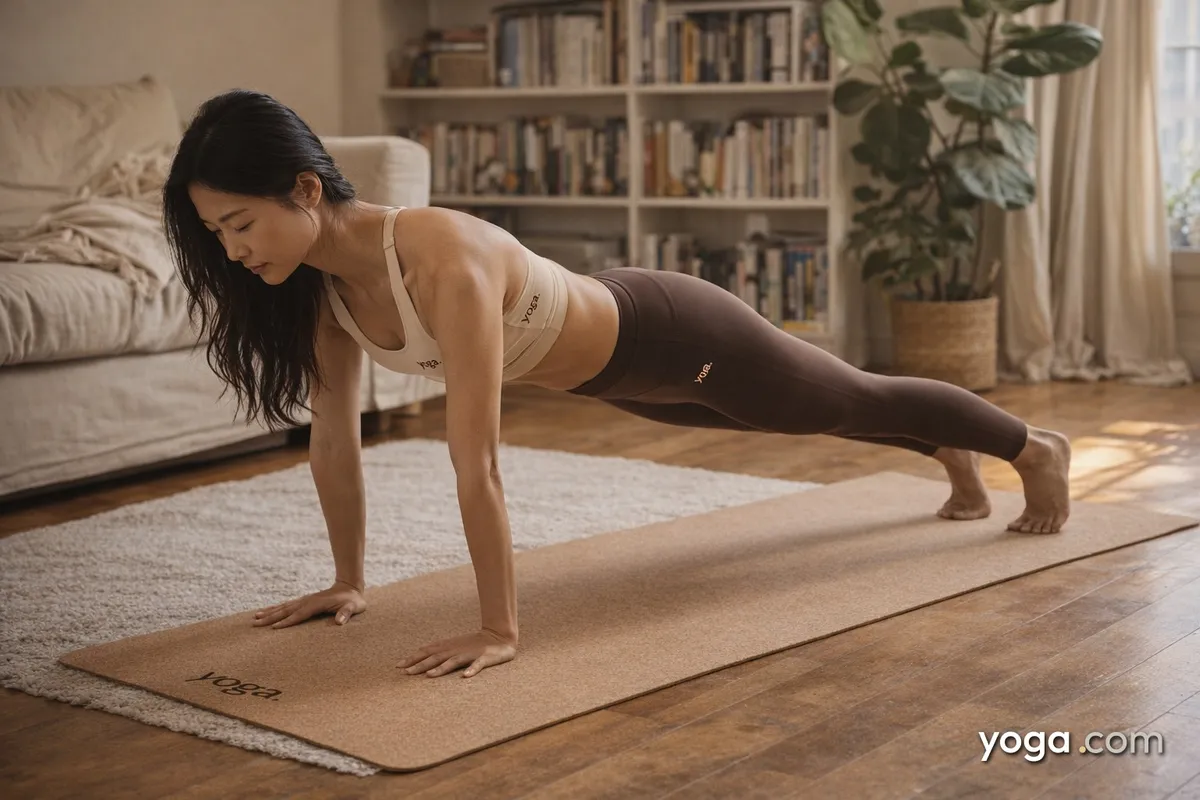
"Am I doing this plank right?" It's one of the most common questions teachers hear, usually from someone silently counting the seconds and suspecting their form has quietly fallen apart. Done well, Plank Pose (Phalakasana) is one of the most efficient things you can do for your body - no equipment, no gym, no excuses. This guide walks you through exactly how to nail the position, how long to hold it, and how to build from there.
Why Plank Pose Deserves a Spot in Your Routine
Plank is not a flashy exercise, but its reach across the body is truly remarkable. Holding Plank Pose for 30 seconds a few times a day strengthens your abdominals, hands, wrists, arms, shoulders, back, core, glutes, and legs - essentially your entire body, all at once. Very few exercises can work as many muscle groups at the same time as Plank Pose does for your body.
The benefits go deeper than muscle tone, and that is something worth keeping in mind. A 2023 study in the Journal of Exercise Rehabilitation found that older adults who practiced plank exercises three days a week for 12 weeks saw meaningful improvements in aerobic capacity (VO2max up ~12%), grip strength (~18%), and core endurance (sit-ups up ~42%). Those are real-world gains - the kind of gains you feel when you are climbing stairs or carrying groceries - and so the numbers matter because they show that plank exercises can make your daily life genuinely easier.
The same study found that lung function markers also improved, with forced expiratory volume increasing by approximately 27% and peak expiratory flow by approximately 16%. On top of that, even your immune system may benefit from your plank practice: natural killer (NK) cells increased by roughly 30% in the plank group, which shows that the plank group received benefits well beyond simple muscle strength.
Keep in mind that this "simple" pose earns its keep many times over, and adding it to your routine is one of the more practical choices you can make for your overall health.
Step-by-Step: How To Do a Perfect Plank Pose
Take your time with each cue below. Rushing into position is how form breaks down before you've even started the clock, and bad form from the very beginning means you lose most of the benefit of the exercise.
- Start on all fours. Place your wrists directly under your shoulders, fingers spread wide, pressing evenly through every knuckle. Keep in mind that your wrist position matters a lot here.
- Step your feet back. Walk one foot back, then the other, until your body forms one long diagonal line from heels to crown. Your body should look like a straight plank of wood from the side.
- Stack your hips. Your hips should be level with your shoulders - not sinking toward the floor, not hiking toward the ceiling. Imagine a glass of water balanced on your lower back, and your job is to keep that glass from spilling.
- Engage your core. Draw your navel gently toward your spine. This isn't a breath-holding crunch - this is a steady, calm activation and you want to maintain that activation for the whole duration of the plank.
- Squeeze your glutes and thighs. These muscles support your spine more than you'd expect, and so you should never let your glutes and thighs go passive during the movement.
- Lengthen through your heels. Press back through your heels as if you are trying to touch the wall behind you.
- Relax your face and jaw. Seriously. Look slightly ahead of your fingertips to keep your neck neutral, and let your expression soften because unnecessary tension in your face and jaw can travel down into your neck and shoulders.
- Breathe steadily. Slow, even inhales and exhales. On top of that, if you can't breathe normally, you've gone too long - come down and rest before your form has a chance to break down completely.
Common Mistakes (and the Easy Fixes)
Hips Too High or Too Low
Both are escape routes your body finds when fatigue sets in. Hips piked up shortens your core engagement; hips sagging dumps strain into your lower back. Reset your alignment every time - it's better to hold less time with good form than more time with poor form.
Holding Your Breath
Gripping through the pose with a held breath spikes your effort and cuts the pose short. Steady breathing is the goal, not survival mode.
Letting Your Head Drop or Crane
Your neck is part of your spine. Keep your gaze a few inches in front of your hands so your head stays in line with the rest of your body.
Forgetting Your Hands
Collapsed wrists are a fast route to discomfort. Spread your fingers, press through your fingertips, and distribute your weight evenly across your entire palm.
How Long Should You Hold It?
This is where many people either undersell or overdo it. Most experts suggest 10 to 30 seconds is plenty when you're starting out, with the option to build toward one to two minutes as you get stronger. Keep in mind that two minutes is widely considered the ceiling and you don't gain significantly more benefit beyond that point, so there is really no reason to push your hold time past two minutes.
Exercise physiologist Katie Lawton recommends aiming to hold a plank for about a minute before advancing, and increasing your hold time in small increments of five to ten seconds at a time. Small, steady increases work better than trying to add too much time all at once, so there is no need for you to rush the timeline.
As for frequency, Lawton suggests planking two to four times a week and this suggestion also aligns with ACSM and CDC guidance that every adult include muscle-strengthening activity at least two days per week. On top of that, keeping your plank sessions at two to four times per week gives your body enough time to recover between your training days.
Modifications To Meet You Where You Are
Knees-Down Plank
Drop your knees to the floor while keeping everything else - hips level, core engaged, long spine - exactly the same. This is a legitimate variation, not a lesser option. Use it until you're ready to progress.
Forearm Plank (Makara Adho Mukha Svanasana)
Lower onto your forearms with elbows under shoulders. This takes wrist pressure out of the equation entirely and deepens the core challenge. Many practitioners find this version more intense than the full plank.
Wall Plank
Place your hands on a wall and walk your feet back until your body is at a diagonal angle. Great for building shoulder stability and learning the alignment cues before taking the pose to the floor.
Plank Pose in Your Yoga Practice
In a vinyasa sequence, Plank Pose typically bridges Downward-Facing Dog (Adho Mukha Svanasana) and Chaturanga Dandasana (Four-Limbed Staff Pose). Pausing here - even for a single breath - is useful. It gives you a moment to reset your alignment before lowering with control rather than collapsing.
You can also use plank as a standalone hold at the start or end of your practice, or thread it between other strengthening poses like Boat Pose (Navasana) and Warrior III (Virabhadrasana III) for a well-rounded core sequence.
A Note on Safety
If you have a wrist injury, shoulder condition, or lower back issue, please check in with a healthcare provider before adding plank to your regular practice. Modifications exist for a reason - use them freely, and never push through sharp pain.
What Matters Most
Plank Pose is humble, honest work. There is nowhere to hide in Plank Pose, and that is exactly why it delivers real results; do not avoid the discomfort because the discomfort is the point. Start with 10 to 30 seconds, focus on your form over your duration, and build your time steadily from there. Keep in mind that your core, your posture, and your breath will all benefit when you do Plank Pose consistently. On top of that, every second you spend holding the position is doing something real for your body. The next time you are in that pose, quietly counting the seconds, you can know with confidence that your effort is not wasted.