That electric zing down the back of your leg — the one that flares when you stand up too fast, sit too long, or bend the wrong way — is something you want gone. Yoga can help. But with sciatica, the wrong poses can make things significantly worse, and a few key moves can genuinely ease the pain. Knowing the difference is everything.

⚠️ Read This First: A Safety Note

Sciatica is a symptom, not a diagnosis. The nerve irritation you're feeling can come from several different causes — a herniated disc, spinal stenosis, or a tight piriformis muscle, to name the most common. Each responds differently to movement. Please talk to your doctor or a physical therapist before starting any yoga practice for sciatica. This article provides general educational guidance, not medical advice.

If you experience any of the following, stop all activity and seek emergency care immediately:

  • Numbness or tingling that is spreading or worsening rapidly
  • Loss of bladder or bowel control (a potential sign of cauda equina syndrome — a rare but serious emergency)
  • Sudden severe weakness in both legs
  • Pain following a significant fall or injury
  • What Is Sciatica, Really?

    The sciatic nerve is the longest in your body, running from your lower spine through your hips and all the way down each leg. When something irritates or compresses it, pain, tingling, or numbness can radiate along that entire path. Research indicates a lifetime incidence of 10% to 40%, so you are far from alone.

    The underlying cause matters enormously for movement choices. The three most common sources are:

  • Disc herniation or bulge: A disc presses on the nerve root. Flexion (forward bending) typically worsens this; gentle extension often eases it.
  • Spinal stenosis: Narrowing of the spinal canal irritates the nerve. Extension can aggravate this; flexion may bring relief.
  • Piriformis syndrome: The piriformis muscle in the hip tightens around or near the sciatic nerve. Targeted hip stretches are often helpful here.
  • This is precisely why a professional assessment is so important before you choose your approach. What soothes one cause can inflame another.

    What the Evidence Actually Says About Yoga and Back Pain

    Research on yoga for back pain is promising but nuanced — and honesty matters here. Most studies focus on chronic non-specific low back pain, not sciatica specifically, so findings don't transfer one-to-one.

    A 2022 Cochrane systematic review of 21 trials with 2,223 participants found that yoga was associated with small improvements in pain and function compared to no exercise — but those improvements were below the threshold considered clinically meaningful. When compared to other forms of back-focused exercise, yoga performed similarly.

    Importantly, low-certainty evidence from the same review showed yoga increased the risk of adverse events — primarily increased back pain — compared to no exercise. This reinforces why guidance from a qualified teacher and your healthcare provider matters.

    On the more encouraging side, the 2017 American College of Physicians clinical practice guidelines recommended yoga as an initial treatment option for chronic low-back pain, and a 2022 systematic review and meta-analysis of 27 studies involving 2,702 participants found yoga was associated with short-term improvements in pain intensity, disability, mental health, and physical functioning for chronic low-back pain. "Associated with" is the key phrase — not a guarantee, and not a cure.

    There is also some research specific to disc-related sciatica: a 2015 randomized controlled trial of 61 adults with low back pain or sciatica from disc bulges or extrusions found that yoga therapy resulted in meaningfully better disability scores than the control group at three months, with no adverse effects reported. Encouraging — but one study, and participants were closely supervised.

    The Critical Warning: Not All Stretches Help

    This is the part most yoga articles get wrong. If your sciatica comes from a herniated or bulging disc, you are likely flexion-intolerant — meaning rounding forward through your spine can increase disc pressure and worsen nerve irritation. The simple fact is that not every stretch is a safe stretch, and the wrong stretch can make your sciatica worse instead of better.

    Poses to approach with extreme caution or avoid entirely if you have disc-related sciatica:

  • Seated Forward Fold (Paschimottanasana) — deep spinal flexion with hamstring pull
  • Standing Forward Fold (Uttanasana) — same concern, especially with a rounded back
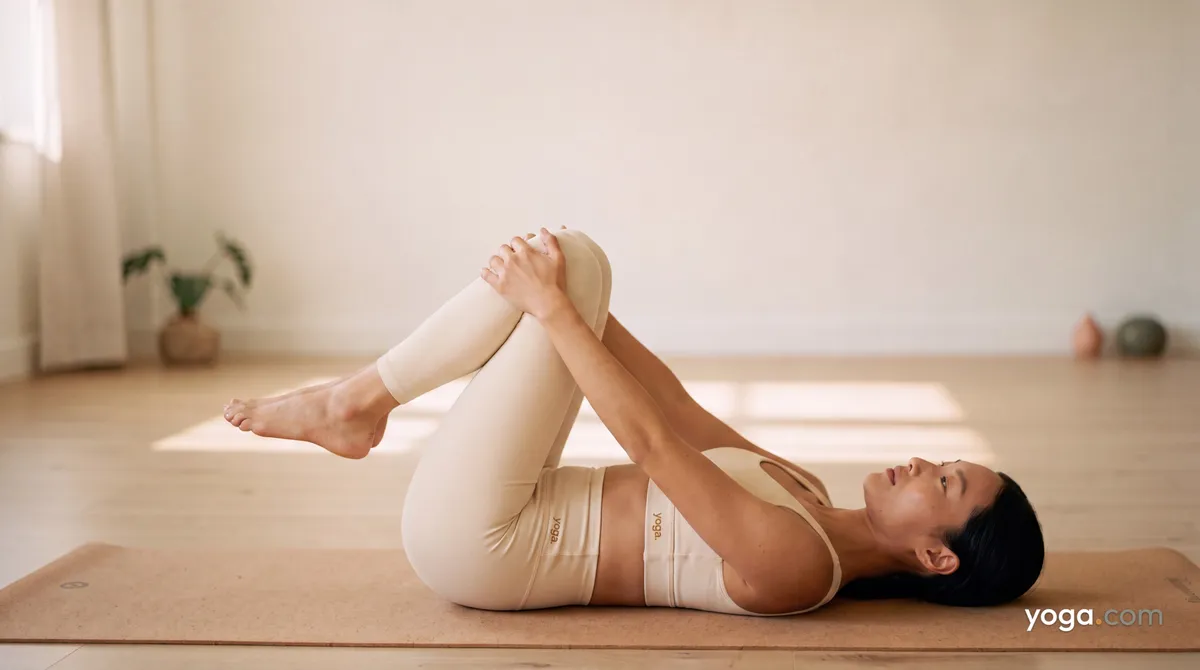
  • Knee-to-Chest Pose (Apanasana) — can increase disc pressure in the lumbar spine
  • Any aggressive hamstring stretching that posteriorly tilts the pelvis and rounds the lower back
  • Keep in mind that your body gives you a very clear signal when a movement is going in the wrong direction. Stop immediately if any movement sends pain, tingling, or numbness further down your leg. On top of that, you should know that this signal has a name — "centralization vs. peripheralization" — and this signal is your body telling you the movement is the wrong direction for your situation and that you need to stop that movement right away.

    Safer Starting Points: Poses Worth Exploring

    These positions are generally gentler starting points, but the word "generally" is doing real work in that sentence and you should not take it lightly. Always check with your provider first, move slowly, and treat any increase in leg symptoms as a reason to stop. The simple fact is that what works well for one person may not work well for you, so paying attention to your body is very important.

    For Disc-Related (Flexion-Intolerant) Sciatica: Extension-Biased Positions

  • Sphinx Pose (Salamba Bhujangasana): Lie on your stomach and prop yourself onto your forearms with elbows placed under your shoulders. This gentle lumbar extension is a classic starting point for disc-related presentations and many people find it helpful. Hold the pose for 1–2 minutes if the position feels comfortable for you.
  • Cobra Pose (Bhujangasana), low version: From Sphinx, very gently lift your chest slightly higher using your hands, and go only as far as feels neutral and not painful because pushing past that point can make things worse. Keep your pubic bone on the mat at all times.
  • Cobra Pose — step-by-step demonstration
    Cobra Pose — step-by-step demonstration
  • Cat-Cow (Marjaryasana-Bitilasana): On hands and knees, move gently between arching and rounding the spine. Stay within a pain-free range and do not force the flexion phase if the flexion phase provokes your symptoms.
  • For Piriformis-Related Sciatica: Supported Hip Openers

  • Supported Figure-4 (Reclined Thread the Needle / Sucirandhrasana): Lie on your back, cross one ankle over the opposite thigh, and gently draw that thigh toward your chest. Keep your spine neutral on the floor. This position targets the piriformis muscle without loading the lumbar spine, and that is exactly why the position is a good starting point for piriformis-related sciatica.
  • Legs Up the Wall (Viparita Karani): This is a gentle, passive position that reduces gravitational load on the spine and can ease nerve irritation. Rest in this position for 5–10 minutes.
  • For General Tension and Nervous System Calm

  • Child's Pose (Balasana): Child's Pose is appropriate for some people, but if Child's Pose increases your leg symptoms you should skip it. Use a bolster under your torso to reduce forward-fold depth and make the position more manageable for your body.
  • Child's Pose — step-by-step demonstration
    Child's Pose — step-by-step demonstration
  • Constructive Rest Position: Lie on your back with knees bent, feet flat on the floor, and arms resting by your sides. Keep in mind that this is not a traditional asana, but the position is deeply useful because it decompresses the lumbar spine with no load at all and so it is a very safe option for most people.
  • How to Practice Safely: Ground Rules

  • Get assessed first. Know your cause before you choose your approach.
  • Work with a qualified teacher — ideally one with experience in therapeutic yoga or back pain. Yoga is considered safe for healthy people when performed properly under the guidance of a qualified instructor; the "qualified" part matters more when you're managing a condition.
  • Move slowly and pay attention. Any movement that sends pain further down your leg is a warning sign to stop.
  • Short sessions first. Ten gentle minutes is better than a full class that leaves you flared for three days.
  • Avoid hot yoga when acutely inflamed — heat increases inflammation short-term.
  • No "pushing through" pain. Mild stiffness is different from nerve pain. Err on the side of caution every time.
  • When to See a Professional (or Go Back to One)

    Yoga is a complement to care, not a replacement for it. See your doctor or physical therapist if:

  • Your symptoms are new, severe, or worsening
  • Pain hasn't improved after 4–6 weeks of conservative management
  • You develop any spreading numbness, weakness, or loss of bladder or bowel function
  • You're unsure of the cause of your sciatica
  • You've had a recent injury, surgery, or significant health change
  • The good news: research suggests that 80–90% of individuals with back pain and sciatica return to work within 12 weeks. With the right support, most people do recover.

    The Bottom Line

    Yoga can be a meaningful part of recovering from sciatica — but it requires more care and nuance than a generic flow class. Know your cause. Distinguish between what helps and what hurts your specific presentation. Work with your healthcare team. And let gentleness, not ambition, guide your practice. Your nervous system will thank you.

    Sources

  • PMC / NCBI — Yoga for Low Back Pain (PMC4878447)
  • NCBI StatPearls — Sciatica (NBK507908)
  • PubMed — Cochrane Review: Yoga for Chronic Non-Specific Low Back Pain (2022)
  • PubMed — RCT: Yoga Therapy for Nonspecific Low Back Pain and Disc Sciatica (2015)
  • NCCIH — Yoga for Pain: What the Science Says