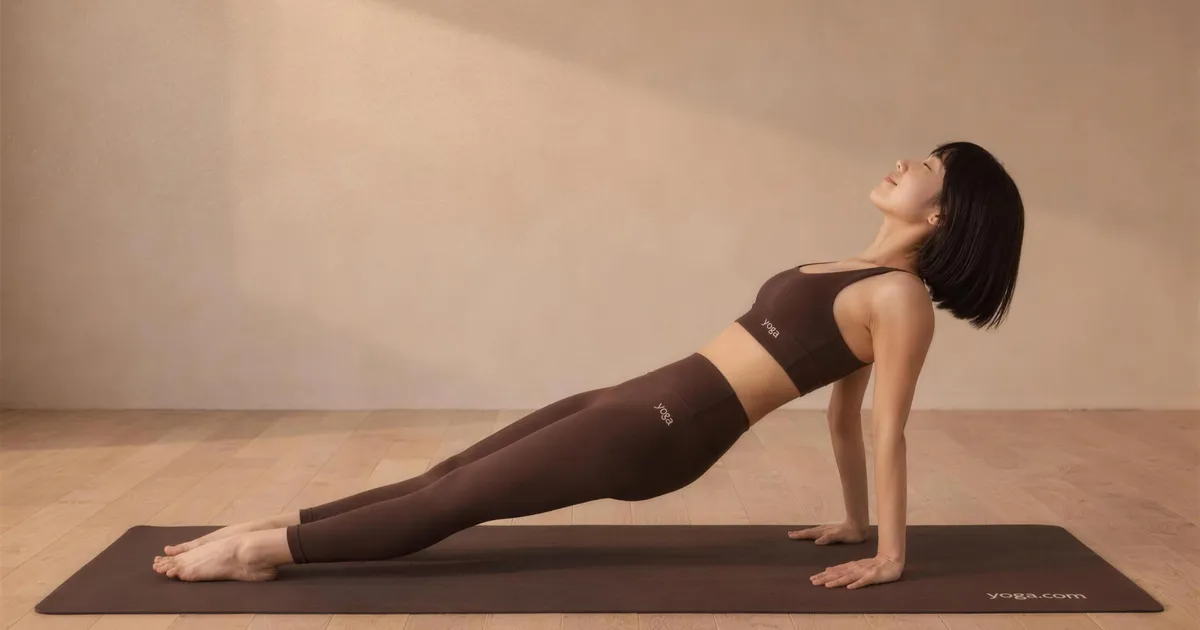
Upward Plank Pose - Pūrvottānāsana, from the Sanskrit pūrva (east/front of the body), uttāna (intense stretch), and āsana (pose) - is a full-body backbend that opens the entire anterior line from shoulders to toes. It is often sequenced as a counter-pose to Dandasana or forward folds, and it appears in both Ashtanga primary series and general vinyasa flows as an energizing, chest-opening complement to forward-bending work.
At a Glance
- Level: Intermediate
- Type: Backbend
- Targets: Shoulders and chest, hip flexors, quadriceps, ankle extensors
- Good for: Building posterior-chain strength, improving shoulder extension, counterbalancing prolonged sitting or forward-folding
How to Do Upward Plank Pose
- Start in Dandasana. Sit with your legs extended straight in front of you, feet together, spine tall, and hands resting beside your hips.
- Plant your palms. Place your hands six to eight inches behind your hips, fingers pointing toward your feet (or slightly outward if your wrists are tight). Press all four corners of each hand firmly into the floor.
- Bend your knees (optional setup). If you are new to the pose, bend your knees and place your feet flat on the floor, hip-width apart - this reduces the load on the wrists and shoulders while you build familiarity.
- Inhale and lift your hips. On an inhale, press into your hands and feet, engage your glutes and legs, and lift your pelvis until your torso forms one long diagonal line from shoulders to knees (bent-knee variation) or shoulders to heels (full variation).
- Straighten your legs (full pose). If working with straight legs, extend one leg at a time, pressing through the soles of your feet until both legs are fully engaged and your body forms a single plank from crown to heels. Keep your feet together or hip-width, pressing the tops of the feet toward the floor.
- Open your chest and let your head release. Draw your shoulder blades together and down, lift your sternum, and if your neck is comfortable, allow your head to release back - gaze drifts toward the ceiling or wall behind you. Avoid crunching the back of the neck; the release should feel spacious.
- Breathe and hold. Stay for three to five breaths, maintaining active legs, a firm core, and an open chest throughout.
- Come out with control. On an exhale, tuck your chin, lower your hips back to the floor with control, and return to Dandasana. Take a breath or two before moving on.
Benefits
- Strengthens the posterior chain - glutes, hamstrings, and spinal extensors - required to maintain the lifted position.
- Stretches the hip flexors and quadriceps across the full front of the body.
- Builds shoulder extension strength and stability through an active, weight-bearing range of motion.
- Stretches the pectoral muscles and the anterior shoulder capsule.
- Strengthens the wrists and forearms under load, building grip and joint resilience over time.
- Mobilizes the ankle joint into plantar flexion, lengthening the shin and top-of-foot line.
Common Mistakes and Alignment Cues
- Hips sagging below shoulder level. If your pelvis drops, your lower back absorbs excess compression. Re-engage your glutes fully and press the floor away with straight arms to lift the hips level with - or slightly above - your shoulders.
- Wrists rolling outward. When the index-finger side of the hand lifts, wrist stability drops. Press evenly through all fingers and the heel of the hand, keeping the forearm neutral.
- Knees splaying wide. Externally rotated legs reduce the lift through the pelvis. Squeeze your inner thighs gently toward each other to keep the legs tracking parallel.
- Collapsed chest or rounded upper back. Passive shoulders let the chest sink. Actively retract and depress the shoulder blades to open the sternum forward and up.
- Forced neck drop. Yanking the head back compresses the cervical spine. Let the head release only as far as gravity takes it comfortably - keep the throat long.
Modifications and Props
- Bent-knee variation (Reverse Table Top). Keep both knees bent, feet flat, hip-width apart. This shortens the lever arm and reduces demand on the hamstrings and shoulders - a practical starting point for most students.
- Blocks under the hands. Place yoga blocks at their medium height under your palms to reduce the angle of wrist extension, making the pose accessible if you have tight wrists or limited range.
- Fingertips pointing sideways. Rotating the hands so fingers point out to the sides (or even slightly back) can ease discomfort in the wrists and forearms for students who find the forward-pointing position painful.
- Forearm variation. Lower onto your forearms instead of straight arms to remove wrist load entirely while still practicing the hip lift and chest opening - similar in principle to Forearm Plank in reverse.
Cautions
- Wrist pain or injury. Weight-bearing on extended wrists is significant here; use blocks or the forearm variation, or skip the pose until the wrist is fully recovered.
- Shoulder impingement or rotator cuff issues. The shoulder-extension load in this pose can aggravate existing impingement; work with a bent-knee variation and less weight through the arms, or avoid the pose.
- Neck issues. Do not drop the head back if you have cervical disc concerns or acute neck pain; keep your chin slightly tucked and gaze forward instead.
- Lower-back sensitivity. If the lower back feels compressed rather than lengthened, shorten your hold, re-engage the core and glutes, or return to the bent-knee variation.
If you're working with an injury or a medical condition, check with a qualified professional before practicing.
Related Poses
- Bridge Pose - a supine backbend that builds similar glute and posterior-chain strength, making it an excellent preparation.
- Upward-Facing Dog Pose - shares the chest-opening and shoulder-extension action; practicing it regularly primes the body for Upward Plank.
- Cobra Pose - a gentler chest opener that introduces the spinal extension pattern with less demand on the wrists and arms.
- Downward-Facing Dog Pose - a natural counter-pose after Upward Plank, re-lengthening the spine and releasing the wrists in the opposite direction.
If your energy is low, A Gentle Yoga Routine for Tired, Low-Energy Days offers a slower approach to opening the body. For a desk-break alternative, try the accessible options in A 10-Move Chair Yoga Sequence for a Midday Reset.