About Upward Plank Pose with Right Leg Up
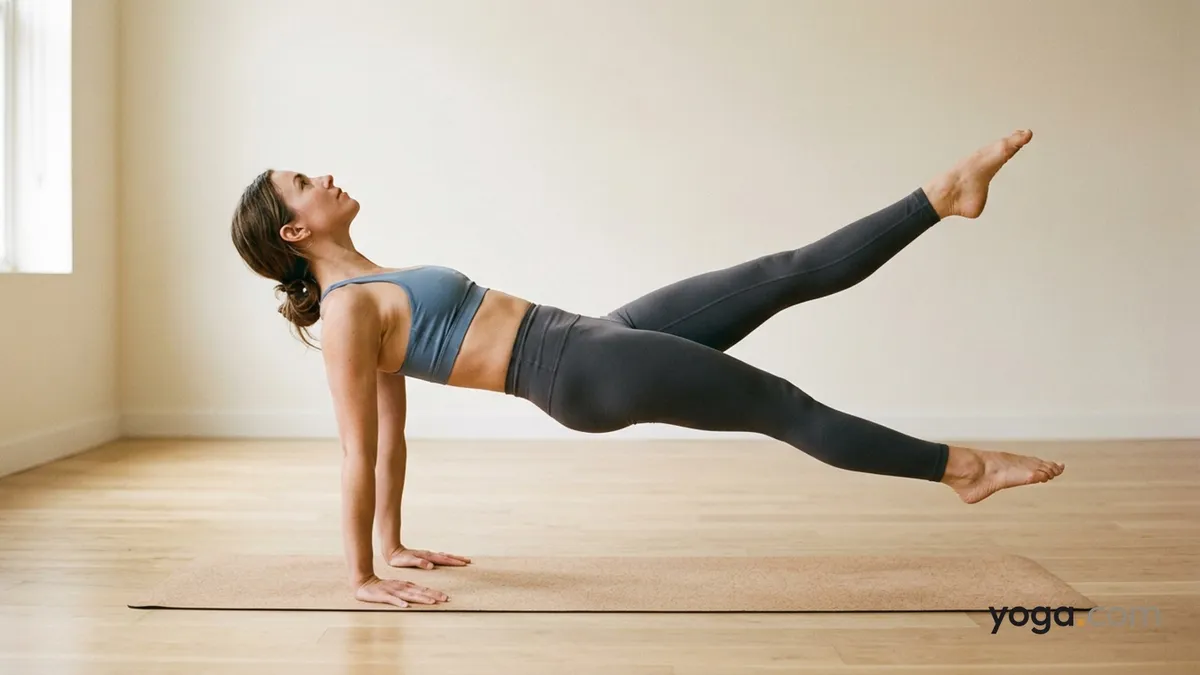
Pūrvottānāsana — from the Sanskrit pūrva (east, or the front of the body), uttāna (intense stretch), and āsana (pose) — is a full-body backbend that opens the chest and strengthens the posterior chain. In this single-leg variation, you lift the right leg while the left leg remains grounded in the classic straight-leg plank line, adding a hamstring stretch for the raised leg and a hip-flexor challenge for the supporting side.
At a Glance
Level: IntermediateType: BackbendTargets: Wrists, shoulders, chest, core, glutes, hamstrings (right leg, lengthening), hip flexors (left leg, lengthening)Good for: Shoulder and chest opening, posterior-chain strengthening, hip-flexor mobility, wrist preparationHow to Do Upward Plank Pose with Right Leg Up
Sit on the floor with your legs extended in front of you. Place your hands about a foot behind your hips, fingers pointing toward your feet, palms flat on the mat.Press firmly through both palms and both heels as you lift your hips toward the ceiling, straightening your arms. Your body rises into one long diagonal line from shoulders to feet.Point both sets of toes away from you so the soles press down into the mat — this is the straight-leg plank line, not a flat-footed position. Your left sole presses firmly down with toes extending away, grounding the supporting leg.Draw your shoulder blades together and down your back to open the chest. Press the sternum upward without collapsing into your lower back.Engage your glutes and thighs. Keep your hips level and lifted — do not allow the left hip to drop as you prepare to raise the right leg.On an exhale, engage your right hip flexors and draw the right leg upward, keeping it straight. Reach the right toes toward the ceiling (or as high as your range of motion allows) while maintaining a pointed foot. Your left leg stays fully extended, left sole pressing down, left toes pointing away.Hold for 3–5 breaths. Keep the chest broad, the neck relaxed, and the gaze soft — you may let the head drop back gently if the neck is comfortable, or keep the chin slightly tucked.To come out: lower the right leg to meet the left, then slowly lower your hips back to the floor with control. Shake out the wrists and rest briefly in Corpse Pose or with a simple forward fold before switching sides.Benefits
Strengthens the posterior chain: Glutes, hamstrings, and spinal extensors work together to hold the lifted hip position against gravity.Stretches the hamstrings of the right leg: Raising the right leg into hip flexion lengthens the right hamstring group through its full range.Lengthens the hip flexors of the left leg: With the left leg fully extended and hips elevated, the left hip flexors are drawn into an active stretch.Opens the chest and shoulders: The retracted shoulder blades and elevated sternum create space across the anterior chest and the front of the shoulders.Builds wrist and shoulder stability: Bearing load through a neutral wrist with arms straight trains the muscles that support the wrist and glenohumeral joint.Challenges core stability unilaterally: Holding one leg airborne requires the deep stabilizers to resist rotation and lateral hip drop.Common Mistakes and Alignment Cues
Mistake: Flat or hip-width feet on the floor. Cue: This is a straight-leg pose — point both sets of toes away from you so the soles press into the mat along the plank line. Flat feet belong in reverse tabletop, not here.Mistake: Left toes pointing forward or foot flexed. Cue: The left sole should press down with the left toes extending away from the body, mirroring the plank line of the lifted leg. A forward-facing flat left foot breaks the line and reduces posterior-chain engagement.Mistake: Hips sagging on the left side when the right leg lifts. Cue: Before you raise the right leg, squeeze both glutes and brace the obliques. Imagine threading a horizontal rod through both hip points and keeping it perfectly level.Mistake: Dumping into the lower back. Cue: Rather than simply arching the lumbar, think of lifting the sternum away from the navel. The backbend should feel long, not compressed.Mistake: Wrists collapsing inward or fingers curling up. Cue: Spread all ten fingers wide, press evenly through the heel of each palm, and distribute weight across every knuckle.Modifications and Props
Wrist sensitivity: Place a folded blanket under the heels of your hands to reduce wrist extension, or make fists and bear weight on the knuckles.Limited shoulder mobility: Position your hands wider than your hips or turn the fingers slightly outward to reduce internal rotation demand at the shoulder.Building up to the full lift: Practice full Upward Plank (both feet down, toes pointed, straight legs) until you can hold it steadily for 5 breaths before adding the single-leg variation.Limited hamstring range: Keep the raised right leg at a lower height — even a few inches off the ground is sufficient to begin training the stability and stretch.Blocks under the hands: If your arms are not yet strong enough to sustain the lift, place yoga blocks under each palm to raise the floor and reduce the load.Cautions
Avoid this pose or proceed with extra care if you have a wrist, elbow, or shoulder injury, as the arms bear significant load throughout.If you experience sharp lower-back pain rather than a broad backbend sensation, come down and revisit alignment before continuing.Those with hamstring or hip-flexor strains should reduce the height of the raised leg and avoid forcing range of motion.If you're working with an injury or a medical condition, check with a qualified professional before practicing.Related Poses
Bridge Pose — a supine backbend that builds the glute and hamstring strength needed to maintain hip height here.Upward-Facing Dog Pose — shares the chest-open, arms-straight backbend shape and trains the same shoulder retraction pattern.Upward Bow Pose — a deeper backbend progression that builds on the chest and shoulder opening established in Pūrvottānāsana.Downward-Facing Dog Pose — a natural counterpose that releases the wrists, stretches the posterior chain, and neutralizes the spine after backbending.