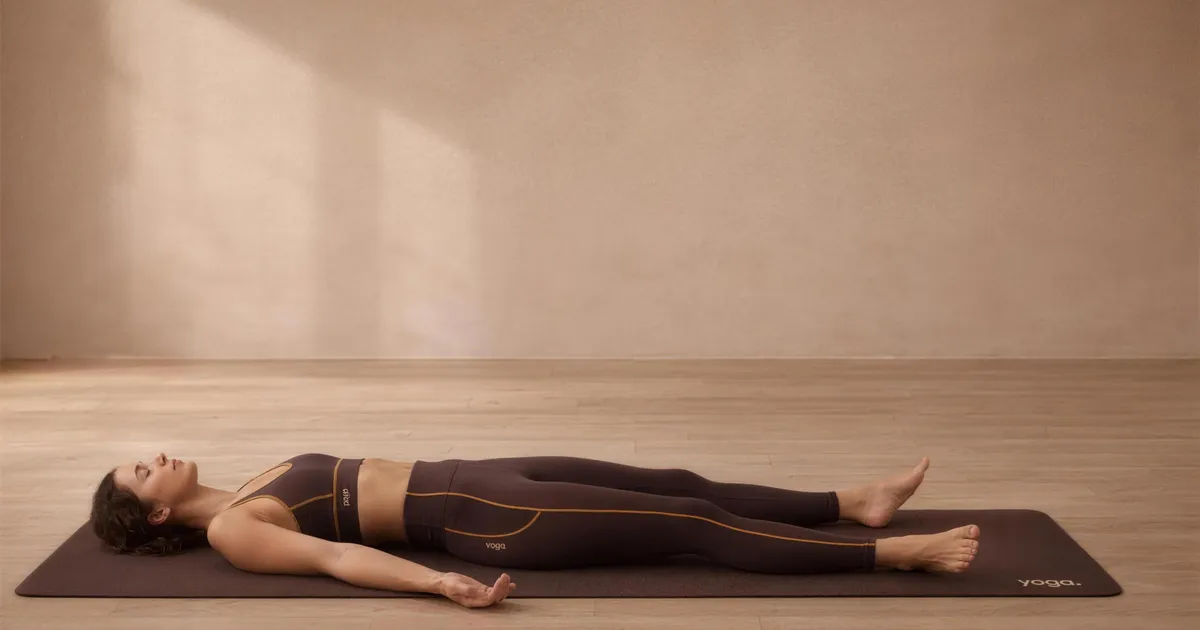
Corpse Pose, known in Sanskrit as Śavāsana (from śava, meaning "corpse," and āsana, meaning "seat" or "posture"), is a supine resting pose practiced lying completely still on your back. It usually comes last in a session, so your nervous system and muscles get a few quiet minutes to absorb the work you've done. It looks simple. It isn't - staying still, awake, and uninvolved asks more of your attention than almost any other pose in the practice.
At a Glance
- Level: Beginner
- Type: Supine
- Targets: Full body, diaphragm, spinal muscles, hip flexors
- Good for: Regulating breath, releasing muscular holding patterns, integrating a practice session
How to Do Corpse Pose
- Sit at the center of your mat, knees bent, feet flat on the floor.
- Lower your torso slowly toward the mat - hands supporting you on the way down - then extend your legs one at a time until both are straight.
- Let your feet fall open naturally - heels about hip-width apart, toes releasing outward without any effort to hold them in place.
- Move your arms slightly away from your sides - roughly 15 to 20 degrees - and turn your palms to face the ceiling. Straighten your fingers softly; let them curl slightly as your hands relax.
- Adjust your head so the chin neither juts up nor presses toward the chest. The back of your skull rests evenly on the mat, and your gaze - eyes closed - points straight up through your lids.
- Take one deliberate breath in, gently engage your whole body for a moment, then exhale and release everything - jaw, tongue, eyes, belly, thighs - completely. Then leave your breath alone. It'll find its own rhythm without your help.
- Stay at least five minutes. Ten is better after a full practice. Keep your awareness steady but passive - awake, watching, not working.
- To come out: Deepen your breath, begin to move fingers and toes, then draw your knees into your chest. Roll to your right side and pause for two or three breaths. Use your left hand to press yourself up to a comfortable seated position.
Benefits
- Your diaphragm gets its full, unrestricted range of motion back after standing and inverted work.
- Lets the spinal muscles decompress and release accumulated tension from weight-bearing poses.
- Gives hip flexors - often shortened during standing sequences - the opportunity to passively lengthen against the floor.
- It trains attention too - the sustained, non-reactive kind - since you're staying alert without moving a muscle.
- Heart rate and breath rate drift back to resting baseline after the demanding work.
- And it grooves the motor pattern of letting everything go at once, which carries over into other supine poses.
Common Mistakes and Alignment Cues
- Chin lifted, throat compressed: Slide a folded blanket under the back of your head until your forehead is level with or slightly higher than your chin.
- Arms pressed against the sides of the torso: Move each arm out enough that there is clear space between your upper arm and your ribcage, allowing your shoulders to release back and down.
- Holding the belly or ribs rigid: Let the abdomen rise on every inhale; consciously soften the intercostals on every exhale rather than bracing through the torso.
- Feet pointing straight up or toward each other: Don't position your feet at all. Stop directing them and let gravity decide where the toes land - any forced angle puts effort back into the hips.
- Falling fully asleep within the first minute: Keep your eyes softly closed but maintain a single point of awareness - the feeling of breath at your nostrils or the contact of your body with the floor.
Modifications and Props
- Lower-back discomfort: Place a bolster or a rolled blanket under your knees to reduce the lumbar curve and allow the lower back to settle toward the mat.
- Head and neck tension: Use a folded blanket (two to three inches thick) under your head so the cervical spine maintains its natural curve without strain.
- Feeling exposed or cold: Cover yourself with a light blanket before settling; your temperature drops once you stop moving, and it's easier to stay the full time when you're warm.
- Difficulty lying flat (late pregnancy or certain chest conditions): Raise the entire torso on a bolster or folded blankets placed lengthwise so you are reclined at a comfortable angle rather than fully supine.
Cautions
- If you have significant disc issues in your lumbar spine, experiment with the knees-bent modification before extending your legs fully flat.
- Lying flat on your back is generally discouraged late in pregnancy; use the inclined bolster variation or practice Side-Lying Corpse Pose instead.
- If acid reflux is a concern, propping the upper body up on a bolster rather than lying fully horizontal will be more comfortable.
- If you're working with an injury or a medical condition, check with a qualified professional before practicing.
Related Poses
- Bridge Pose - a common active counterpart earlier in a sequence before settling into rest
- Knee Press Both Legs - a gentle transition pose to draw into just before or just after Śavāsana
- Lying Diamond Pose - another supine resting shape that prepares the hips and inner thighs for stillness
- Rotation Pose with Legs to the Left - a supine twist that releases the spine immediately before final rest
See also: A Gentle Yoga Routine for Tired, Low-Energy Days and A 10-Move Chair Yoga Sequence for a Midday Reset.