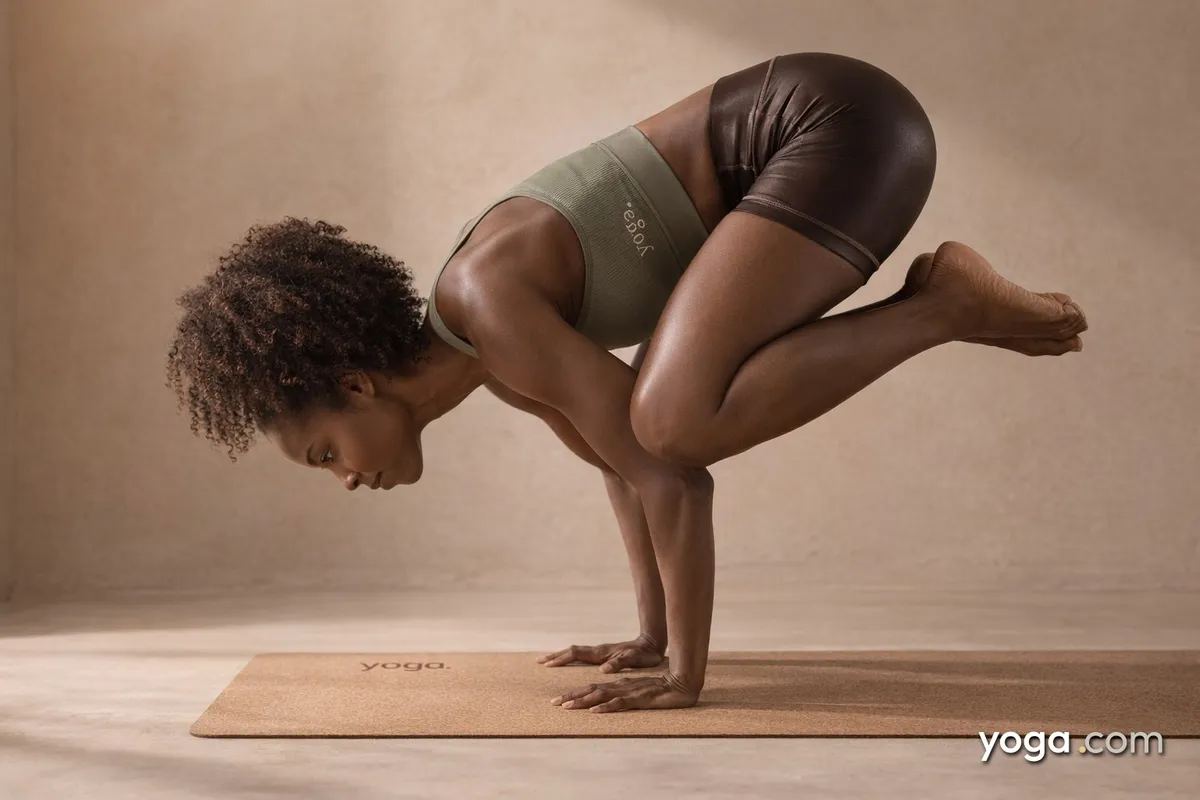
Crane Pose, Heels Drawn High (Bakāsana (half-bent legs up) - from Sanskrit baka, "crane," and āsana, "seat") is an advanced arm balance that asks you to hold your bent knees against your upper arms while your feet lift only partway toward your seat rather than fully extending or fully tucking. That mid-range leg position is the whole trick. Your feet aren't parked anywhere - not tucked to your seat, not extended - so your hip flexors and core have to hold them in space, which asks more of them than standard Crane does. A strength challenge, yes. Mostly, though, it's a study in controlled tension. You'll usually meet it near the peak of a well-warmed arm-balance sequence.
At a Glance
- Level: Advanced
- Type: Arm Balance
- Targets: Wrists and forearms, core (transverse abdominis, hip flexors), shoulders, upper back
- Good for: Building shoulder stability, strengthening wrist-bearing capacity, developing active hip-flexor control
How to Do Crane Pose, Heels Drawn High
- Begin in a squat. From Malasana (garland pose), place your hands shoulder-width apart on the mat, fingers spread wide, index fingers parallel or angled slightly out. Press every knuckle firmly into the floor.
- Set your shelf. Bend your elbows to roughly 90 degrees so your upper arms make a flat platform - a shelf your knees can actually sit on. Draw your knees up and press your inner knees snugly against the backs of your upper arms, just above the elbows.
- Engage your core before you lift. Pull your low belly in and up - think Uddiyana Bandha - and let your upper back round slightly. Then squeeze your inner thighs against your arms so the grip works both ways, legs into arms and arms into legs.
- Lean forward. Shift your weight steadily into your hands until your heels start to float on their own - they'll know when. Don't stare straight down; keep your gaze about six inches in front of your fingertips.
- Lift to the half-bent position. Rather than drawing your heels all the way to your seat, stop when your shins are roughly parallel to the floor and your feet are at knee height - legs half-bent, not tucked tight. Holding here is active work - hip flexors contracting, upper back keeping its firm dome. Nothing about this position holds itself.
- Breathe and hold. Keep the elbows stacked over the wrists (avoid letting them splay wide), press the floor away to stabilize the shoulders, and sustain the lift for three to five full breaths.
- Come out with control. Exhale and lower your feet to the mat slowly - a deliberate landing, not a drop. Return to a squat, then press back to Downward-Facing Dog and give your wrists a moment to decompress.
Benefits
- Strengthens the wrist flexors and forearm muscles under sustained load
- Builds shoulder protractor strength and scapular stability
- Develops active hip flexor engagement through the mid-range of hip flexion
- Trains deep core activation (transverse abdominis and pelvic floor) in an inverted-weight context
- Improves proprioception and body-position awareness in flight
- Cultivates the ability to maintain a stable spinal curve under load
Common Mistakes and Alignment Cues
- Mistake: Elbows splaying outward. Cue: Spin your elbow creases slightly forward so the arms form a contained shelf; this keeps load over the wrist joints.
- Mistake: Legs creeping fully tucked or fully extended. Cue: Anchor your attention on keeping the shins parallel to the floor - use a mirror or a teacher's eye until you can feel the true mid-bend position.
- Mistake: Gazing straight down, causing rounding to collapse rather than support. Cue: Find a focal point a hand's length in front of your fingers and keep the crown of the head reaching forward.
- Mistake: Holding the breath. Cue: Count your exhales aloud - if you can't speak, you're gripping rather than engaging; soften the jaw and breathe.
- Mistake: Knees sliding off the upper arms mid-hold. Cue: Press your knees into your arms and simultaneously press your arms back into your knees - the isometric squeeze is your anchor.
Modifications and Props
- Blocks under hands: Place two blocks (medium height) under your palms to increase the height of your platform, giving your feet more clearance and reducing the lean-angle demand on your shoulders.
- Block under forehead: Rest your forehead lightly on a block while you practice the leg-position and core engagement before committing to the full balance - this takes fear of falling forward out of the equation.
- Wall at your back: Practice near a wall so your feet can rest against it at the half-bent height while you focus on arm and core engagement without the balance variable.
- Full Crow as preparation: If the half-bent position feels out of reach for now, that's fine. Consolidate full Crow first, knees tucked tight, then let your legs travel away from your body a little at a time as your hip-flexor stamina builds.
Cautions
- Wrist pain or injury: This pose places significant compressive load on the wrists; avoid or modify substantially if you have acute wrist inflammation, carpal tunnel symptoms, or a recent sprain.
- Shoulder instability: If you have a rotator-cuff tear or shoulder impingement, don't work on arm balances alone - practice under direct supervision, and only once your baseline shoulder strength is solid.
- Pregnancy: Avoid prone and deep forward-weight-bearing positions; this pose is not appropriate during pregnancy.
- Elbow hyperextension: If your elbows tend to lock into hyperextension, maintain a micro-bend and engage the triceps actively throughout to protect the joint.
If you're working with an injury or a medical condition, check with a qualified professional before practicing.
Related Poses
- Easy Crow Pose - where most people should start - build arm-balance confidence there before trying to control the half-bent leg position
- Crane Pose - the straight-leg variation - the far end of the range this pose sits in the middle of
- Crane Pose with Head on the Mat - a supported variation for practicing the wrist and core load with less balance demand
- Plank Pose - an essential preparation for building the wrist strength and shoulder stability this balance requires
Want to fold arm balances into a wider practice? See A Gentle Yoga Routine for Tired, Low-Energy Days for a recovery-focused counterpoint, or A 10-Move Chair Yoga Sequence for a Midday Reset for an accessible mid-day option.