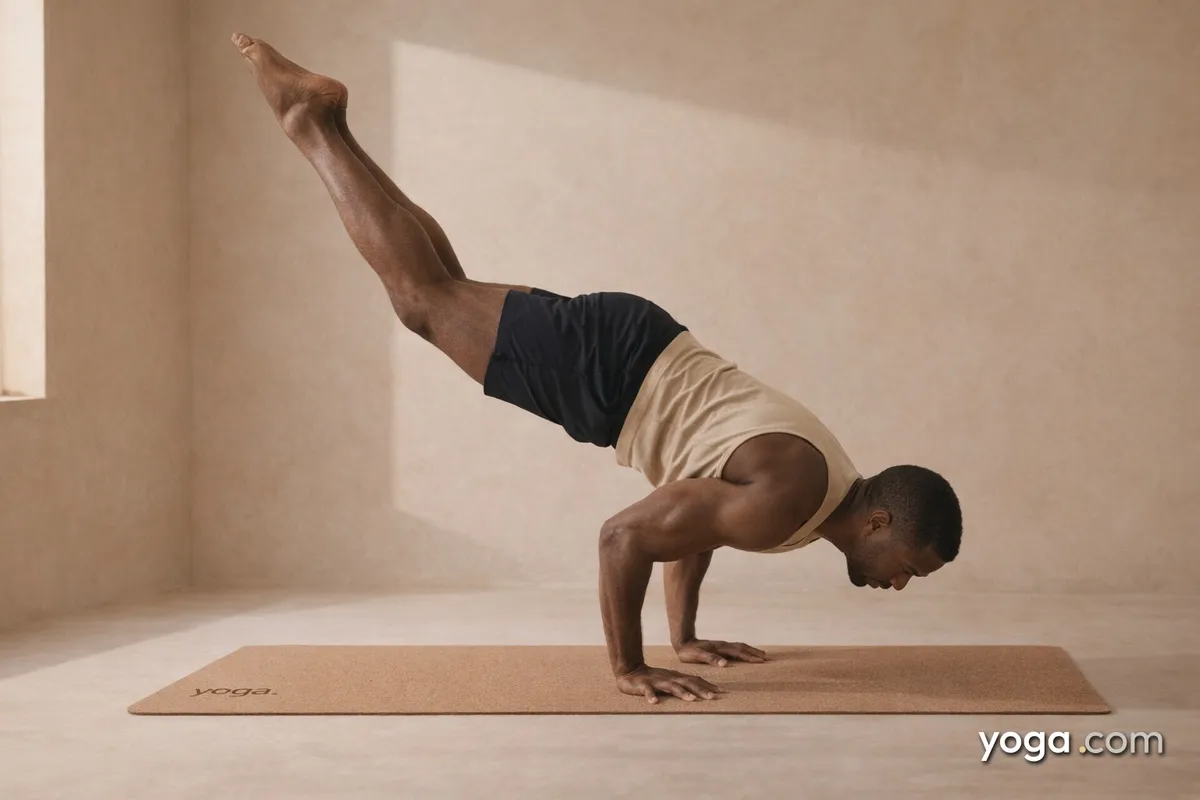
Crane Pose, Full Expression is a demanding arm balance that takes the classic Bakāsana (Crane Pose) - literally "crane pose" - to its most powerful expression. Where standard Crane keeps the knees bent on the triceps, this variation straightens both legs fully overhead, shifting the center of gravity and demanding far greater core compression and shoulder stability. It typically appears near the peak of a strong vinyasa or arm-balance-focused practice.
At a Glance
- Level: Advanced
- Type: Arm balance
- Targets: Wrists and forearms, core (transverse abdominis and hip flexors), shoulders and serratus anterior, spinal extensors
- Good for: Building shoulder girdle stability, strengthening wrist-bearing capacity, developing full-body tension and coordination
How to Do Crane Pose, Full Expression
- Begin in a squat with your feet together, hands planted shoulder-width apart on the mat, fingers spread wide and the index-finger knuckles pressing firmly down.
- Come into standard Crane Pose: bend the elbows directly back (not flared out), place the inner knees high on the backs of the upper arms, and lean forward until your feet lift - both feet together, gaze slightly forward.
- Establish this base fully: round the upper back, draw the navel firmly toward the spine, and hug the midline with your inner thighs to create one solid unit of the lower body.
- On an exhale, begin to straighten both legs simultaneously, pressing the feet upward and together. Keep the inner thighs squeezing and the hip creases pulling toward the chest - do not let the pelvis drop.
- As the legs extend, press even more strongly through the hands and protract the shoulder blades wide (serratus anterior fires here). The crown of the head pitches slightly down as the hips and legs rise.
- Hold for 3-5 breaths. Keep the breath steady; do not hold it. Gaze stays a few inches forward of the fingertips.
- To come out, bend the knees back onto the triceps and slowly lower the feet to the squat, or transition directly into Chaturanga by shooting the legs back on an exhale.
Benefits
- Strengthens the wrist flexors, forearm muscles, and surrounding connective tissue under loaded conditions.
- Develops serratus anterior engagement and shoulder-girdle protraction essential for stable arm balances.
- Builds deep hip-flexor and transverse-abdominis strength as the legs extend fully against gravity.
- Trains full-body neuromuscular coordination - integrating hands, core, and legs into a single line of tension.
- Improves proprioception and spatial awareness in an inverted orientation.
Common Mistakes and Alignment Cues
- Mistake: Elbows flare out to the sides. Cue: Keep the elbows stacked directly over the wrists and squeeze them toward each other as you press down.
- Mistake: Hips sag as the legs straighten. Cue: Pull the hip creases up and toward the chest the moment you begin to extend - think "hips higher than the heels."
- Mistake: Holding the breath and gripping the jaw. Cue: Exhale to initiate the leg extension and keep a soft face; breath suspension collapses core engagement.
- Mistake: Legs separate or turn out during extension. Cue: Press the inner edges of the feet together and firm the inner thighs before and throughout the extension.
- Mistake: Weight stays too far back, feet never fully lift. Cue: Lean the shoulders clearly past the wrist line - without that forward shift, the legs cannot become light.
Modifications and Props
- Block under the forehead: Place a block in front of your hands and rest your forehead on it as a psychological and physical anchor while you practice the leg-extension movement without fear of falling.
- Wall at the feet: Set up close to a wall and straighten the legs until the soles touch the wall. This lets you feel the full-leg extension without bearing 100 percent of the balance load.
- Build through Crane Pose first: Spend several breaths in standard Crane Pose each session before attempting the extension; the knees-on-arms version is the essential prerequisite.
- Strap around the upper arms: Loop a strap around the arms just above the elbow crease to prevent the elbows from splaying, freeing your attention for the leg work.
Cautions
- Wrist pain or recent wrist injury: The full weight of the body loads the wrists at a deep angle; avoid this pose if you have acute wrist, carpal tunnel, or forearm inflammation.
- Shoulder instability or rotator-cuff issues: Strong protraction is required; practice shoulder-stability work before attempting this variation.
- Pregnancy: Skip all full arm balances that compress the abdomen during pregnancy.
- Unresolved lower-back concerns: The spinal flexion combined with the load of extended legs places significant demand on the lumbar spine; approach only when the standard Crane is steady and pain-free.
- If you're working with an injury or a medical condition, check with a qualified professional before practicing.
Related Poses
- Crane Pose - the direct prerequisite; master the bent-knee version first.
- Easy Crow Pose - a gentler introduction to the arm-balance family that builds the wrist-loading and forward-lean mechanics.
- Four-Limbed Staff Pose - develops the elbow-over-wrist strength and serratus engagement this pose demands.
- Crane Pose with Head on the Mat - a related arm-balance variant that explores a different weight distribution from the same family.
Looking for context around your arm-balance practice? See A Gentle Yoga Routine for Tired, Low-Energy Days for when you need to dial things back, or A 10-Move Chair Yoga Sequence for a Midday Reset for an accessible midday option.