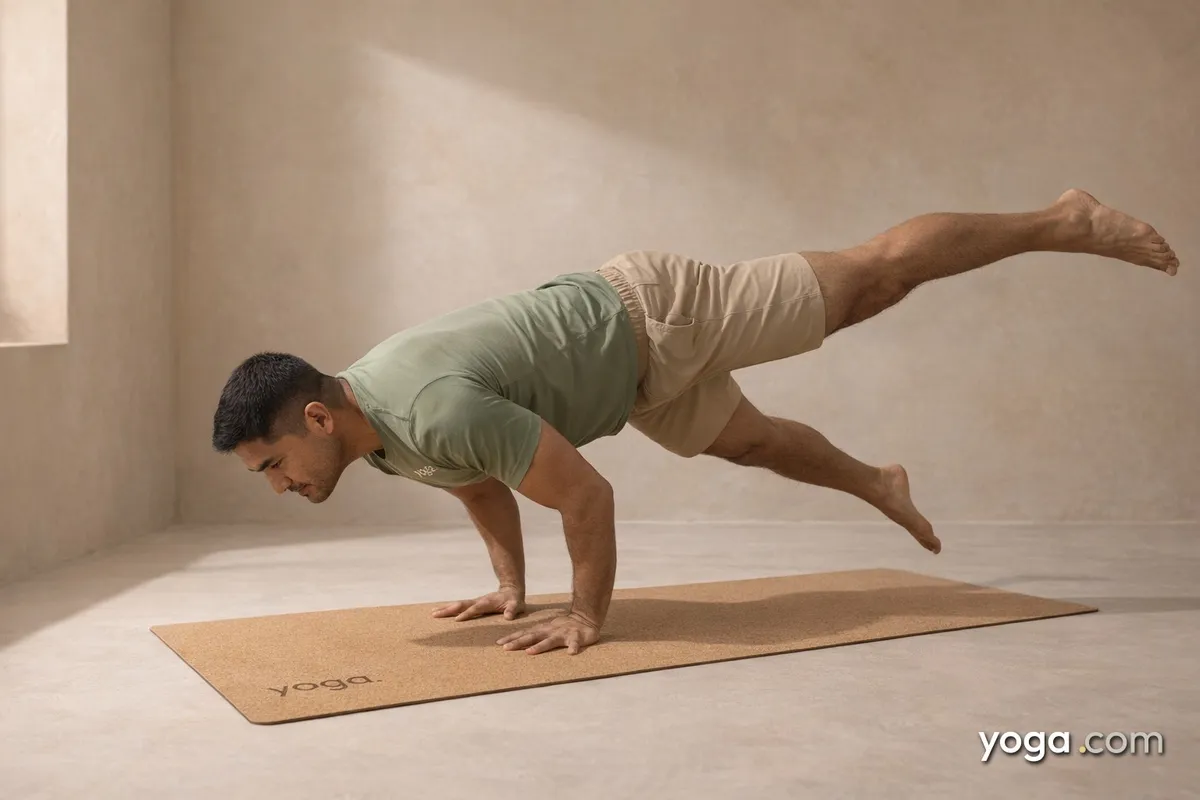
Crane Pose with Right Leg Extended Back - Eka Pāda Bakāsana, from the Sanskrit baka (crane) and āsana (seat or posture) - takes the classic arm balance one step further by extending the right leg straight back while the left knee remains hooked on its corresponding upper arm. The result is a long, asymmetrical line that demands precision from fingertip to heel.
At a Glance
- Level: Advanced
- Type: Arm Balance
- Targets: Left hip flexors, wrist and forearm flexors, serratus anterior, core (transverse abdominis, obliques), right glutes and hamstrings
- Good for: Wrist and shoulder strength, single-leg hip stability, core integration, proprioception
How to Do Crane Pose with Right Leg Extended Back
- Begin in a squat. Plant your palms shoulder-width apart, fingers spread wide, index fingers pointing straight forward. Bend your elbows to about 90 degrees, stacking forearms vertically over wrists.
- Hook both knees. Rise onto the balls of your feet and press both knees firmly into the backs of your upper arms, just above the elbows. This two-point contact is your starting shelf - feel the grip before you commit any weight.
- Shift forward. Lean your torso forward until your shoulders travel past your wrists. Keep pressing the floor away actively - protract the shoulder blades to dome the upper back.
- Lift both feet. Draw your navel toward your spine, squeeze your inner thighs against your arms, and float both feet off the floor. You are now in full Crane Pose. Breathe here for one or two cycles to find stability.
- Extend the right leg. From that stable base, begin to straighten the right leg back, reaching through the right heel. Engage your right glutes and hamstrings to hold the leg at hip height - these are the muscles doing the lifting and stabilizing work. The right hip flexors lengthen as the thigh moves into extension; let them release rather than grip.
- Maintain the left-knee shelf. The left knee stays hooked on the left upper arm throughout. Press that knee actively into the arm and simultaneously press the arm back into the knee - this reciprocal action stabilizes the pelvis and keeps your torso from tipping right.
- Hold and breathe. Gaze slightly forward, not straight down. Keep the core firm, the elbows hugging toward each other, and the extended right leg energized. Hold for 3-5 steady breaths.
- To exit: Bend the right knee and draw it back to your upper arm, returning to full Crane Pose. Lower both feet to the floor with control and rest in a squat or Child's Pose.
Benefits
- Builds wrist and forearm strength. Sustaining full bodyweight through the palms develops the flexor chain from fingertips to shoulder.
- Strengthens serratus anterior and shoulder girdle. Active protraction throughout the pose trains the serratus to stabilize the scapulae under load.
- Develops core integration. The obliques and transverse abdominis work continuously to prevent the torso from rotating toward the extended leg.
- Strengthens left hip flexors. Keeping the left knee hooked and drawn toward the chest shortens and loads the left iliopsoas under bodyweight, building functional hip-flexor strength.
- Strengthens right glutes and hamstrings. Holding the right leg at hip height in extension requires sustained posterior-chain engagement on that side.
- Trains proprioception and balance. The asymmetrical load challenges your nervous system to find a stable center constantly shifting between the two sides.
Common Mistakes and Alignment Cues
- Mistake: Dropping the head to look at the floor. Cue: Keep a soft forward gaze - let your chin move slightly away from your chest so the cervical spine stays neutral.
- Mistake: Collapsing the upper back (losing protraction). Cue: Push the floor away and round the thoracic spine upward. Think “ceiling with your mid-back” rather than sinking between the shoulders.
- Mistake: Letting the right hip drop as the leg extends. Cue: Squeeze the right glutes and drive through the right heel to keep the extended leg level with the pelvis.
- Mistake: Releasing the left-knee press when extending the right leg. Cue: The left knee hooks the left arm the entire time - that grip is your anchor. If it loosens, you lose the counter-balance.
- Mistake: Gripping the floor only with the fingertips or the heel of the hand. Cue: Spread all ten fingers and press evenly across the entire palm, emphasizing the index-finger mound to protect the wrists.
Modifications and Props
Place a folded blanket or block under your forehead as a spotter - knowing something is there lets you commit weight forward without fear of tipping. If the wrists are sensitive, perform the pose on fists (knuckles down) to reduce wrist extension. To build strength for extending the leg, practice holding full Crane Pose and simply lifting one foot slightly off the opposite shin before working toward full extension. A yoga block under the feet at the beginning of the squat gives extra height to the starting position, making the forward shift easier.
Cautions
Avoid or modify this pose if you have acute wrist, elbow, or shoulder injuries. Those with recent abdominal surgery or significant core weakness should establish a solid full Crane Pose before attempting the leg extension. Pregnancy is generally a contraindication for deep prone-pressure arm balances; consult a specialist. If you're working with an injury or a medical condition, check with a qualified professional before practicing.
Related Poses
- Easy Crow Pose - builds the foundational arm-balance mechanics before full hip extension is introduced.
- Crane Pose - the direct prerequisite; master symmetrical balance here first.
- Crane Pose with Head on the Mat - a supported variation that trains the same wrist and core load with less balance demand.
- Four-Limbed Staff Pose - develops the elbow-stack strength and scapular protraction essential for all crane variations.