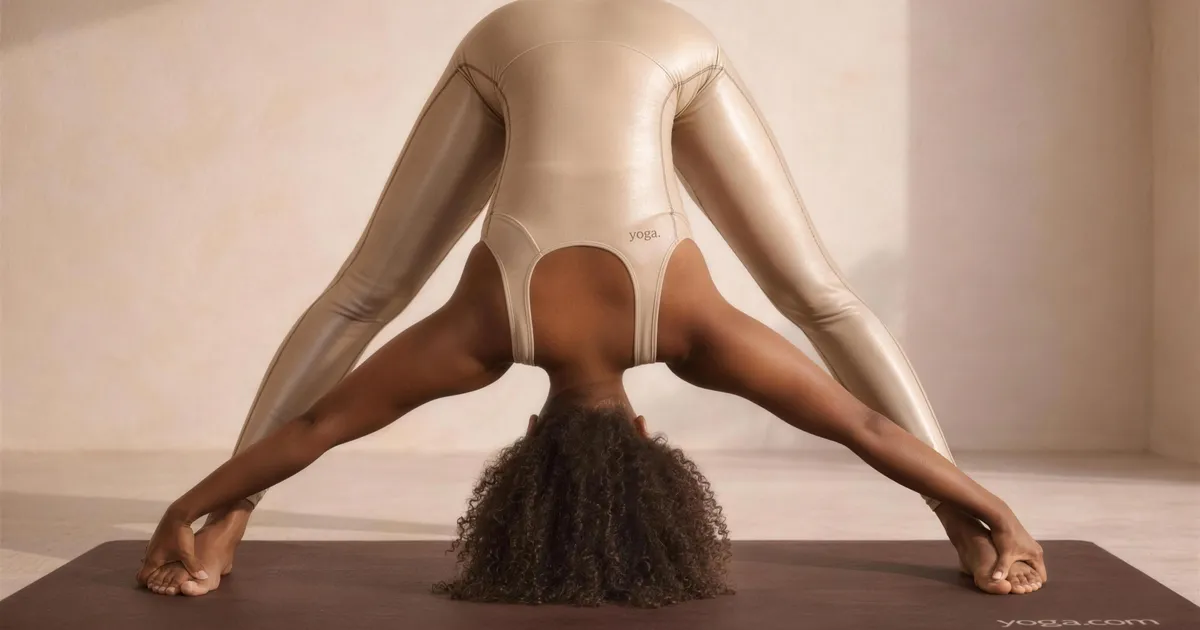
Wide-Legged Forward Bend with Feet Grab is a standing forward fold that takes you deeper into the hamstrings and inner groins by anchoring both hands to the outer edges of the feet. Its Sanskrit name, Prasārita Pādottānāsana (feet grab), translates roughly as "spread-foot intense stretch" - and gripping the feet adds traction that encourages the spine to lengthen more fully than the hands-on-floor variation. It fits naturally in the standing sequence of a Vinyasa or Ashtanga-inspired class, and works equally well as a transition between standing poses and floor work.
At a Glance
- Level: Intermediate
- Type: Forward Bend
- Targets: Hamstrings, inner groins (adductors), lumbar spine, upper back
- Good for: Lengthening the posterior chain, building spinal decompression under load, deepening hip-flexor mobility
How to Do Wide-Legged Forward Bend with Feet Grab
- Set your stance. From Mountain Pose, step your feet wide - roughly 3½ to 4½ feet apart, toes pointing forward or very slightly in. Press all four corners of each foot into the mat and engage your quadriceps to draw the kneecaps up.
- Establish a long spine. Place your hands on your hips, inhale, and lift the chest. Feel your side waist lengthen and your lower back broaden before you fold.
- Hinge forward. On an exhale, hinge at the hips - not the waist - keeping the spine long. Let your fingertips come to the floor directly below your shoulders. Take one breath here, chest reaching forward.
- Grab the feet. Walk your hands back and wrap the fingers around the outer edges of each foot - index and middle fingers hooking under the arch, thumbs resting on top. Keep your grip firm but your wrists relaxed.
- Deepen the fold. On each exhale, use the grip to gently draw your torso closer to the floor. Let the crown of your head release downward; if your flexibility allows, the top of your head moves toward or touches the mat between your feet. Keep both legs straight and strong.
- Hold and breathe. Stay 5-10 slow breaths. With each inhale, create space in the spine; with each exhale, invite a little more release in the hamstrings and groins without forcing.
- Come out with care. Release the feet, place your hands back on your hips, and on an inhale press through your feet to rise with a flat back - lead with the chest, not the head.
- Return to Mountain. Step or hop the feet together and take two grounding breaths before moving on.
Benefits
- Stretches the hamstrings and calves through a long, sustained lengthening under body weight.
- Opens the inner groins and adductors in the wide-stance position, which a narrower forward fold cannot reach as effectively.
- Encourages axial elongation of the lumbar and thoracic spine when traction through the foot grip is used skillfully.
- Builds eccentric strength in the spinal erectors and glutes as they control the descent and the return.
- Improves proprioception and balance by requiring stable, active feet while the upper body is inverted.
- Quiets the nervous system through sustained inversion and diaphragmatic breathing.
Common Mistakes and Alignment Cues
- Rounding from the lower back instead of hinging at the hips. Before you fold, find the anterior tilt of the pelvis - think "tailbone back" - so the fold initiates at the hip crease, not the lumbar spine.
- Letting the knees hyperextend. Microbend the knees slightly if you feel pressure behind the joint, then engage the quadriceps to straighten without locking.
- Collapsing the arches and rolling the feet out. Press the big-toe mounds firmly down; imagine the feet are rooting into the floor rather than splaying outward.
- Using arm strength to yank the torso down. The hands are levers for lengthening, not for pulling. Keep the shoulders away from the ears and let gravity and the breath do the work.
- Holding the breath. A gripped breath creates tension that works against the fold. Soften the jaw, keep the exhales long, and let the belly release toward the mat.
Modifications and Props
- Blocks under the hands: If reaching the feet compresses the spine or rounds the back severely, place two blocks on the floor and rest your hands there instead of grabbing the feet. Work the long-spine position first.
- Strap around the feet: Loop a strap around each foot at the arch so you can hold the strap ends without needing the full hamstring length to reach the feet directly.
- Narrower stance: Reduce the width of your stance by 6-12 inches if the inner groin stretch feels too intense or if your lower back rounds immediately upon folding.
- Wall support: Stand with your back a foot from a wall and let your tailbone rest lightly against it on the way down - this provides feedback to keep the pelvis from tucking under.
Cautions
- Hamstring injury: Avoid a deep fold if you have a recent hamstring tear or strain; stay in the halfway position with hands on blocks until the tissue has healed.
- Lower back conditions: If your lumbar spine rounds significantly or you feel compression or sharp sensation in the lower back, use blocks and focus on maintaining a neutral pelvis rather than chasing depth.
- High blood pressure or glaucoma: Use caution with full inversions; keep the head at or above hip level and come out slowly.
- Dizziness upon rising: Come up on an inhale, pause halfway with hands on hips, and wait for your blood pressure to equalize before standing fully upright.
If you're working with an injury or a medical condition, check with a qualified professional before practicing.
Related Poses
- Standing Forward Bend - a preparatory narrow-stance fold that warms the hamstrings before the wide-legged version.
- Wide-Angle Seated Forward Bend - the floor equivalent, targeting the same inner groins and hamstrings with the support of the ground.
- Downward-Facing Dog Pose - an accessible counter-pose that re-engages the shoulders and resets spinal length after the fold.
- Seated Forward Bend - a natural next step to carry hamstring length into a deeper, supported fold.
Looking to weave this pose into a sequence? See A Gentle Yoga Routine for Tired, Low-Energy Days or try the accessible standing work in A 10-Move Chair Yoga Sequence for a Midday Reset.