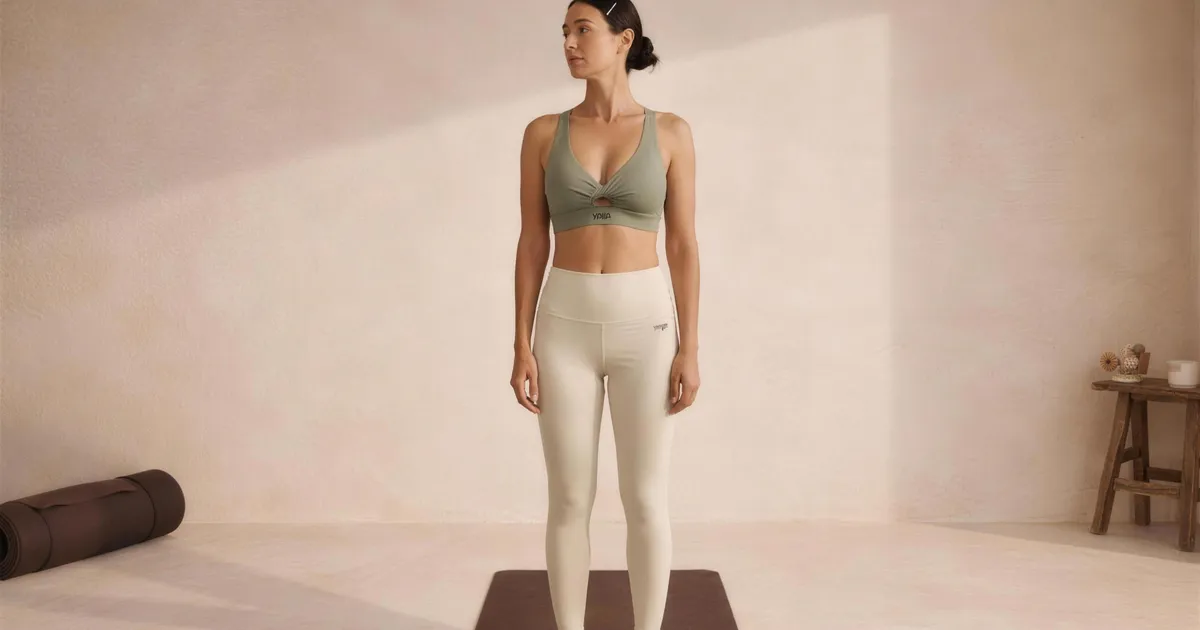
Mountain Pose (Tāḍāsana, from the Sanskrit tāḍa meaning "mountain" and āsana meaning "seat" or "posture") is the foundational standing pose of yoga. Though it looks like simply standing, it asks you to organize every part of the body with deliberate intention. You'll return to it between sequences, use it as a home base before stepping into other standing poses, and find that the alignment principles you establish here carry through your entire practice.
At a Glance
- Level: Beginner
- Type: Standing
- Targets: Feet and ankles, legs and quadriceps, core and spinal extensors, postural muscles of the upper back
- Good for: Building full-body postural awareness, developing balanced weight distribution through the feet, strengthening the muscles that support upright stance
How to Do Mountain Pose
- Stand with your feet together or hip-distance apart - together is traditional; hip-distance suits beginners or anyone with balance concerns. Let the outer edges of your feet run parallel.
- Press all four corners of each foot evenly into the floor: the base of the big toe, the base of the little toe, and both sides of the heel. Feel the arches lift gently without gripping the toes.
- Engage your quadriceps to lift the kneecaps, straightening the legs fully without locking or hyperextending the knees. Internally rotate the thighs slightly so the inner thighs draw back and apart.
- Bring the pelvis to neutral: neither tucking the tailbone under nor letting the lower back arch excessively. Gently draw the lower belly in and up to support the lumbar spine.
- Lengthen through the entire spine - imagine the crown of the head floating toward the ceiling. Let the shoulder blades slide down the back and broaden across the collarbones.
- Allow the arms to hang alongside the body, palms facing the outer thighs or turning forward for a more open chest position. Fingers are soft, not splayed or clenched.
- Set your gaze (drishti) softly at a fixed point at eye level. Breathe steadily for 5-10 full breaths, continually checking that you are not gripping anywhere.
- To come out, take one full breath in, then exhale and release any muscular engagement, returning to an easy, neutral stand - or step your feet apart to transition into your next pose.
Benefits
- Strengthens the intrinsic muscles of the feet, ankles, and arches, building a stable base for all standing poses.
- Activates and tones the quadriceps, hamstrings, and gluteal muscles in a weight-bearing position.
- Engages the spinal extensors and deep postural muscles along the back, reinforcing upright spinal alignment.
- Trains symmetrical weight distribution through both feet, highlighting and helping to correct habitual imbalances in standing posture.
- Develops body-awareness and proprioception from the ground up, which transfers directly to more complex standing and balancing poses.
- Encourages diaphragmatic breathing by opening the chest and releasing unnecessary tension across the shoulders and throat.
Common Mistakes and Alignment Cues
- Locking the knees: Hyperextending the knee joints compresses the joint surfaces. Keep a micro-bend available, and instead focus on firming the thighs rather than forcing the legs "back."
- Tucking the tailbone too aggressively: Over-tucking flattens the natural lumbar curve and strains the lower back. Find neutral pelvis - hip points and pubic bone level in the same vertical plane.
- Collapsing the arches: If the inner arches drop, lift from the inner ankles and spread the toes, pressing evenly through all four corners of the foot.
- Rounding or shrugging the shoulders: Draw the shoulder blades gently toward each other and down the back; then let the trapezius soften so the shoulders are neither pulled back rigidly nor creeping toward the ears.
- Shifting weight into the heels: Check that you can lightly lift and spread the toes - if you can't without wobbling, your weight is sitting too far back. Bring it slightly forward until the toes can lift freely.
Modifications and Props
- Wall for balance: Stand with your back heels, sacrum, shoulder blades, and the back of the head lightly touching a wall. Use the wall as feedback for spinal alignment without relying on it for support.
- Block between the thighs: Place a yoga block on its medium setting between the inner thighs and gently squeeze it. This activates the adductors, encourages neutral rotation of the femurs, and gives proprioceptive feedback for alignment.
- Feet hip-distance apart: If standing with feet together feels unstable or uncomfortable in the knees or hips, step the feet to hip-distance. This broadens your base of support without changing the essential alignment of the spine and upper body.
- Chair variation: Sit toward the front edge of a sturdy chair, feet flat and parallel on the floor. Apply the same cues for pelvis, spine, and shoulders in a seated mountain shape - useful when prolonged standing is not appropriate.
Cautions
- Headaches or dizziness: Standing still for extended periods with eyes focused at a fixed point can increase dizziness for some people. Practice near a wall and soften your gaze or close the eyes if needed.
- Low blood pressure: Prolonged stillness in standing may cause lightheadedness. Keep the session brief or move between poses rather than holding for long periods.
- Flat feet or plantar issues: If your arches have significantly collapsed, work with a prop (rolled mat edge under the inner arch) and avoid forcing an arch that is not yet available.
- Knee hyperextension: If your knees naturally press back past straight, maintain a very slight bend (micro-bend) throughout the pose to protect the joint. If you're working with an injury or a medical condition, check with a qualified professional before practicing.
Related Poses
- Mountain Pose with Upward Stretch - a direct progression that adds shoulder and lateral body opening from the same foundation.
- Chair Pose - builds on Mountain Pose alignment by adding a deep bend of the knees and hips, testing the same postural muscles under load.
- Warrior Pose with Right Leg Bent - takes the foot and leg alignment principles from Mountain Pose into a wide-stance lunge.
- Corpse Pose - the supine counterpart to Mountain Pose; use it at the end of practice to integrate everything established in standing.
Put Mountain Pose to work in a full sequence: A Gentle Yoga Routine for Tired, Low-Energy Days or try the seated version in A 10-Move Chair Yoga Sequence for a Midday Reset.