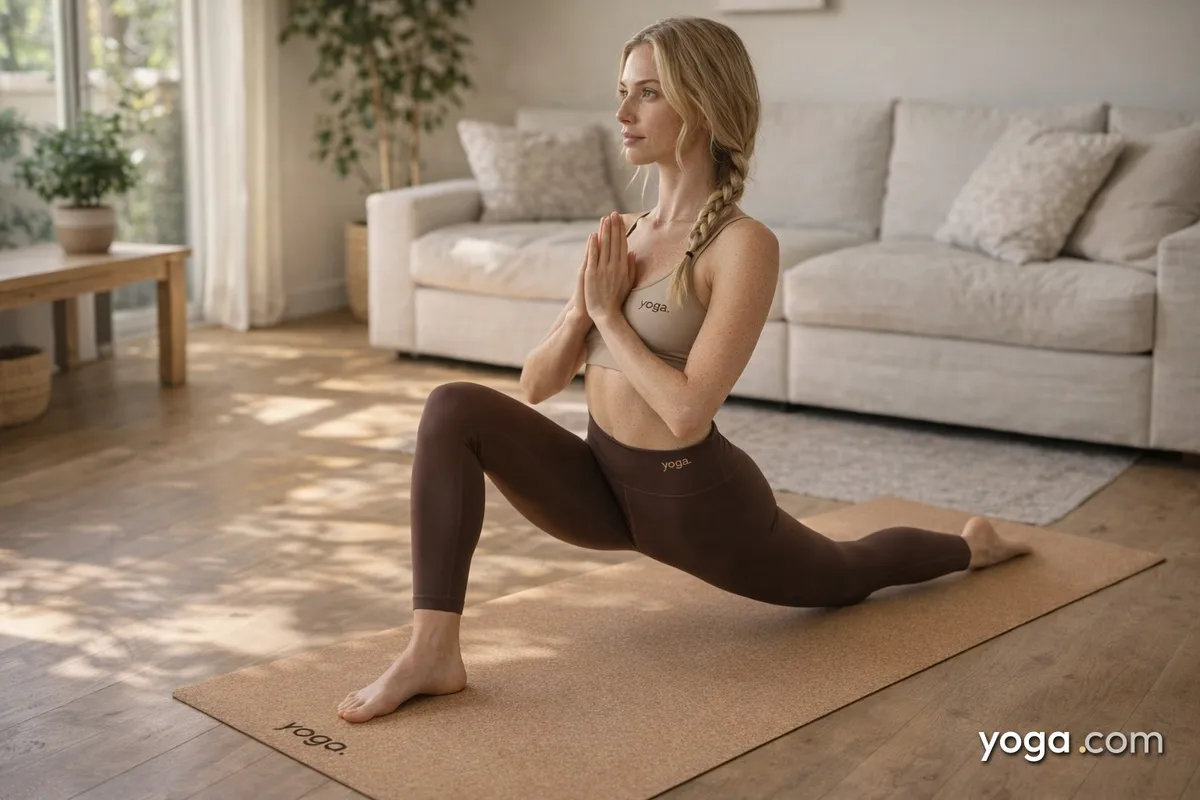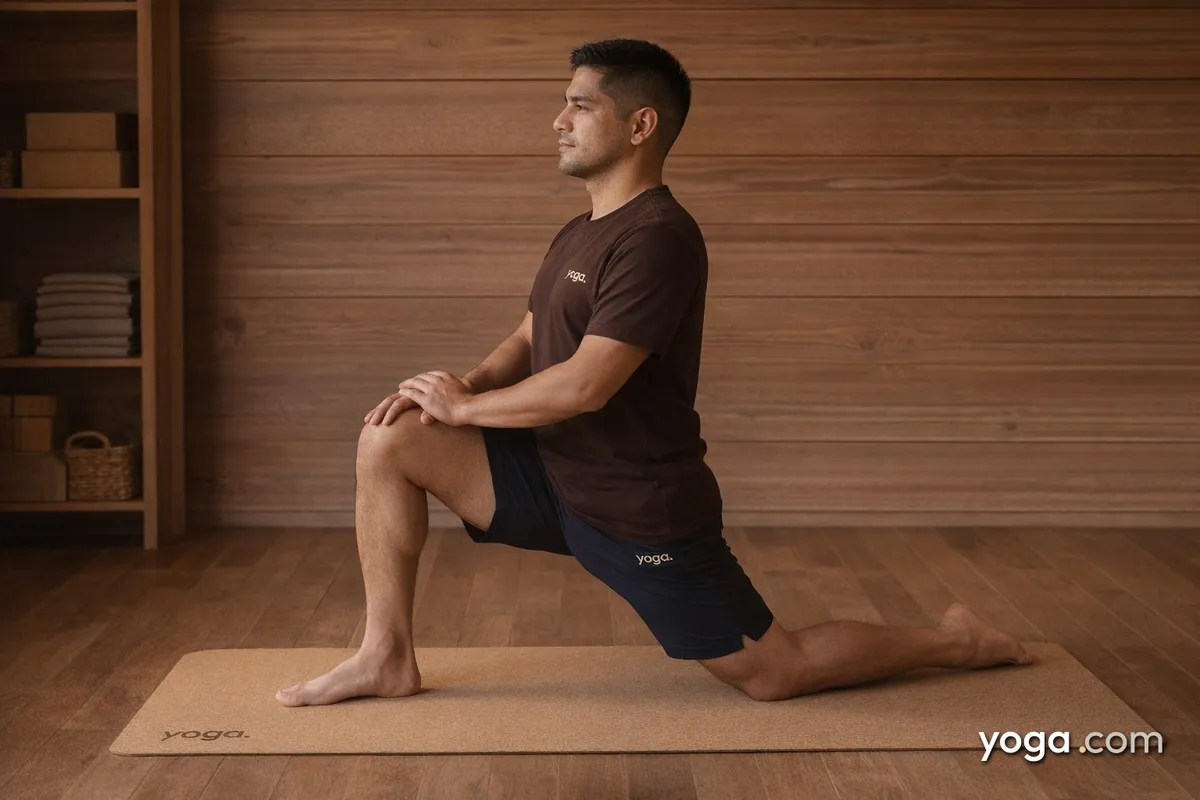
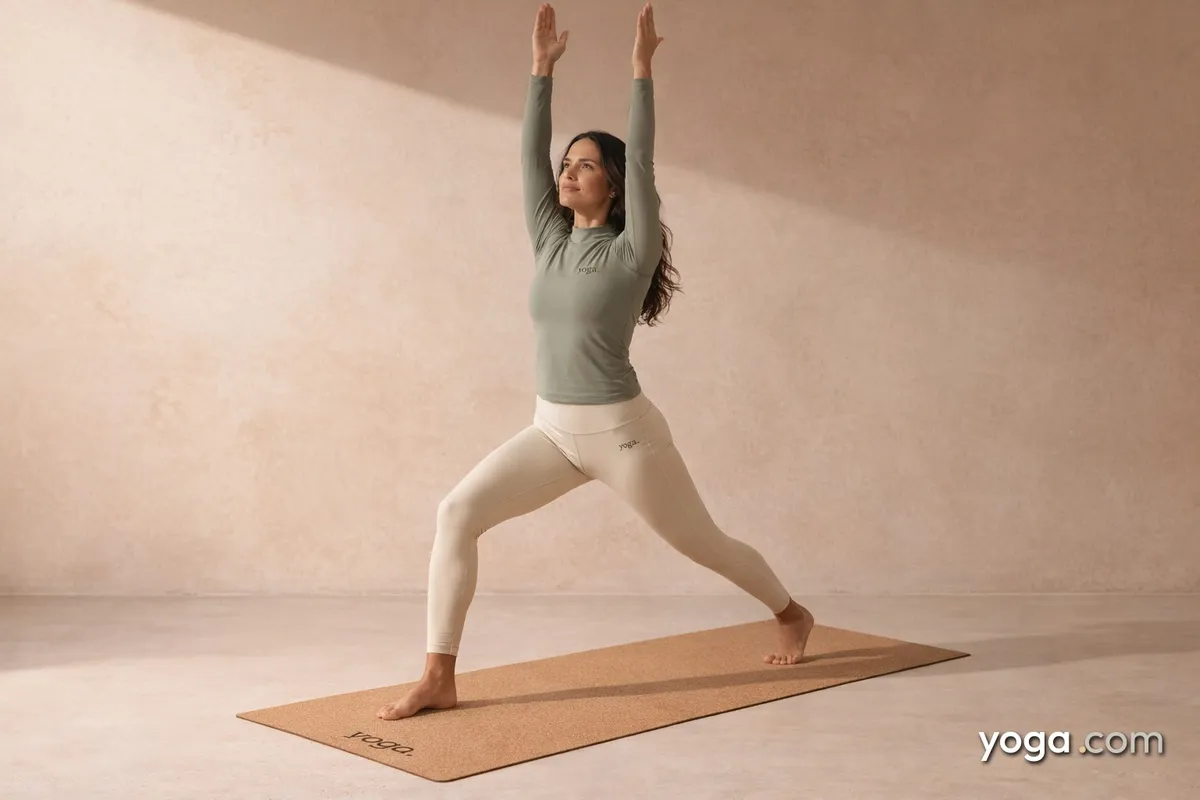
Warrior I with the right leg bent is a foundational standing pose that builds lower-body strength and opens the front of the hip and chest. Its Sanskrit name, Vīrabhadrāsana I (right leg bent), translates roughly as "the pose of the fierce warrior Vīrabhadra" - a figure from Hindu mythology - with this variation specifically placing the right foot forward and the right knee bent over the ankle. It appears early in standing sequences and serves as both a strength builder and a preparation for more demanding lunge-based postures.
At a Glance
- Level: Beginner
- Type: Standing
- Targets: Quadriceps, hip flexors, glutes, shoulders
- Good for: Building lower-body strength, improving hip extension range, developing shoulder and arm endurance
How to Do Warrior Pose with Right Leg Bent
- Start in Mountain Pose. Stand at the top of your mat with your feet together, arms at your sides, and your weight evenly distributed across both feet.
- Step your left foot back 3-4 feet. Turn the left foot out to roughly a 45-degree angle so the outer edge of the foot presses firmly into the mat. Both heels should be on the same line, or slightly wider apart if balance is challenging.
- Square your hips toward the front of the mat. Draw the left hip forward and the right hip back, working toward parallel alignment. Place your hands on your hips to check: both hip points face forward as much as possible.
- Bend the right knee. Track the knee directly over the second toe and aim to bring the right thigh parallel to the floor. Keep the right shin vertical - the knee should not travel past the ankle.
- Press through the outer left foot. Straighten and firm the left leg, pressing the back heel down so the leg acts as a stable anchor for the pose.
- Raise your arms overhead. Inhale and sweep both arms up alongside your ears, palms facing each other (or touching if your shoulders allow). Draw the shoulder blades down away from your ears and lengthen through the sides of the waist.
- Lift your gaze slightly upward - toward your thumbs or the ceiling - keeping the back of the neck long. Hold for 5-8 steady breaths.
- To come out, press firmly through both feet, straighten the right knee on an inhale, lower the arms to your sides, and step the left foot forward to return to Mountain Pose.
Benefits
- Strengthens the quadriceps, glutes, and hamstrings of the right (front) leg under load.
- Lengthens the hip flexors of the left (back) leg, particularly the psoas and rectus femoris.
- Builds endurance and stability in the muscles of the shoulder girdle and upper arms.
- Develops isometric strength in the core and spinal extensors, which work to keep the torso upright.
- Improves balance and proprioception through the coordination demanded of the back foot and ankle.
Common Mistakes and Alignment Cues
- Mistake: The front knee collapses inward. Cue: Gently press the right knee out toward the little-toe side of the foot so it tracks over the second and third toes.
- Mistake: The back heel lifts off the mat. Cue: Shorten your stance slightly and actively root through the outer edge of the left foot; think of pressing the heel into the floor as you lengthen the back leg.
- Mistake: The lower back compresses or arches sharply. Cue: Tuck the tailbone very slightly and draw the lower ribs in; this lengthens the lumbar spine rather than crunching it.
- Mistake: The shoulders ride up toward the ears. Cue: On each exhale, slide the shoulder blades down the back; let the neck stay long as the arms reach upward.
- Mistake: The torso leans forward over the front thigh. Cue: Stack the shoulders directly over the hips; keep the chest lifted and the spine vertical.
Modifications and Props
- Shorten the stance: If the back heel does not reach the floor, step the feet closer together until the heel grounds fully. This reduces the demand on the left hip flexors and Achilles tendon.
- Use the wall for balance: Place fingertips lightly on a wall at your side while you establish foot and hip alignment, then try lifting the hands overhead once you feel steady.
- Blocks under the hands: If raising both arms overhead creates significant shoulder tension, hold a block in each hand with arms slightly in front of the body, reducing the overhead shoulder range required.
- Chair under the front thigh: Rest the front thigh on the seat of a chair placed lengthwise to support the bent-knee position; this is helpful if the quadriceps fatigue quickly or balance is a concern.
Cautions
- Knee concerns: If you have acute knee pain or recent knee surgery, avoid deep bending of the front knee. Keep the knee bend shallow and emphasize alignment over depth.
- Hip or groin tightness: Forcing the hips to square when the hip flexors are very tight can strain the groin. Shorten the stance and allow a small hip turn until flexibility develops over time.
- Shoulder or neck issues: If overhead arm positioning causes pain or pinching, keep the arms at shoulder height with the elbows bent, or hold hands at the heart center instead.
- High blood pressure or balance challenges: Avoid holding the pose for extended periods; shorten the hold and come out sooner if you feel light-headed or unsteady.
If you're working with an injury or a medical condition, check with a qualified professional before practicing.
Related Poses
- Mountain Pose - the starting point for this pose; establishes grounding and upright alignment.
- Mountain Pose with Upward Stretch - prepares the arms and shoulders for the overhead position.
- Warrior Pose with Right Leg Forward, Left Leg Straight - the closely related Warrior II variation; a natural companion and contrast pose.
- Chair Pose - shares the deep front-knee bend and upright torso, making it an excellent complementary strength pose.
Put this pose to work in a full practice: see A Gentle Yoga Routine for Tired, Low-Energy Days or try the accessible seated version of similar standing shapes in A 10-Move Chair Yoga Sequence for a Midday Reset.