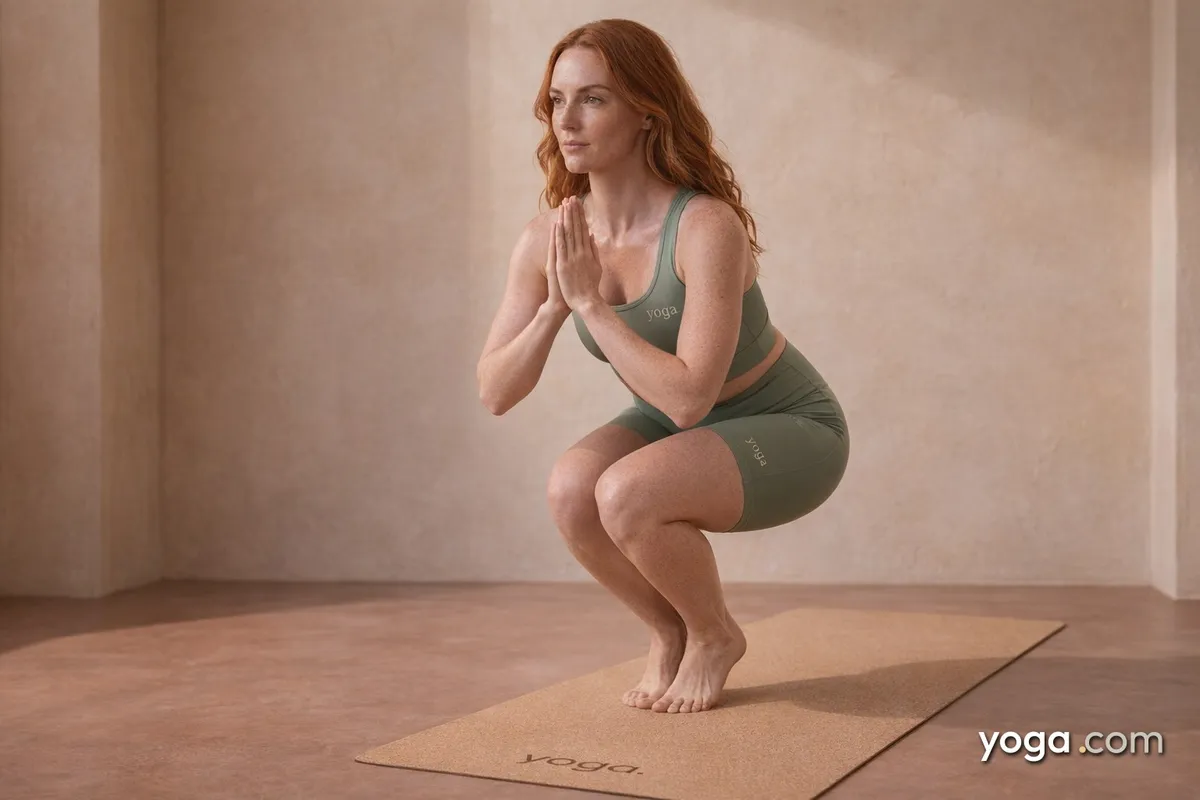
Chair Pose on Toes with Knees Together is a demanding standing balance that layers two refinements onto the classic squat shape: rising onto the balls of the feet and drawing the knees into a single, tightly stacked line. Its Sanskrit name is Utkaṭāsana (on toes, knees together) - utkaṭa meaning "fierce" or "powerful" - and the variation earns that word. You'll find it at home in standing sequences and balance-focused flows, often placed after the grounded version of the pose to intensify the work.
At a Glance
- Level: Intermediate
- Type: Standing / Balance
- Targets: Ankles, calves and Achilles tendon, quadriceps, core
- Good for: Building lower-leg strength, improving ankle stability, sharpening single-point balance focus
How to Do Chair Pose on Toes with Knees Together
- Start in Mountain Pose. Stand with your feet together - big toes touching, heels lightly apart. Ground through all four corners of each foot and lengthen your spine.
- Raise your arms. On an inhale, sweep both arms overhead, palms facing each other and shoulders drawing away from your ears. This is your entry into the classic Chair shape.
- Bend your knees. Exhale and sit your hips back and down as you would in standard Utkatasana. Keep your knees pressing firmly together - inner thighs active - and your chest lifting forward and up so the torso forms a roughly 45-degree angle with the floor.
- Rise onto the balls of your feet. On your next inhale, press firmly through the mounds of all ten toes and lift both heels simultaneously. Move smoothly; avoid letting the knees splay apart as the heels leave the floor.
- Refine the alignment. Stack your hips directly over the balls of your feet, knees pressed together and tracking straight forward. Pull your low belly gently in and up to stabilize the lumbar spine. Keep your gaze fixed on a still point at eye level.
- Hold and breathe. Stay for 5-10 steady breaths, continuing to reach the crown of the head up while the hips resist sinking. If balance wavers, micro-bend the toes into the mat for grip.
- Come out with control. To exit, lower your heels back to the floor on an exhale, returning briefly to grounded Utkatasana. Then inhale to straighten the legs fully, returning to Mountain Pose with the arms lowering to your sides.
Benefits
- Strengthens the quadriceps, gluteus medius, and hip flexors under increased load.
- Builds calf and soleus strength while lengthening the Achilles tendon under load.
- Trains ankle proprioception and improves dynamic ankle stability.
- Engages the deep core stabilizers (transverse abdominis) to maintain an upright torso on a narrow base.
- Develops inner-thigh (adductor) activation by demanding that the knees stay pressed together throughout.
- Sharpens concentration and single-point gaze (drishti) as the reduced base of support demands heightened neuromuscular attention.
Common Mistakes and Alignment Cues
- Knees drifting apart as the heels lift: Press the inner knees firmly toward each other before and throughout the heel raise - think of squeezing a block between your thighs.
- Heels rising unevenly: Lift both heels at the same moment and to the same height; check that the weight distributes evenly across the knuckles of all ten toes.
- Chest collapsing forward: Keep drawing the sternum up and forward; let the arms reach actively overhead rather than allowing them to drift in front of the face.
- Lower back overarching: Tail slightly tucked - not aggressively, but enough to keep the lumbar long; engage the low belly to support the spine.
- Gaze wandering: Fix your drishti on a single, unmoving point at eye level before you lift the heels; a moving gaze is usually what tips the balance first.
Modifications and Props
- Wall support: Stand with your back a few inches from a wall. Rise onto the toes and, if balance falters, allow the fingertips to lightly touch the wall - then work toward removing that support breath by breath.
- Block between the thighs: Place a yoga block (narrow edge) between your upper thighs. Squeezing it gives tactile feedback for the knees-together action and activates the adductors more deliberately.
- Heel raise only (no squat): If the full combination is too challenging, practice rising onto the toes in Mountain Pose first to build ankle strength, then gradually add the bent-knee position.
- Partial heel lift: Raise the heels just an inch or two off the floor rather than fully onto the toe mounds, building strength incrementally before going to the full height.
Cautions
- Ankle instability or recent ankle sprain: The narrow, raised base significantly increases demand on the ankle joint; approach with care and use wall support.
- Knee pain or recent knee injury: Deep flexion combined with a compressed, knees-together position can load the joint unevenly - work shallower or skip the variation until strength is established.
- Achilles tendon issues: Rising onto the toes under load places direct stress on the Achilles; avoid forcing the heel height if you feel sharp tension.
- Balance disorders or inner-ear conditions: Practice near a wall or with a spotter to reduce fall risk.
- If you're working with an injury or a medical condition, check with a qualified professional before practicing.
Related Poses
- Chair Pose - the foundational version; master this first before adding the toe balance.
- Mountain Pose - the starting and ending position; use it to reset alignment between attempts.
- Mountain Pose with Upward Stretch - practice the arm position and shoulder mechanics here before combining with the squat.
- Child's Pose - a restful counter-pose to release the ankles, knees, and lower back after intense standing work.
Build a broader context around this pose in A Gentle Yoga Routine for Tired, Low-Energy Days or explore seated balance work in A 10-Move Chair Yoga Sequence for a Midday Reset.