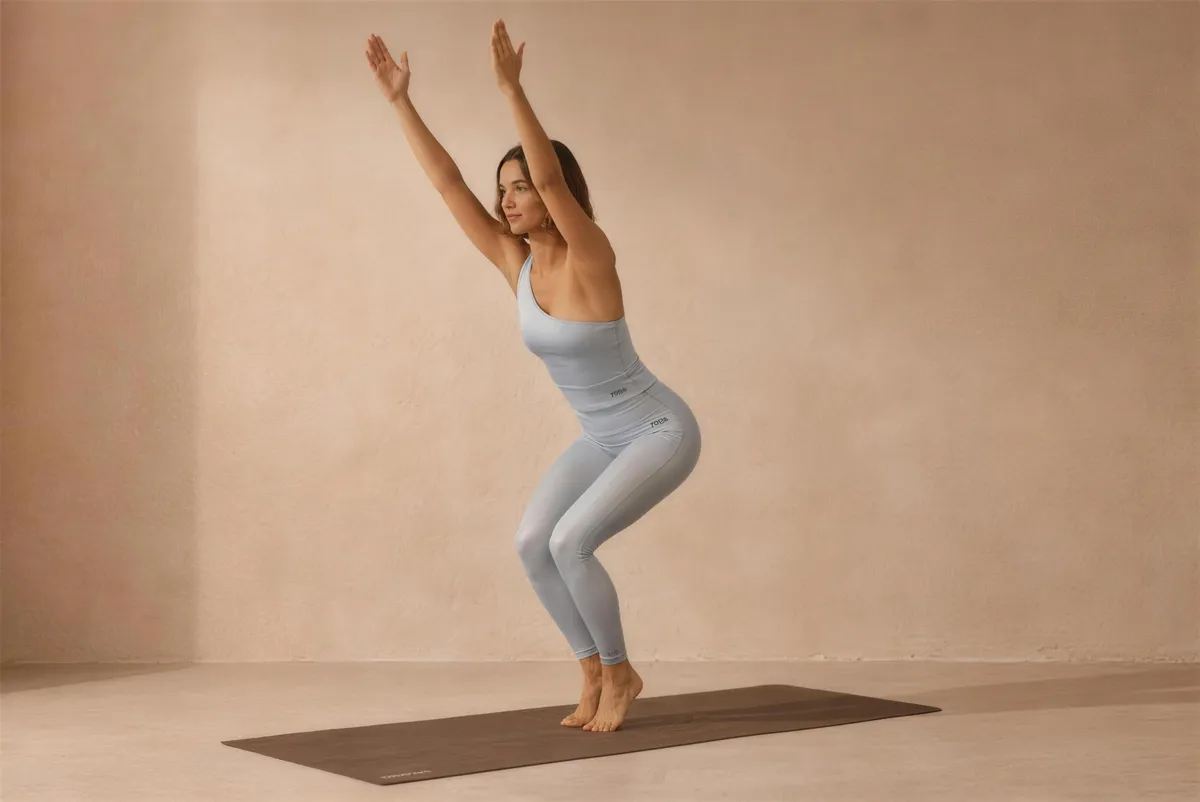
Chair Pose on Toes - Utkaṭāsana, Sanskrit for fierce or powerful pose, practiced here with heels lifted - takes the grounding challenge of a standard squat and layers in the precision and balance demands of rising onto the balls of the feet. The result is a full-chain conversation between your ankles, thighs, and core that asks every stabilizer to show up at once.
At a Glance
- Level: Intermediate
- Type: Standing
- Targets: Quadriceps, glutes, calves, Achilles tendon, intrinsic foot muscles, core
- Good for: Ankle stability, lower-body strength, balance, postural awareness
How to Do Chair Pose on Toes
- Begin in Mountain Pose, feet hip-width apart or big toes touching. Root through all four corners of each foot and lengthen your spine tall.
- Inhale and raise your arms overhead, palms facing each other or touching. Draw your shoulder blades down your back so your ears stay clear of your shoulders.
- Exhale and bend your knees, sending your hips back and down as you would in standard Chair Pose. Aim to bring your thighs as parallel to the floor as your mobility allows.
- On your next exhale, press firmly through the balls of all ten toes and lift your heels off the mat. Rise until you are balanced on the pads of your feet. Keep the heels level with each other.
- Actively draw your inner thighs toward each other - engage inward - to stabilize the knees and prevent them from splaying wide.
- Knit your lower ribs in, tuck your tailbone slightly, and lengthen through the crown of your head. Your torso should stay as upright as possible rather than pitching far forward.
- Fix your gaze on a single point (drishti) at eye level or just below to support balance. Hold for 5-10 steady breaths.
- To exit: Lower your heels to the mat with control, then straighten your legs and return to Mountain Pose on an inhale. Release your arms on an exhale.
Benefits
- Loads and strengthens the Achilles tendon and calf complex. Sustaining the heel-raised position under load builds tensile capacity through the gastrocnemius, soleus, and Achilles.
- Builds quadriceps and glute endurance. Holding a deep knee bend isometrically challenges the entire anterior and posterior thigh chain.
- Trains ankle stability. Balancing on the metatarsal heads requires constant micro-adjustment from the peroneals and tibialis anterior, developing proprioceptive responsiveness at the ankle joint.
- Strengthens the intrinsic foot muscles. Active toe spreading and weight-bearing through the forefoot recruits the small muscles that support the arch.
- Develops core and spinal stability. Keeping the torso upright against the forward pull of the low squat demands sustained engagement of the deep abdominals and erector spinae.
- Improves postural body awareness. The pose gives immediate feedback - any collapse in the ankles, knees, or spine is felt at once, making it an efficient teacher of whole-body alignment.
Common Mistakes and Alignment Cues
- Mistake: Knees drift wide as heels lift. Cue: Actively engage your inner thighs inward the moment you rise onto the balls of your feet. The knees should track directly over your second and third toes.
- Mistake: Heels are uneven - one higher than the other. Cue: Before lifting, press both feet evenly into the floor; as you rise, match the height of both heels precisely and hold that symmetry.
- Mistake: Excessive forward lean collapses the chest toward the thighs. Cue: Lift your chest and draw the lower ribs in. Think of lengthening your spine diagonally upward, not folding over your legs.
- Mistake: Gaze wanders, causing balance to break. Cue: Choose a fixed point at or just below eye level before you lift your heels, and keep it throughout the hold.
- Mistake: Arms creep forward instead of staying overhead. Cue: Externally rotate your upper arms slightly, spread your fingers, and reach through the fingertips while keeping the shoulder blades anchored down.
Modifications and Props
- Hands on a wall: Place fingertips lightly on a wall in front of you to practice the heel lift without the balance challenge. Gradually reduce contact as confidence grows.
- Chair back for support: Hold the top rail of a sturdy chair to work on depth and heel height independently.
- Reduce the knee bend: If the ankles or knees feel strained, keep the squat shallower - a smaller bend is still effective and lets you focus on the heel-rise mechanics.
- Block between thighs: Place a block lightly between your mid-thighs and squeeze inward to reinforce adductor engagement and knee alignment before adding the heel lift.
Cautions
- Avoid this variation if you have an acute ankle sprain, Achilles tendon irritation, or recent knee injury.
- People with balance challenges or inner-ear conditions should practice near a wall.
- If you experience sharp pain in the knees, ankles, or feet during the pose, come out immediately.
- If you're working with an injury or a medical condition, check with a qualified professional before practicing.