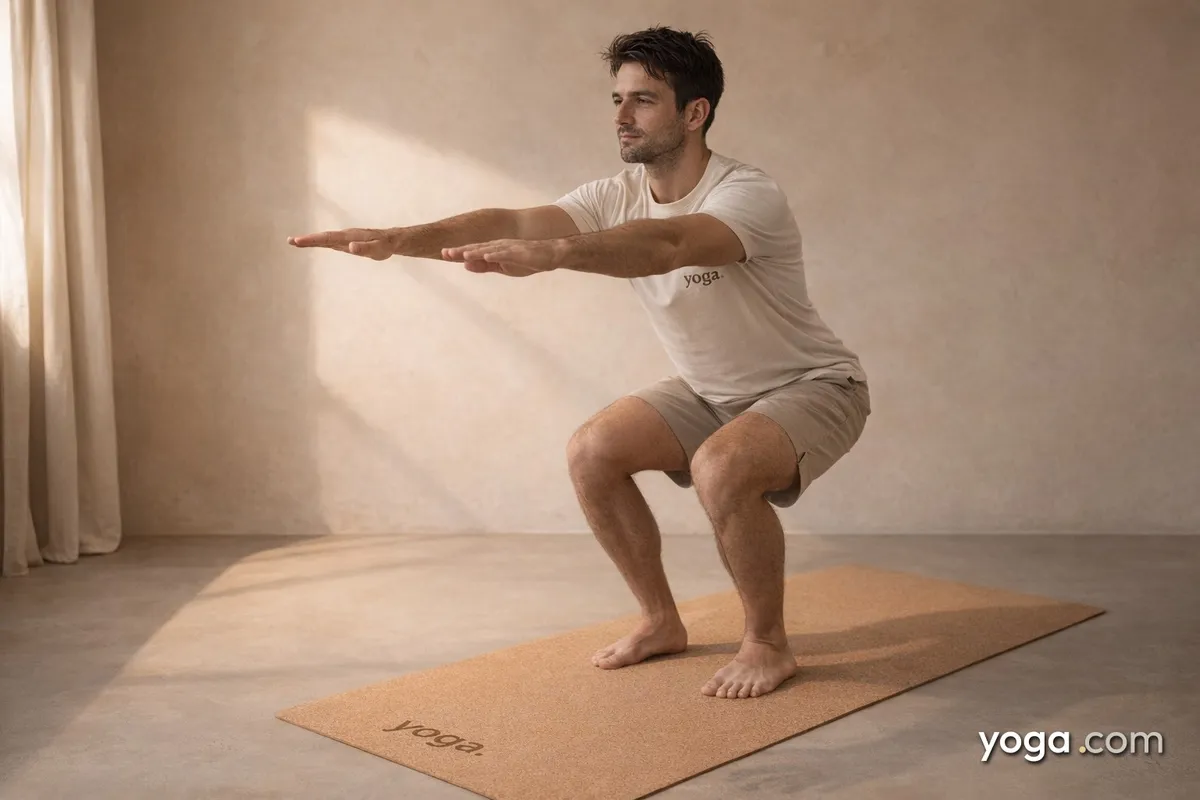
Chair Pose with Straight Arms Forward is a standing strength pose in which you sink into a deep squat position while reaching both arms parallel to the floor, palms facing down. Its Sanskrit name is Utkaṭāsana (arms forward) - utkaṭa meaning "fierce" or "powerful" and āsana meaning "seat" - reflecting the muscular demand the shape places on the lower body. This variation appears frequently as a warm-up, a transition between standing sequences, or a building block toward deeper squat and balance work.
At a Glance
- Level: Beginner
- Type: Standing
- Targets: Quadriceps, glutes, core, shoulder girdle
- Good for: Building lower-body strength, developing postural awareness, warming up the hips and thoracic spine
How to Do Chair Pose with Straight Arms Forward
- Stand in Mountain Pose, feet together or hip-width apart, arms at your sides. Root evenly through all four corners of both feet.
- Inhale and draw the lower belly gently inward, lengthening through the crown of the head.
- Exhale and bend both knees, lowering your hips as though sitting back onto the edge of a chair. Aim to bring your thighs toward parallel with the floor - go only as deep as you can without your heels lifting.
- On your next inhale, reach both arms straight forward at shoulder height, palms facing down and fingers actively spread. Keep the arms parallel to the floor and in line with your shoulders.
- Press the heads of the upper arms outward slightly to broaden the collarbones and keep the shoulders away from the ears.
- Shift a little weight back into your heels, stack your knees over your second toes, and draw the inner thighs toward each other without letting the knees splay or pinch inward.
- Gaze forward or slightly down at a fixed point on the floor a few feet ahead of you. Hold for 5-10 steady breaths.
- To come out: inhale, straighten the legs, and lower the arms back to your sides, returning to Mountain Pose.
Benefits
- Strengthens the quadriceps, hamstrings, and glutes through an extended isometric hold.
- Engages the transverse abdominis and erector spinae, building core stability under load.
- Builds endurance in the shoulder flexors and the muscles that stabilize the scapulae.
- Stretches the Achilles tendons and calf muscles when the heels are pressed firmly into the ground.
- Trains proprioception and ankle stability required for more advanced standing balances.
- Warms the hip flexors and thoracic extensors, preparing the spine for deeper backbends or twists.
Common Mistakes and Alignment Cues
- Heels rising off the floor: Reduce the depth of your squat until the heels stay grounded; place a folded blanket under the heels if needed.
- Knees collapsing inward: Press a block between the inner thighs to activate the adductors and keep the knees tracking over the second toe.
- Lower back rounding excessively: Tilt the pelvis slightly toward neutral - imagine a small tail-tuck rather than a full tuck - and lift the lower ribs away from the hip points.
- Shoulders creeping toward ears: Actively slide the shoulder blades down the back and reach fingertips forward with intention; think "long arms, low shoulders."
- Weight shifting into the toes: Visualize pressing the floor away with your heels and feel your sitting bones descending back and down while your heels stay firmly weighted.
Modifications and Props
- Wall support: Stand about two feet from a wall and let the tailbone lightly touch the wall as you lower. This gives feedback on pelvic position and reduces knee strain.
- Block between thighs: Squeeze a block between the inner thighs throughout the hold to switch on the adductors and stabilize the knee alignment.
- Blanket under heels: Roll a blanket or place a wedge under the heels if tight calves cause the heels to lift, allowing you to work the pose safely while flexibility develops.
- Reduced depth: A shallower bend - thighs at 45 degrees rather than parallel - carries the same alignment principles with less demand; build depth gradually over multiple sessions.
Cautions
- Approach carefully if you have acute knee pain or recent knee injuries; reduce depth and avoid any sharp sensation in the joint.
- Low-back discomfort can flare when the lumbar rounds under load - prioritize a neutral spine over depth in the squat.
- Those with ankle instability should keep the feet hip-width apart and consider the wall variation for additional support.
- If shoulder impingement or rotator-cuff issues are present, lower the arms to a comfortable angle rather than forcing them to shoulder height.
If you're working with an injury or a medical condition, check with a qualified professional before practicing.
Related Poses
- Mountain Pose - the foundation and entry/exit point for this pose.
- Chair Pose - the classic arms-overhead variation; practice both to compare upper-body demand.
- Mountain Pose with Upward Stretch - warms the shoulder flexors before moving into the squat shape.
- Warrior Pose with Right Leg Bent - shares the deep knee bend and lower-body strength focus as a natural progression.
Put this pose to work in a sequence: A Gentle Yoga Routine for Tired, Low-Energy Days or explore seated adaptations in A 10-Move Chair Yoga Sequence for a Midday Reset.