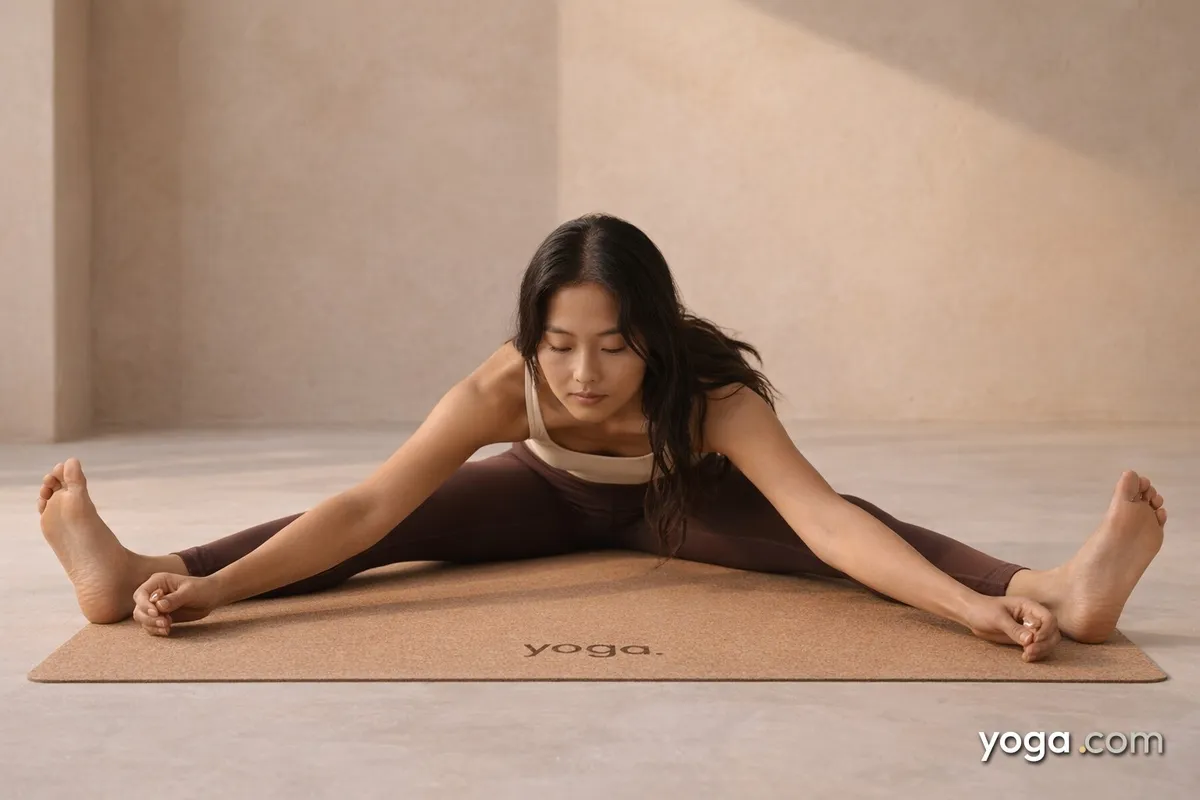
Wide-Angle Seated Forward Bend is a seated forward fold performed with both legs spread wide apart, asking the hamstrings, inner thighs, and lower back to lengthen simultaneously. Its Sanskrit name, Upaviṣṭa Koṇāsana, translates roughly as "seated angle pose" - upaviṣṭa meaning seated, koṇa meaning angle. It typically appears in the seated sequence of a practice, after the hips and hamstrings are already warm.
At a Glance
- Level: Intermediate
- Type: Forward Bend
- Targets: Hamstrings, inner thighs (adductors), lower back, hip flexors
- Good for: Lengthening the posterior chain, building hip mobility, strengthening spinal extensors under load
How to Do Wide-Angle Seated Forward Bend
- Sit on the floor with your legs extended straight in front of you in Staff Pose. Root both sitting bones evenly into the mat.
- Open your legs out to the sides as wide as feels sustainable - roughly a 90-to-120-degree angle to start. Flex your feet firmly so the toes point straight up toward the ceiling; press out through all ten toes.
- Place your hands on the floor between your legs, fingers pointing forward. On an inhale, lengthen your spine - lift the crown of your head, draw the lower belly gently in, and sit as tall as possible.
- On an exhale, begin to walk your hands forward along the floor, hinging at the hips rather than rounding the lower back. Keep the chest broad and the collarbones wide.
- Continue folding forward, maintaining length through the spine. Bring your forearms to the floor if that is available; if the torso reaches the mat, extend your arms forward or out toward each foot.
- Keep both legs active throughout - quadriceps engaged, kneecaps drawing up, feet flexed. Avoid letting the inner thighs roll upward; rotate them gently toward the floor.
- Hold for 5-10 slow breaths, allowing the fold to deepen with each exhale without forcing it.
- To come out, walk your hands back toward your hips on an inhale, pressing down to lift the torso upright. Draw the legs together slowly and return to Staff Pose.
Benefits
- Stretches the hamstrings and calf muscles along the entire back of both legs.
- Lengthens the adductor group (inner thigh muscles) through a wide range of hip abduction.
- Mobilizes the hip joints, encouraging greater range in external rotation and abduction over time.
- Strengthens the spinal extensors as they work eccentrically to control the forward fold.
- Stretches the lower back muscles and the thoracolumbar fascia.
- Builds body awareness of the pelvis, teaching you to distinguish a hip hinge from spinal flexion.
Common Mistakes and Alignment Cues
- Rounding the lower back immediately: Before folding, sit on the edge of a folded blanket to tilt the pelvis forward. Lead with the sternum, not the forehead.
- Letting the feet collapse inward: Keep the feet actively flexed and the inner ankles stacked above the floor. This also protects the knee joints.
- Forcing the legs wider than the hamstrings allow: A smaller angle with a long spine is more effective than a wide angle with a rounded back. Work at the edge where length is still possible.
- Collapsing the inner thighs toward the ceiling: Rotate the thighs inward slightly so the backs of the knees press toward the floor, keeping the adductors in productive stretch.
- Holding the breath: Use each exhale to soften and release; gripping the breath will create tension in the very muscles you are trying to lengthen.
Modifications and Props
- Blanket under the sitting bones: If the pelvis tips backward and the lower back rounds heavily, sit on one or two folded blankets to restore a natural lumbar curve.
- Strap around each foot: Loop a yoga strap around one or both feet and hold the ends in your hands. This lets you maintain spinal length without straining to reach the floor.
- Hands on blocks: Place a block in front of you to rest your hands or forearms on. This raises the floor to meet you so you can keep the spine long throughout the fold.
- Wall support: Sit with your back against a wall to learn the leg and foot positioning before adding the forward fold, or place your feet against the wall to keep the legs active.
Cautions
- Hamstring or groin strain: Avoid sharp or pulling sensations at the sitting bones or inner thigh. Reduce the leg spread and keep the fold shallow until tissue integrity is restored.
- Lower back pain or disc issues: Work with a raised pelvis (blanket) and prioritize spinal length over depth. Stop if you feel compression or sharp sensation in the lumbar spine.
- Knee discomfort: Ensure feet are actively flexed and knees are not hyperextended. A small roll under each knee can help if the backs of the knees feel strained.
- Recent hip or groin surgery: This pose places significant demand on the adductors and hip joint; hold until you have clearance from your care team.
If you're working with an injury or a medical condition, check with a qualified professional before practicing.
Related Poses
- Seated Forward Bend - a direct preparation that teaches the hip-hinge mechanics you need here.
- Bend to Left Leg - works one side of the wide-angle shape at a time, useful for addressing asymmetry.
- Both Big Toes Pose - a reclined or supine variation that allows deeper hamstring work with less demand on balance.
- Bridge Pose - a natural counter-pose that opens the hip flexors and restores the lumbar curve after an extended forward fold.
For accessible practice sequences where seated forward bends fit well, see A Gentle Yoga Routine for Tired, Low-Energy Days and A 10-Move Chair Yoga Sequence for a Midday Reset.