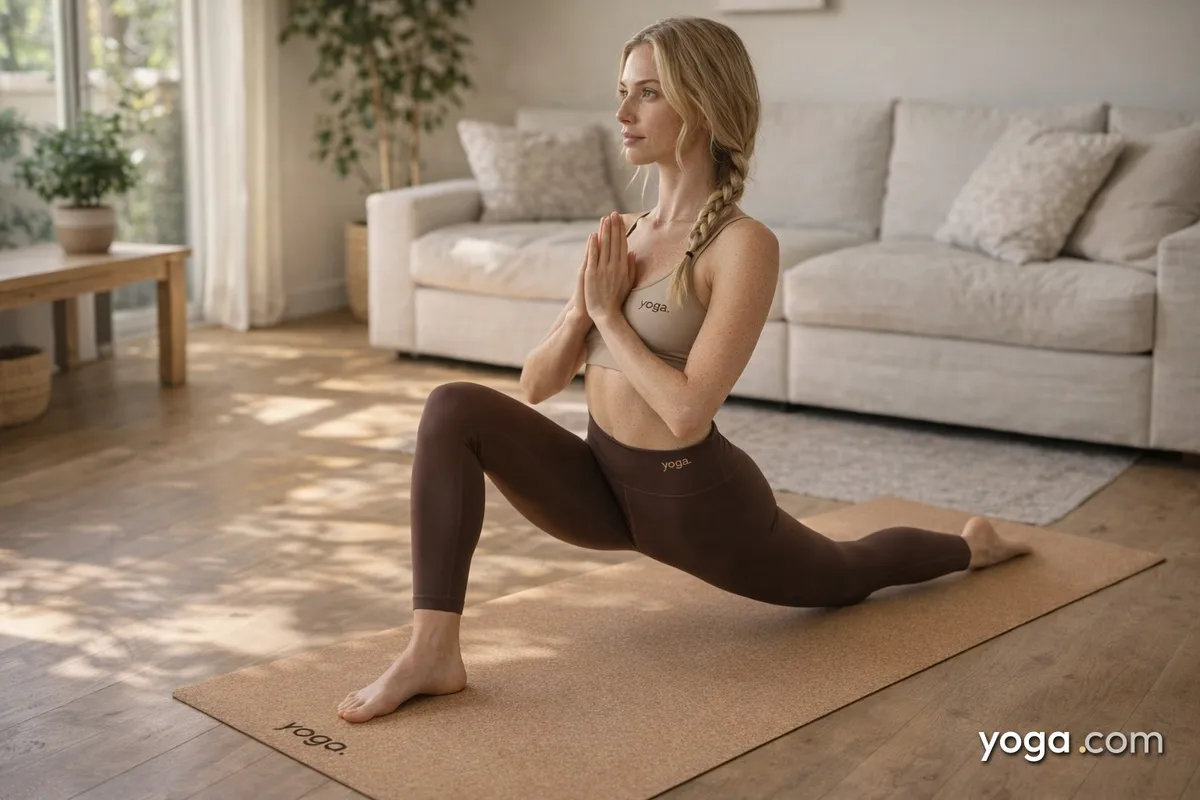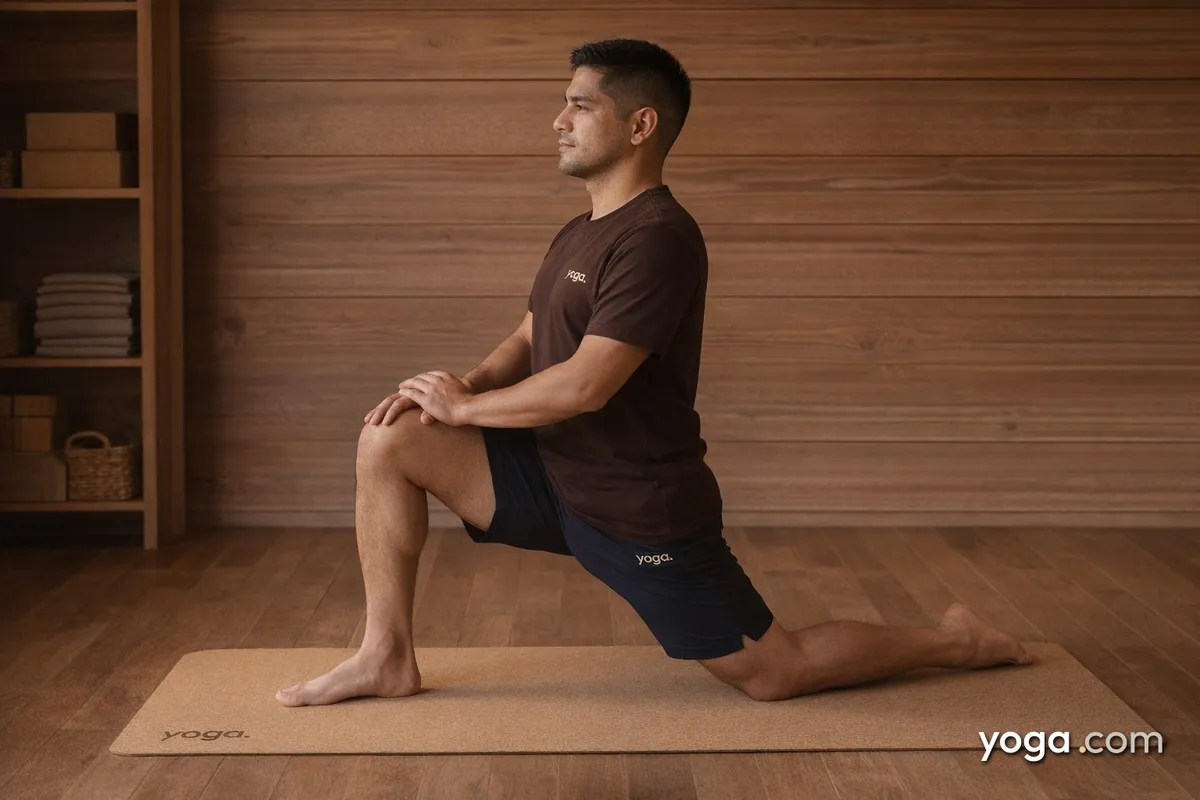
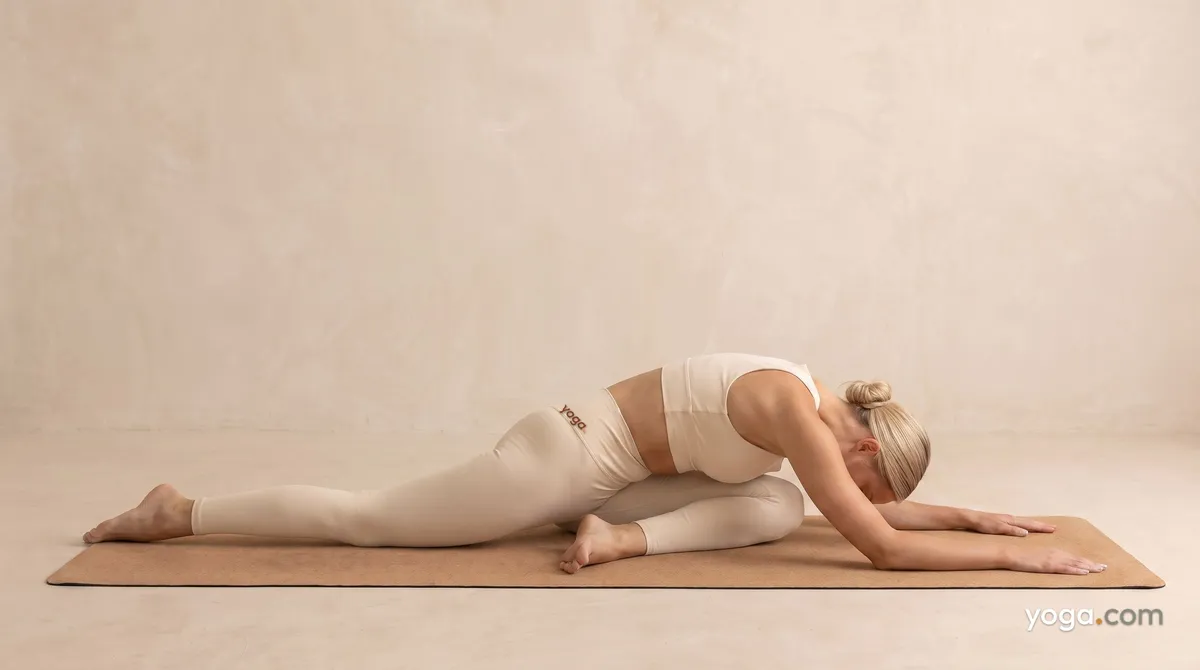
Pigeon Pose with Head Down on Left Foot is a deep, floor-based forward bend that combines the hip-opening geometry of a classic pigeon setup with a full forward fold, resting the forehead on or near the left foot. Its Sanskrit name, Eka Pāda Rājākapotāsana (left, head down), translates roughly as "one-legged royal pigeon pose," and this variation belongs to the more inward, surrendered end of that lineage. You'll typically encounter it toward the middle or close of a practice, after the hips, spine, and hamstrings are well warmed.
At a Glance
- Level: Intermediate
- Type: Forward bend
- Targets: Left hip external rotators, right hip flexors and quadriceps, hamstrings of the left leg, lower back extensors
- Good for: Deepening hip range of motion, lengthening the spine through forward flexion, building patience and breath awareness in a sustained hold
How to Do Pigeon Pose with Head Down on Left Foot
- Begin in Downward-Facing Dog. Lift your left leg, bend the knee, and sweep it forward, placing the left shin on the mat so the outer left hip rests down - left knee points roughly toward the left wrist, left foot toward the right hip. Extend the right leg straight back, top of the right foot on the mat.
- Square your hips toward the front of the mat as much as your range allows. Press both hip points gently forward and down; if the left hip floats, slide a folded blanket or block beneath it.
- Walk both hands forward on either side of the left shin, elongating the torso. Take a breath in to create length from the tailbone through the crown of the head.
- On an exhale, begin to fold forward over the left shin, lowering the torso toward the floor. Let the elbows bend and the forearms rest on the mat.
- Continue folding until the forehead can rest on or very close to the left foot - or on stacked fists or a block if that is where your spine naturally arrives without rounding sharply from the lower back.
- Extend the arms forward or let them rest alongside the body, whichever allows your shoulders to release away from your ears. Soften the jaw and breathe steadily for 5-10 breaths.
- To come out: Press the palms into the mat, inhale, and lift the torso upright. Walk the hands back under the shoulders.
- Tuck the right toes, press into both palms, and step back to Downward-Facing Dog before switching sides.
Benefits
- Stretches the external rotators of the left hip, including the piriformis and deep lateral rotator group.
- Lengthens the hip flexors and quadriceps of the right (extended) leg.
- Increases forward-flexion range in the lumbar and thoracic spine under load.
- Strengthens the spinal extensors isometrically as they work to control the descent into the fold.
- Encourages diaphragmatic breathing under mild compression, improving breath capacity awareness.
- Builds sustained proprioceptive awareness of hip alignment across an asymmetrical base.
Common Mistakes and Alignment Cues
- Mistake: Left hip hiking off the mat. Cue: Place a folded blanket or block under the left sit bone so the pelvis is supported evenly; you shouldn't have to muscle the hip down.
- Mistake: Collapsing onto the left knee with the foot tucked under the hip. Cue: Position the left foot further from the right hip - even if only a few centimetres - to reduce torque through the knee joint and direct the load into the hip.
- Mistake: Rounding sharply at the lower back to reach the head to the foot. Cue: Prioritise a long spine over reaching the forehead down; use a block under the forehead if needed and let the fold deepen gradually over time.
- Mistake: Right leg rotating outward so the knee falls to the side. Cue: Spin the right inner thigh toward the ceiling to keep the leg in neutral; the top of the right foot should press evenly into the mat.
- Mistake: Holding the breath as you fold deeper. Cue: Match movement to exhales; each inhale should create slight length, each exhale invites a small release rather than a forced push.
Modifications and Props
- Blanket under the left hip: If the left hip doesn't reach the mat, place a folded blanket or block underneath it. This is often essential rather than optional for practitioners with tighter external rotators.
- Block under the forehead: If the head doesn't reach the foot without rounding dramatically in the lower back, rest the forehead on a block at whatever height allows you to maintain spinal length.
- Hands on the mat rather than extended: Keep the forearms on the mat with elbows bent for more support through the upper body, especially if the lower back feels compressed.
- Reclined pigeon as a preparation: If kneeling creates knee discomfort, practise the supine figure-four stretch (lying on your back, left ankle crossed over right thigh) to access a similar hip-opening action without floor pressure on the knee.
Cautions
- Knee discomfort: Any sharp or pinching sensation in the left knee means you should back the left foot further from the hip or choose the reclined variation instead.
- Sacroiliac joint sensitivity: Asymmetric hip positions can aggravate the SI joint; proceed slowly, keep both sides of the pelvis as level as possible, and come out if you feel one-sided sacral pain.
- Recent hip or groin injury: Avoid deep external rotation loading until cleared to do so; the reclined variation offers a gentler starting point.
- Lower back concerns: Keep the fold partial and use props so the lumbar spine does not bear excessive rounding force.
- If you're working with an injury or a medical condition, check with a qualified professional before practicing.
Related Poses
- Downward-Facing Dog Pose - the standard entry and exit point for this pose; builds shoulder and hamstring readiness.
- Bend to Left Leg - a seated preparation that introduces forward folding over the left leg with a similar hip angle.
- Seated Forward Bend - develops the spinal lengthening and hamstring flexibility needed to fold fully in pigeon.
- Left Half Bound Lotus Intense Stretch Pose - a natural progression that adds a bound arm variation to a comparable left-hip external-rotation setup.
For a slower-paced context where hip-opening holds like this one feel at home, see A Gentle Yoga Routine for Tired, Low-Energy Days. If you prefer a shorter, more accessible seated practice, explore A 10-Move Chair Yoga Sequence for a Midday Reset.