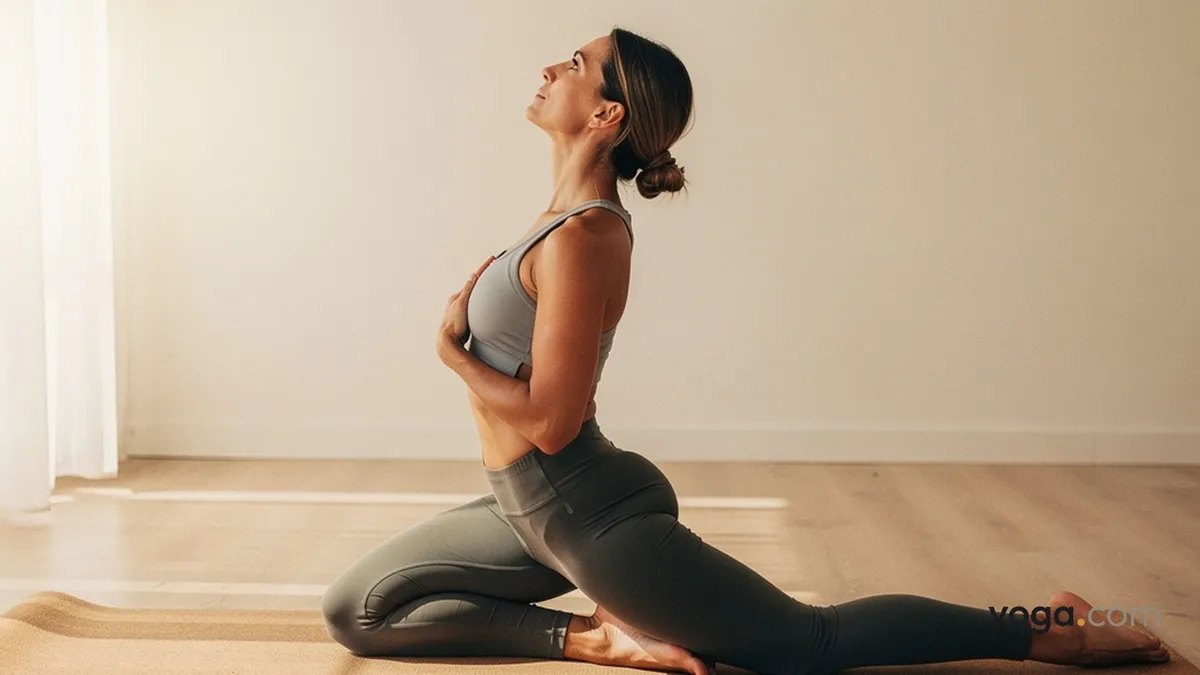
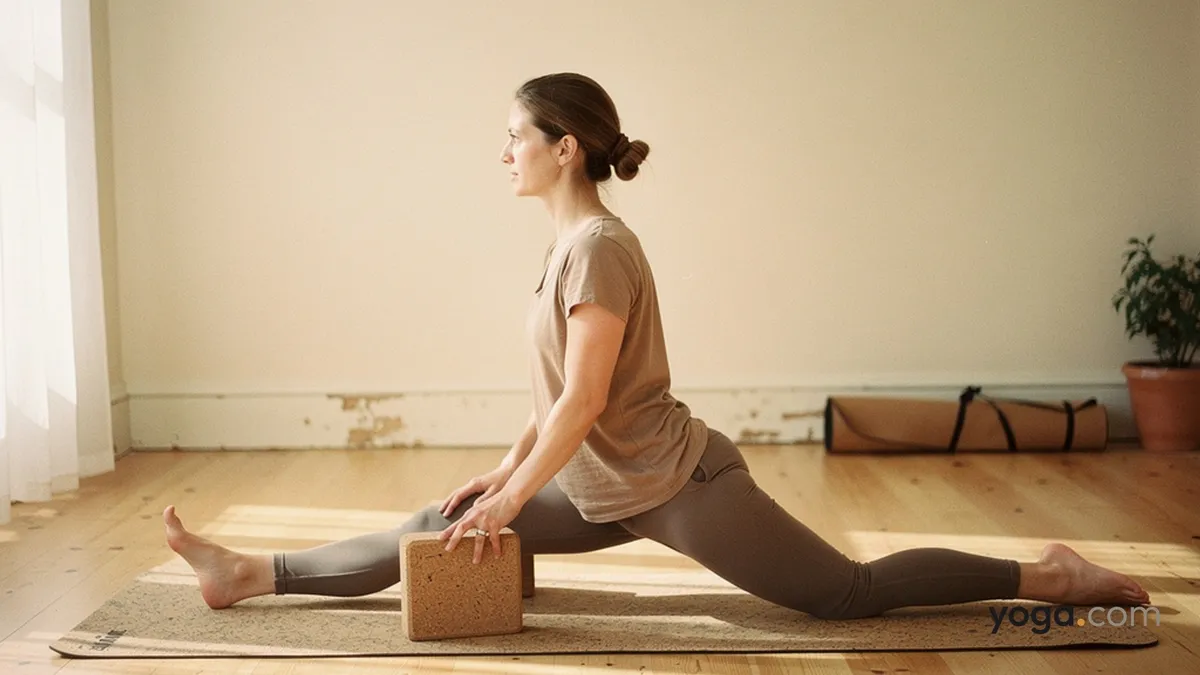
Pigeon Pose on Right Foot, Head Up is a deep backbend that begins from a low lunge or tabletop base, with the right shin drawn forward across the mat and the torso rising tall rather than folding down. Its Sanskrit name, Kapotāsana (right foot, head up), translates loosely as "pigeon pose" — kapota meaning pigeon or dove, referencing the proud, chest-lifted silhouette the shape creates. Practiced with the gaze and crown lifted, this variation belongs in the heart-opening arc of an intermediate backbend sequence, typically after the spine and hip flexors are well warmed.
At a Glance
Level: IntermediateType: BackbendTargets: Hip flexors (left side), hip external rotators (right side), thoracic spine, chest and anterior shouldersGood for: Building spinal extension, lengthening the front of the hip on the back leg, developing postural awareness in the upper backHow to Do Pigeon Pose on Right Foot, Head Up
Begin in a tabletop position. Bring your right knee forward toward your right wrist and guide your right foot forward — the closer the right shin runs parallel to the front of the mat, the more intense the hip opening; new students can keep the foot closer to the left hip.Slide the left leg straight back along the mat, top of the left foot pressing down. Square your hip points forward as much as your flexibility allows, using a folded blanket under the right outer hip if it lifts off the mat.Place your fingertips on the mat on either side of your right shin. On an inhale, press down through both hands and lengthen the spine upward, lifting the crown of the head toward the ceiling.Draw the low belly gently in and up to support the lumbar spine. Avoid dumping into the lower back — think length before depth.On the next inhale, begin to lift the chest and draw the shoulder blades toward each other and down. Let the gaze rise to a comfortable point at the horizon or slightly above — this is the "head up" expression of the pose.If the thoracic spine is mobile and the shoulders are open, you may bring the hands to the top of the left thigh or draw them together at the sternum in a chest-opening clasp, continuing to breathe into the front of the body for 5–10 breaths.To come out, place the hands back on the mat, tuck the left toes, and press up to Downward-Facing Dog. Shake the hips gently to neutralize, then repeat on the left side before continuing your sequence.Benefits
Stretches the right hip's external rotators, including the piriformis and deep lateral rotators.Lengthens the left hip flexors and the front of the left thigh (rectus femoris and iliopsoas).Strengthens the spinal extensors engaged to hold the upright backbend position.Opens the pectorals and anterior deltoids as the chest broadens and lifts.Develops active thoracic extension, counteracting rounded-upper-back posture patterns built from prolonged sitting.Builds body awareness and breath capacity in a demanding asymmetrical shape.Common Mistakes and Alignment Cues
Mistake: Hip lifts and tilts to the right. Cue: Place a folded blanket or block under the right outer hip so both hip points can level and point forward.Mistake: Collapsing into the lower back. Cue: Engage the lower belly, lengthen the tailbone toward the left heel, and prioritize a long spine over a deep arch.Mistake: Shoulders creeping up to the ears. Cue: Actively slide the shoulder blades down the back and widen the collarbones before lifting the gaze.Mistake: Left knee rolling outward. Cue: Press the top of the left foot evenly into the mat and draw the inner left thigh toward the ceiling to keep the leg aligned.Mistake: Holding the breath as the backbend deepens. Cue: Soften the jaw, and let each inhale lift the sternum a little higher; exhale without releasing the length you've found.Modifications and Props
Blanket under the right hip: If the right hip floats off the mat, slide a folded blanket beneath it to create a stable, level foundation and reduce strain on the right knee.Hands on a block: Place two blocks at their tallest height on either side of the shin to bring the floor closer to you, making it easier to maintain an upright torso without straining the wrists or shoulders.Hands on the thigh: Instead of reaching up or clasping the hands, rest the palms on the top of the left thigh. This gives the upper body something to press against, encouraging the chest to open more safely.Reclined figure-four stretch: If the knee is sensitive or the hip is very tight, practice Reclined Figure-Four (Supta Kapotasana) on your back as a preparatory alternative that removes the weight-bearing element entirely.Cautions
Knee discomfort: Any sharp or pinching sensation in the right knee is a signal to reduce the angle of the shin or elevate the right hip with a prop. The knee should never be the site of intensity in this pose.Sacroiliac joint sensitivity: The strong asymmetry of this pose can stress the SI joint. Keep both hip points squaring forward and avoid forcing the range of motion.Lower back compression: Approach this backbend carefully if you have disc issues or lumbar sensitivity; favor length over depth and keep the core gently engaged throughout.Neck tension: If lifting the gaze strains the cervical spine, keep the chin parallel to the mat and the neck long rather than cranking the head back.If you're working with an injury or a medical condition, check with a qualified professional before practicing.
Related Poses
Cobra Pose — a foundational backbend that warms up the spinal extensors before deeper work.Upward-Facing Dog Pose — builds the chest-lift and anterior-shoulder opening needed here.Camel Pose with Palms Set Against Feet — a kneeling backbend that develops similar thoracic extension as a next progression.Bow Pose — a prone backbend that strengthens the spinal extensors and broadens the chest as a complementary shape.Looking for ways to weave backbends into a gentler context? See A Gentle Yoga Routine for Tired, Low-Energy Days or try A 10-Move Chair Yoga Sequence for a Midday Reset for accessible practice ideas.