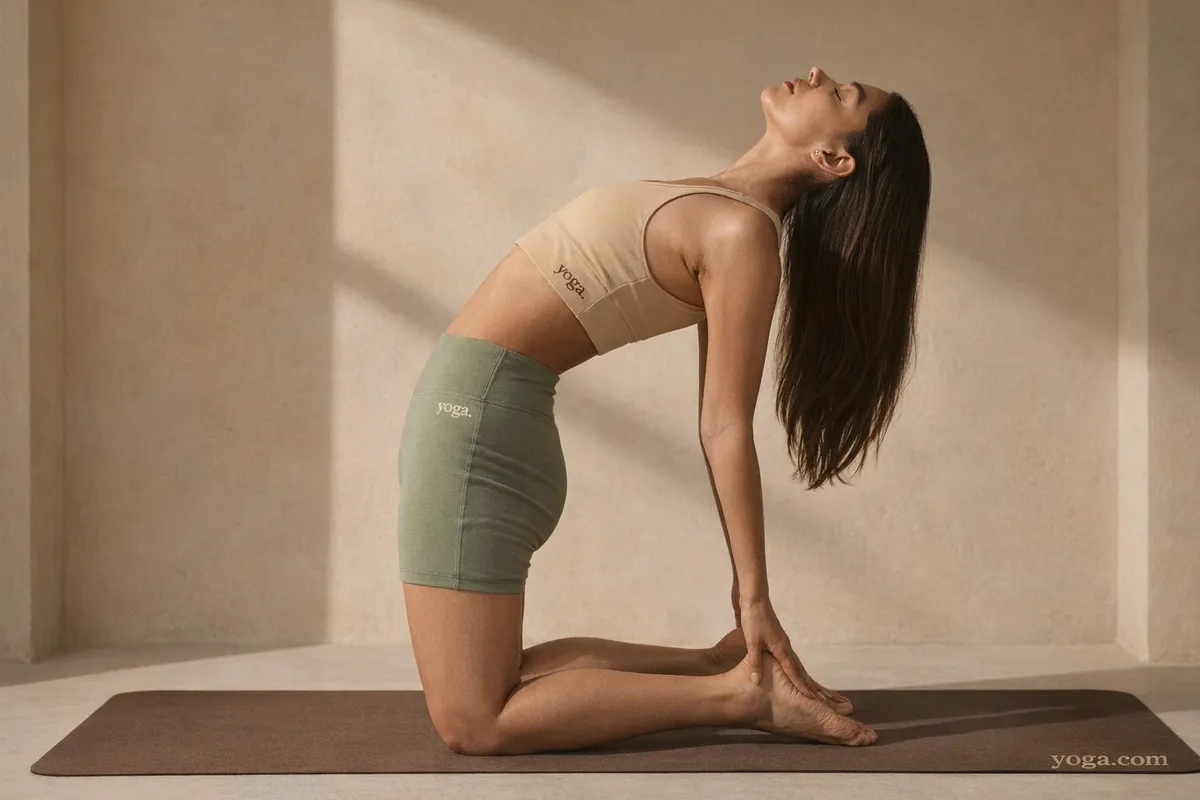
Camel Pose with Palms Set Against Feet is a deep kneeling backbend in which both hands reach back to rest flat against the soles of the feet, creating a full-contact grip that anchors the pose and encourages a more even spinal extension. Its Sanskrit name, Uṣṭrāsana (palms on feet), translates roughly as "camel posture with palms placed," distinguishing it from the more common fingertip-on-heel variation. This pose typically appears near the peak of a backbend sequence, after the spine and hip flexors have been warmed through preparatory shapes.
At a Glance
- Level: Intermediate
- Type: Backbend
- Targets: Thoracic and lumbar spine, hip flexors, anterior chest and shoulders, quadriceps
- Good for: Extending spinal mobility through the full curve, lengthening the front body from thighs to throat, building active shoulder and upper-back engagement
How to Do Camel Pose with Palms Set Against Feet
- Kneel upright with your knees hip-width apart, shins parallel, and the tops of your feet flat on the mat (toes untucked). Press all ten toenails evenly into the floor.
- Place your hands on your hips, draw your lower belly in gently, and lengthen your tailbone toward the mat to set a neutral pelvis. Lift the sternum and draw the shoulder blades toward each other without squeezing your glutes hard.
- Inhale to grow tall through the crown; on an exhale, begin to arch back, leading with the chest rather than the lower back. Keep your hips stacked directly over your knees throughout.
- Reach your right hand back first, placing the palm flat on the right sole - fingers pointing toward the toes, heel of the hand near the heel of the foot. Pause to check that your hips have not drifted behind your knees.
- Reach your left hand back to place the left palm flat on the left sole in the same way. Both elbows are softly extended, arms pressing against the outer calves if possible.
- Press the palms into the feet to help lift the chest higher; let the head follow the natural arc of the spine - only drop the head back fully if your neck is comfortable and free of strain.
- Hold for 5-8 steady breaths, continuing to lift the sternum on each inhale.
- To come out: bring one hand at a time back to your hip, use your core to draw the torso upright, and return to a tall kneeling position. Rest in Child's Pose for several breaths to allow the spine to neutralize.
Benefits
- Stretches the hip flexors, including the iliopsoas, across the full range of extension
- Mobilizes the thoracic spine into extension, counteracting prolonged forward-flexed postures
- Lengthens the anterior chest and the pectoral muscles
- Strengthens the erector spinae and mid-back muscles isometrically as they support the arc of the spine
- Develops active shoulder stability as the arms press into the feet and draw the chest open
- Builds quadriceps strength and endurance, which are loaded throughout the hold
Common Mistakes and Alignment Cues
- Hips drift back behind the knees. Before reaching for the feet, confirm your hips are stacked over your knees; if they drift, you lose the hip-flexor stretch and compress the lower back.
- Collapsing into the lumbar spine. Instead of hinging from the low back, initiate the arch from the middle and upper back; think of lifting the breastbone toward the ceiling before bending.
- Gripping or squeezing the glutes. Over-contracting the gluteals jams the sacrum; keep the glutes softly engaged but not clenched, and rely on hip-flexor length to find depth.
- Throwing the head back abruptly. Let the neck follow the thoracic curve gradually; keep a soft engagement at the throat and only release the head fully when the upper-back arc supports it.
- Knees splaying wider than hip-width. Keep a hip-width distance and parallel shins; splaying the knees shifts load unevenly through the sacroiliac joints.
Modifications and Props
- Toes tucked under: If your palms cannot reach flat to the feet without the hips falling back, curl your toes under to raise the height of each heel. This shortens the reach significantly and is the most common bridge to the full variation.
- Blocks beside the feet: Place a block on the lowest height just outside each ankle and rest a palm on each block. This mimics the flat-palm position while reducing the range of motion needed.
- One hand at a time: Practice reaching one palm to one foot while the opposite hand stays on the hip; this lets you build strength and confidence asymmetrically before committing to both hands.
- Wall support for hips: Kneel about a thigh's length from a wall and let the fronts of your thighs rest against it as you arch back. The wall prevents the hips from drifting and lets you focus on opening the chest.
Cautions
- Neck sensitivity or cervical injury: Keep the chin gently tucked and avoid dropping the head fully back; use a rolled blanket behind the head for support if needed.
- Lower-back pain or lumbar disc concerns: Prioritize thoracic extension over lumbar depth and keep the core lightly engaged throughout; avoid any sensation of sharp compression.
- Recent knee injury or kneecap sensitivity: Fold a blanket under your knees to pad the joint, and exit the pose immediately if you feel pinching rather than stretch.
- High or low blood pressure: The inverted head position can intensify head-rush sensations; come out slowly and pause in Child's Pose before standing.
- If you're working with an injury or a medical condition, check with a qualified professional before practicing.
Related Poses
- Bridge Pose - a supine backbend that warms the spine and hip flexors as preparation
- Upward-Facing Dog Pose - builds thoracic extension and anterior shoulder opening on the path to Camel
- Bow Pose - a prone backbend that similarly demands full hip-flexor length and chest lift
- Upward Bow Pose - the natural next progression for practitioners ready to deepen spinal extension
For a gentle, full-body sequence that includes accessible backbends, see A Gentle Yoga Routine for Tired, Low-Energy Days. If you prefer a shorter practice, A 10-Move Chair Yoga Sequence for a Midday Reset offers supported spinal-opening options.