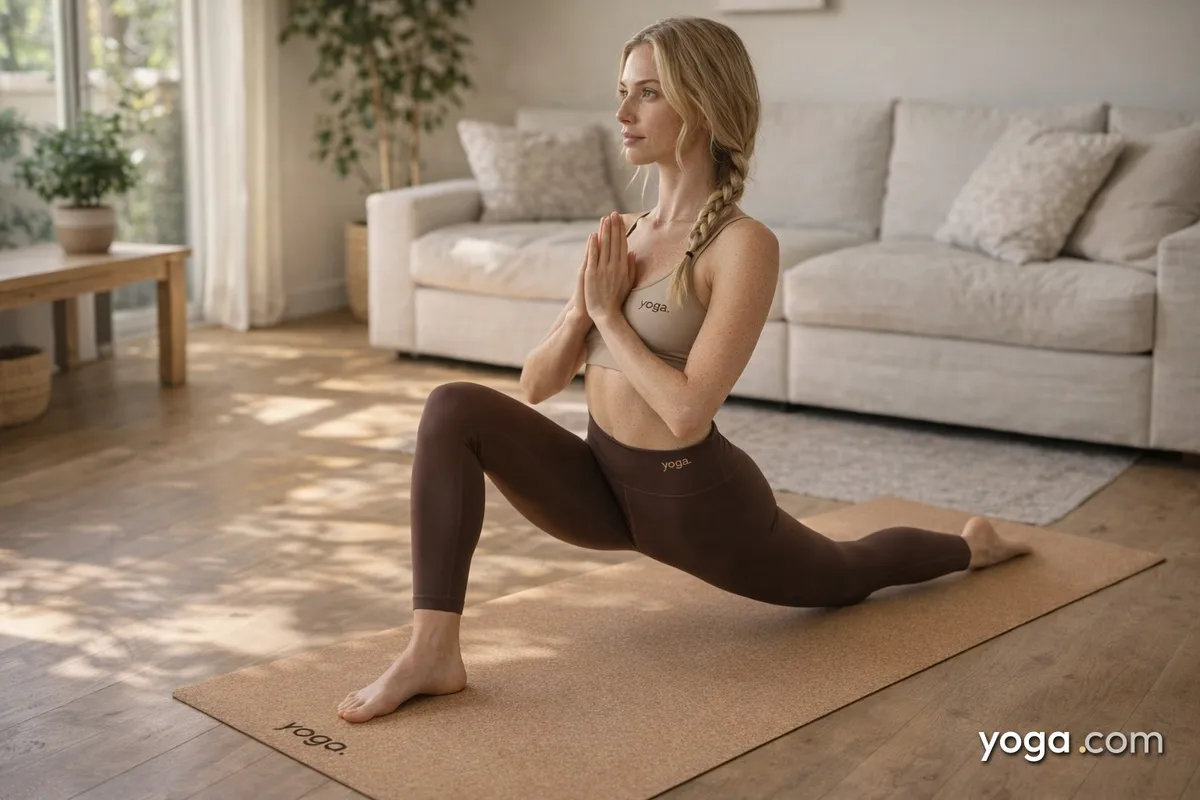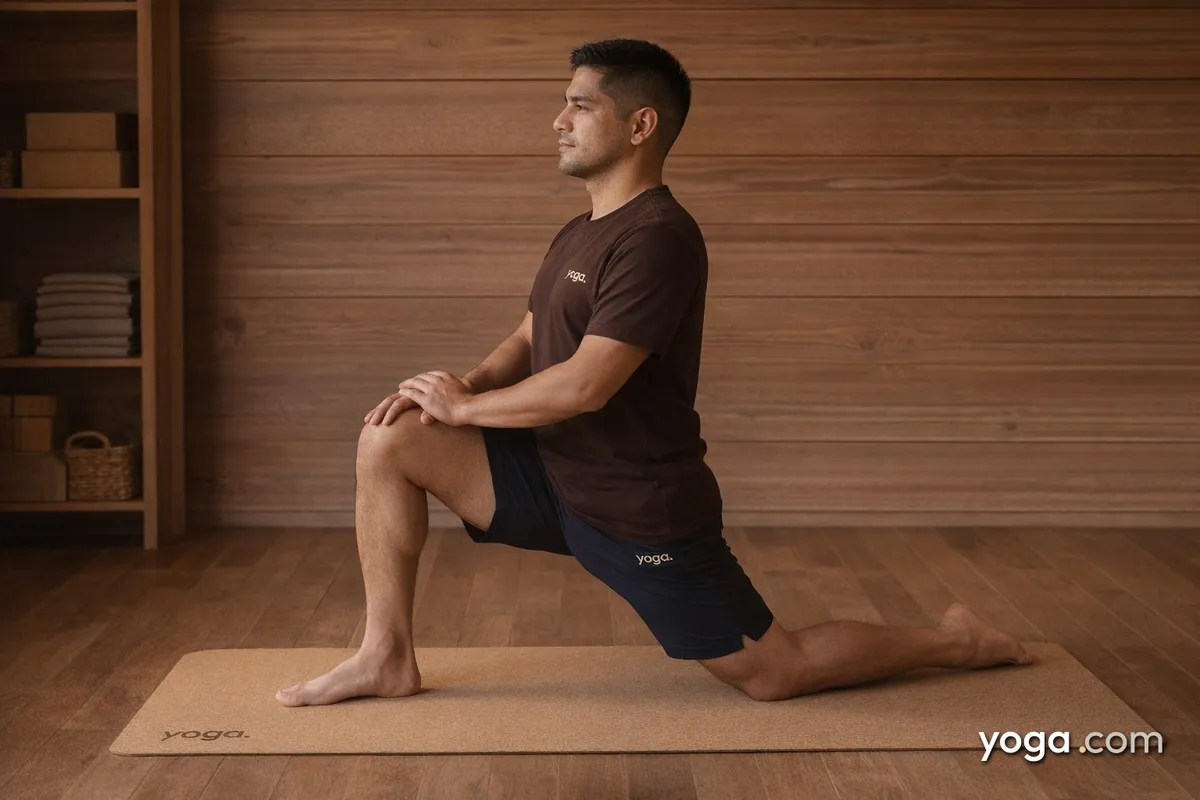
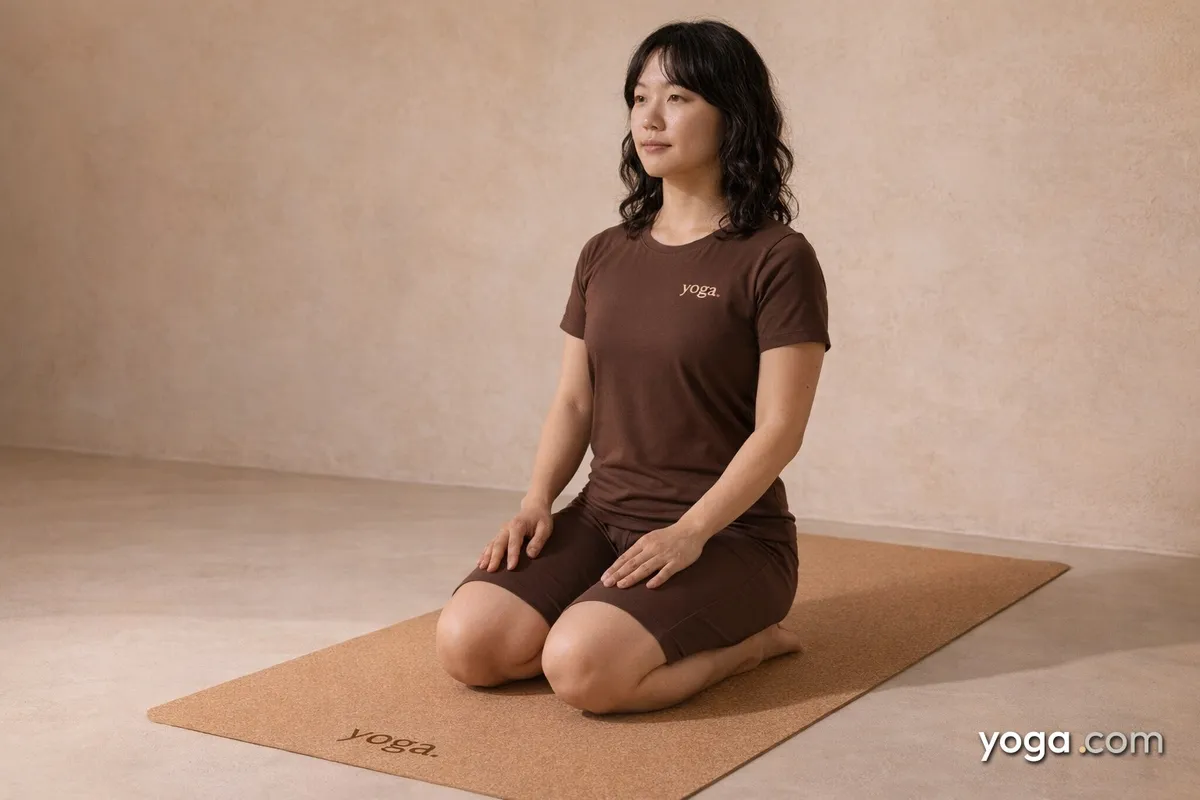
Hero Pose with Hands on Thighs is a foundational kneeling posture known in Sanskrit as Vīrāsana (hands on thighs) - from vīra, meaning "hero" or "warrior," and āsana, meaning "seat" or "posture." In this variation, the hands rest quietly on the thighs, grounding the arms and encouraging an upright, composed torso. It appears regularly at the start of a seated practice, during breathwork, or as a resting shape between more demanding poses.
At a Glance
- Level: Beginner
- Type: Kneeling
- Targets: Quadriceps, hip flexors, ankles, shins
- Good for: Building an upright seated posture, lengthening the front of the thighs, grounding focus before meditation or pranayama
How to Do Hero Pose with Hands on Thighs
- Begin in a kneeling position with your knees together and the tops of your feet flat on the mat, toes pointing straight back.
- Separate your feet slightly wider than hip-width apart, creating a space between your heels for your seat to eventually land.
- Use your hands to draw the calf muscles gently outward and down, then slowly lower your hips toward the mat between your feet. Sit on a block or folded blanket if your hips don't reach the floor comfortably.
- Check that the tops of your feet press evenly into the mat and that your ankles are not splaying outward. Your big toes should point straight back and rest close to your outer hips.
- Lengthen through your spine - press your sitting bones down, lift the crown of your head, and draw your lower front ribs gently in to avoid over-arching the lower back.
- Place your hands palm-down on your thighs, fingers relaxed, roughly mid-thigh. Let your shoulders drop away from your ears and your arms settle without tension.
- Soften your jaw and direct your gaze forward or slightly downward. Hold for 5-15 slow breaths, or for the duration of your breathwork or meditation.
- To come out, press your palms into the mat beside your hips, tuck one shin forward, and return to a kneeling position. Shake out the ankles gently.
Benefits
- Stretches the quadriceps and hip flexors along the front of the thighs
- Lengthens the tibialis anterior and the connective tissue around the shins and ankles
- Strengthens the spinal erectors through active upright sitting
- Establishes a stable, symmetrical base for seated breathing practices
- Encourages neutral pelvic alignment by grounding both sitting bones evenly
Common Mistakes and Alignment Cues
- Feet splaying outward: Press the tops of all ten toenails evenly into the mat and draw the outer ankles toward the floor so the feet track straight back.
- Hips too high off the mat, causing strain: Sit on a folded blanket or a block - enough height so your thighs slope gently downward toward the knees without gripping.
- Collapsing through the lower back: Root your sitting bones down and simultaneously lift the back of your skull, creating length along the full spine rather than arching or rounding.
- Shoulders creeping up toward the ears: Let the weight of your hands on your thighs anchor your arms; consciously soften the trapezius with each exhale.
- Knees drifting apart: Draw the inner thighs gently toward each other to keep the knees in line with the second toe of each foot.
Modifications and Props
- Block or blanket under the hips: Place one or two folded blankets, or a yoga block on its lowest or middle height, between your feet before sitting down. This reduces the depth of the knee bend and eases pressure on the ankle joints.
- Rolled blanket behind the knees: Tuck a tightly rolled blanket into the crease behind both knees to decompress the joint if you feel sharp pressure there.
- Wall support: Sit close to a wall and let the back body lightly contact it to reinforce the vertical spine while you build the muscular habit of upright sitting.
- Chair variation: Sit sideways on a chair with both knees bent and shins dropping toward the floor - this approximates the hip and thigh position with significantly less ankle load.
Cautions
- Avoid or modify if you have a current knee injury, recent knee surgery, or significant cartilage damage - use sufficient prop height or skip the pose entirely.
- Those with ankle sprains, Achilles tendon issues, or plantar fasciitis may find direct pressure on the tops of the feet uncomfortable; a blanket under the shins can help.
- If you feel any sharp or pinching sensation in the knee joint at any point, come out of the pose and revisit the prop setup before trying again.
- Varicose veins in the legs may be aggravated by sustained kneeling; limit hold time and check with a healthcare provider.
If you're working with an injury or a medical condition, check with a qualified professional before practicing.
Related Poses
- Diamond Pose - a close sibling in the kneeling family, useful for comparing foot and hip position
- Hare Pose - a natural forward-fold progression from the Hero seat
- Table Pose - a good preparatory shape to warm the wrists and knees before settling into the kneeling position
- Cat Pose - pairs well as a counter-movement to mobilize the spine after sustained kneeling
Find Hero Pose with Hands on Thighs in practice: A Gentle Yoga Routine for Tired, Low-Energy Days and A 10-Move Chair Yoga Sequence for a Midday Reset.