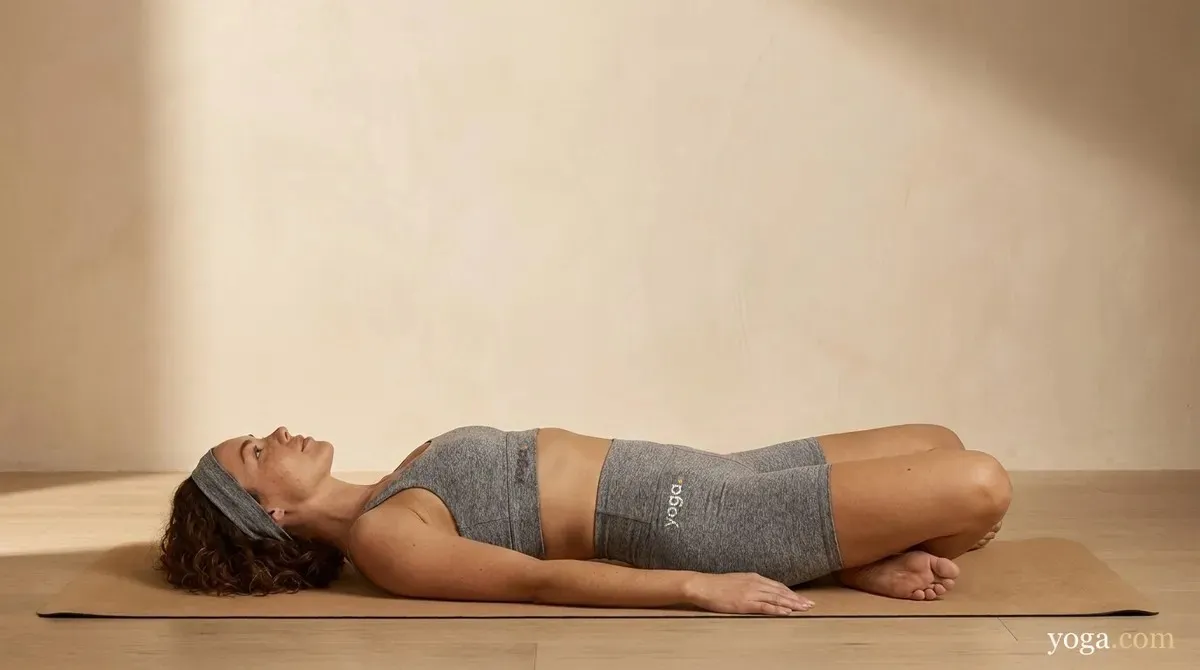
Lying Hero Pose, or Supta Vīrāsana (from the Sanskrit supta, "reclining," and vīra, "hero"), is the reclined version of Hero Pose (Vīrāsana). You begin seated between your heels and gradually lower your torso toward the floor, creating a deep stretch through the quadriceps and hip flexors. It appears most often near the end of a practice as a cooling pose, or as preparation for deeper backbends.
At a Glance
- Level: Intermediate
- Type: Supine
- Targets: Quadriceps, hip flexors, ankles, abdominals
- Good for: Lengthening the front of the thighs, improving ankle flexibility, opening the chest and ribcage
How to Do Lying Hero Pose
- Kneel on your mat with your knees together and your feet slightly wider than hip-width apart, toes pointing straight back. Lower your hips to sit between your feet - this is Vīrāsana. If you can't sit comfortably on the floor here, place a block or folded blanket under your sitting bones before going further.
- Press your fingertips into the mat beside your hips and check that your feet are symmetrical - inner ankles close to outer hips, toes pointing straight back, not splaying outward.
- Lean back and place your forearms and elbows on the floor, one at a time, keeping your knees tracking together. Pause here and breathe; if your lower back compresses or your knees lift off the mat, stay on your elbows rather than going lower.
- If your lower back and knees are comfortable, lower your torso all the way to the floor. Extend your arms overhead or rest them at your sides, palms facing up. Allow the back of your skull to rest on the mat; your chin stays roughly level with your forehead.
- Draw the tailbone gently toward your knees to lengthen the lumbar spine - avoid letting the lower back arch sharply away from the floor. Soften the ribcage down rather than letting it flare upward.
- Hold for 5-15 slow breaths, letting gravity do the work of releasing the front body.
- To come out: Bring your arms alongside your body, press your palms into the floor, engage your core, and use your elbows to push yourself back up to seated - the reverse of how you went down. Come onto hands and knees, then extend each leg briefly to counter the knee flexion before standing.
Benefits
- Stretches the quadriceps and hip flexors along the entire front of the thigh
- Lengthens the anterior ankle and the tibialis anterior
- Expands the chest and intercostal muscles, creating more room for the breath
- Strengthens the spinal extensors in their effort to maintain neutral lumbar length
- Prepares the body for deeper backbends by gradually mobilising the thoracic spine
Common Mistakes and Alignment Cues
- Knees splaying wide apart: Keep your knees touching or no more than hip-width apart throughout. Sliding apart shifts stress unevenly into the medial knee.
- Sharp lower-back compression: Tuck the tailbone gently toward the knees and engage your lower abdominals lightly. If the arch remains deep and uncomfortable, prop the torso on a bolster instead of going fully flat.
- Feet turning outward: Before lying back, re-set your feet so that the tops rest evenly on the mat and toes point directly behind you, not out to the sides.
- Rushing the descent: Lower one elbow at a time, pause, assess, then proceed. Moving too quickly risks straining the knee ligaments or jarring the lumbar spine.
- Ribcage flaring: Soften the front ribs toward the mat and think of lengthening the front body rather than simply arching backward.
Modifications and Props
- Bolster along the spine: Place a bolster lengthwise from the sacrum to the head. This is the most accessible version - it reduces the quad stretch significantly and allows tight quadriceps or sensitive knees to ease into the shape over time.
- Folded blankets under the sitting bones: If you can't sit on the floor in Vīrāsana without knee pain, stack one or two folded blankets under your hips before reclining. Add height until both sitting bones are fully supported.
- Block under the head: If your head doesn't comfortably reach the floor when you're on a bolster, place a block under the back of the skull to support the cervical spine.
- Elbows-only version: Stay on your elbows rather than lying fully flat. This is an excellent intermediate stage that still stretches the quads and hip flexors with less demand on the lower back and knees.
Cautions
- Knee discomfort or injury: Any sharp or pinching sensation in the knees is a signal to stop and add more height under the hips, or to skip this pose entirely until your knees are assessed.
- Ankle sensitivity: If your ankles are tight or painful when the tops of the feet press into the mat, roll a small towel and place it under each ankle to reduce the dorsiflexion load.
- Lower-back conditions: A pronounced lumbar arch can concentrate compression. Use a bolster and engage the abdominals actively; if discomfort persists, choose a gentler alternative.
- Pregnancy: Avoid lying supine for extended periods after the first trimester; practice a supported, more upright reclined angle or skip the reclined version.
If you're working with an injury or a medical condition, check with a qualified professional before practicing.
Related Poses
- Lying Diamond Pose - a gentler supine hip-opener that makes a good preparation or alternative
- Bridge Pose - a natural counter-pose that re-extends the hip from a different angle after deep quad work
- Upward-Facing Dog Pose - an active backbend that builds on the chest and quad opening developed here
- Corpse Pose - the ideal follow-up to allow the body to absorb the effects of the reclined position
See also: A Gentle Yoga Routine for Tired, Low-Energy Days and A 10-Move Chair Yoga Sequence for a Midday Reset.