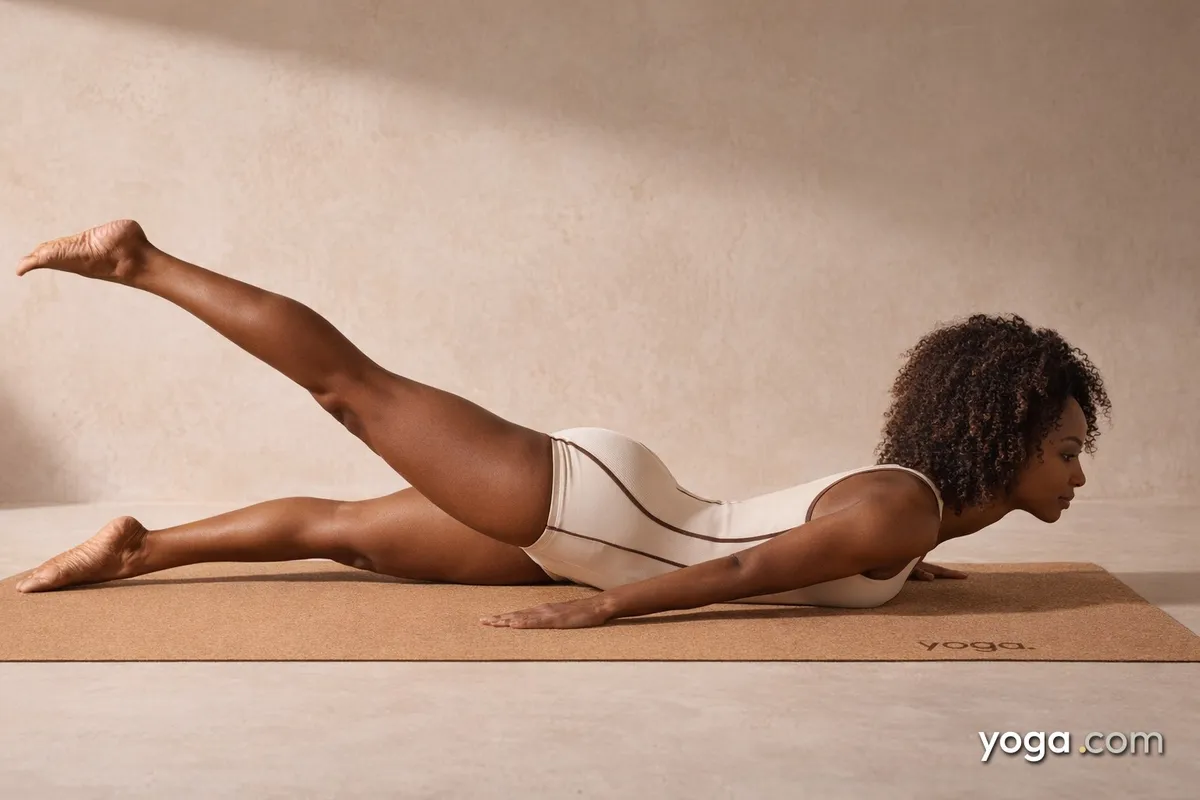
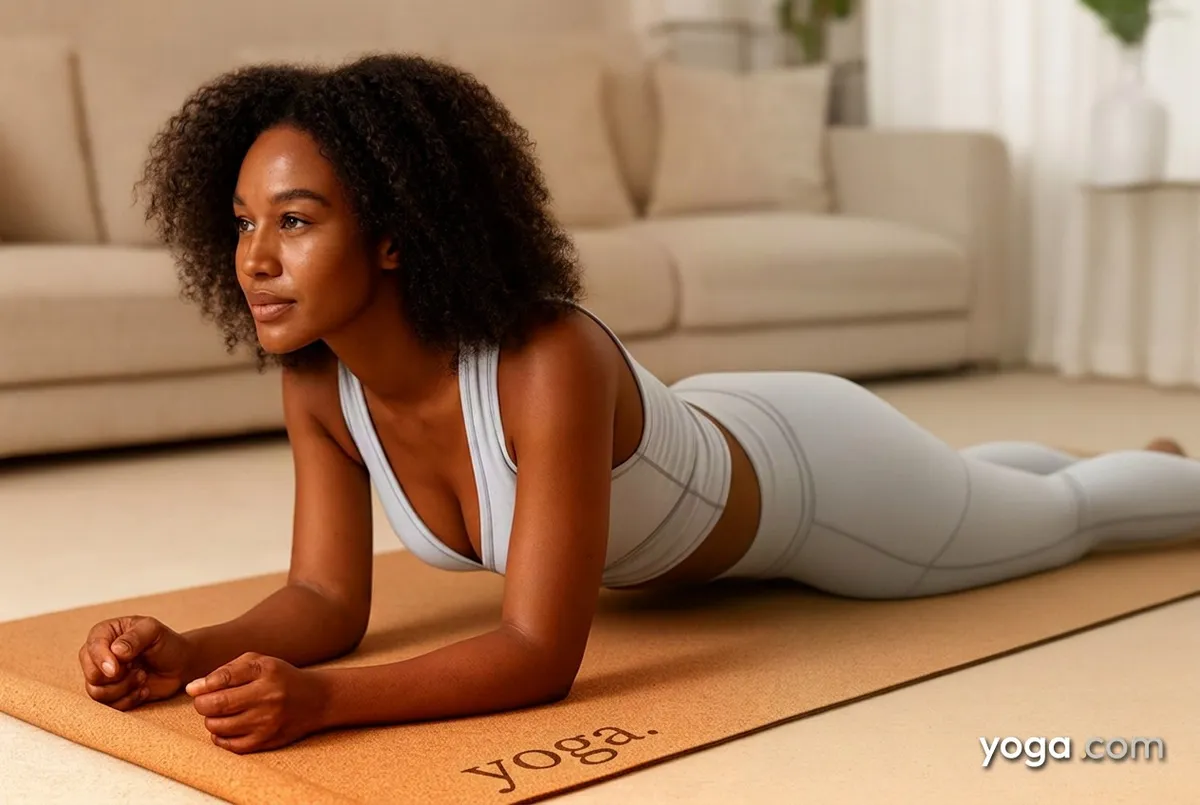
Half Cobra Pose, or Ardha Bhujaṅgāsana (AHR-dah boo-jahn-GAH-sah-nah), translates literally as "half serpent pose" - ardha meaning half, bhujaṅga meaning serpent or cobra. It is a gentler, low-range backbend performed prone on the floor, making it an ideal introduction to spinal extension before progressing to full Cobra. You'll find it early in warm-up sequences, in restorative flows, and as a preparatory shape before deeper backbends.
At a Glance
- Level: Beginner
- Type: Backbend
- Targets: Thoracic and lumbar spine, abdominal muscles, chest, upper back
- Good for: Strengthening the spinal extensors, improving thoracic mobility, building body awareness for deeper backbends
How to Do Half Cobra Pose
- Lie face down on your mat with your legs extended hip-width apart, the tops of your feet pressing evenly into the floor.
- Place your forearms on the mat with your elbows directly beneath your shoulders, palms flat and facing down. Your forearms should be parallel to each other.
- Press your pubic bone and the tops of your thighs gently into the mat to anchor the pelvis.
- On an inhale, press down through your forearms and lift your chest and the top of your head away from the floor. Keep your elbows bent and your forearms grounded - this is what distinguishes Half Cobra from full Cobra.
- Draw your shoulder blades toward each other and down your back, away from your ears, so your neck stays long.
- Gaze forward or very slightly upward; avoid cranking the chin toward the ceiling.
- Hold for 3-5 breaths, maintaining a steady press through your forearms and a gentle engagement of the lower abdominals to support the lumbar spine.
- To come out, exhale and slowly lower your chest back to the mat. Rest your forehead on your stacked hands or turn it to one side, and let the body release completely before repeating or moving on.
Benefits
- Strengthens the erector spinae and other spinal extensor muscles along the entire length of the back.
- Stretches the abdominal muscles and the anterior chest wall.
- Builds shoulder stability by training the serratus anterior and lower trapezius to work together.
- Improves thoracic extension, counteracting the rounding that comes from prolonged seated postures.
- Develops body awareness of pelvic neutrality and lumbar support - foundational skills for all backbend families.
Common Mistakes and Alignment Cues
- Elbows flaring wide: Keep your elbows directly under your shoulders and hugging gently toward the midline. Flared elbows collapse the chest rather than opening it.
- Crunching the lower back: Press your pubic bone into the mat and lightly tone the lower abdominals. Think about lengthening the tailbone toward your heels rather than compressing the lumbar vertebrae.
- Shrugging the shoulders up to the ears: Actively slide your shoulder blades down your back before and during the lift. This keeps the neck long and the upper trapezius out of the work.
- Gripping the glutes hard: Soften the buttocks. Squeezing them tightly often increases lumbar compression and prevents the pelvis from settling neutrally.
- Lifting too high for your current range: If your elbows have to straighten to get higher, you've gone past Half Cobra into full Cobra. Keep the forearms down and work within a comfortable range of spinal extension.
Modifications and Props
- Folded blanket under the hips: Slide a folded blanket beneath your pelvis and lower abdomen to reduce lumbar compression, especially helpful if you feel any pinching in the lower back.
- Rolled blanket under the ankles: If the tops of your feet are uncomfortable on the mat, place a rolled blanket under your ankles for cushioning.
- Hands instead of forearms (partial progression): To begin exploring a slightly higher lift while still keeping a soft elbow bend, plant your palms under your shoulders and press up only partway - this is a midpoint between Half and full Cobra.
- Wall variation: Stand facing a wall at arm's length, place your forearms against the wall at shoulder height, and lean in to create a standing version of the spinal extension. This is useful for anyone who cannot lie prone comfortably.
Cautions
- Move carefully if you have a recent or acute lumbar disc injury; keep the range of extension small and stop if you feel radiating sensations.
- Avoid this pose in late pregnancy, when lying prone is not comfortable or safe.
- If you have a wrist or shoulder injury, use the forearm variation and avoid any pose that loads the joint under compression or stress.
- Those with spinal stenosis should practice with extra care, keeping the lift minimal and prioritizing length over height.
If you're working with an injury or a medical condition, check with a qualified professional before practicing.
Related Poses
- Cat Pose - warm up spinal flexion and extension before coming to the floor for backbends.
- Cobra Pose - the natural next step once you're comfortable with half the range of this pose.
- Upward-Facing Dog Pose - a deeper progression that straightens the arms and lifts the thighs off the mat.
- Downward-Facing Dog Pose - a complementary counter-pose that lengthens the spine after backbending.
Practice Half Cobra in context: try A Gentle Yoga Routine for Tired, Low-Energy Days or reset your afternoon with A 10-Move Chair Yoga Sequence for a Midday Reset.