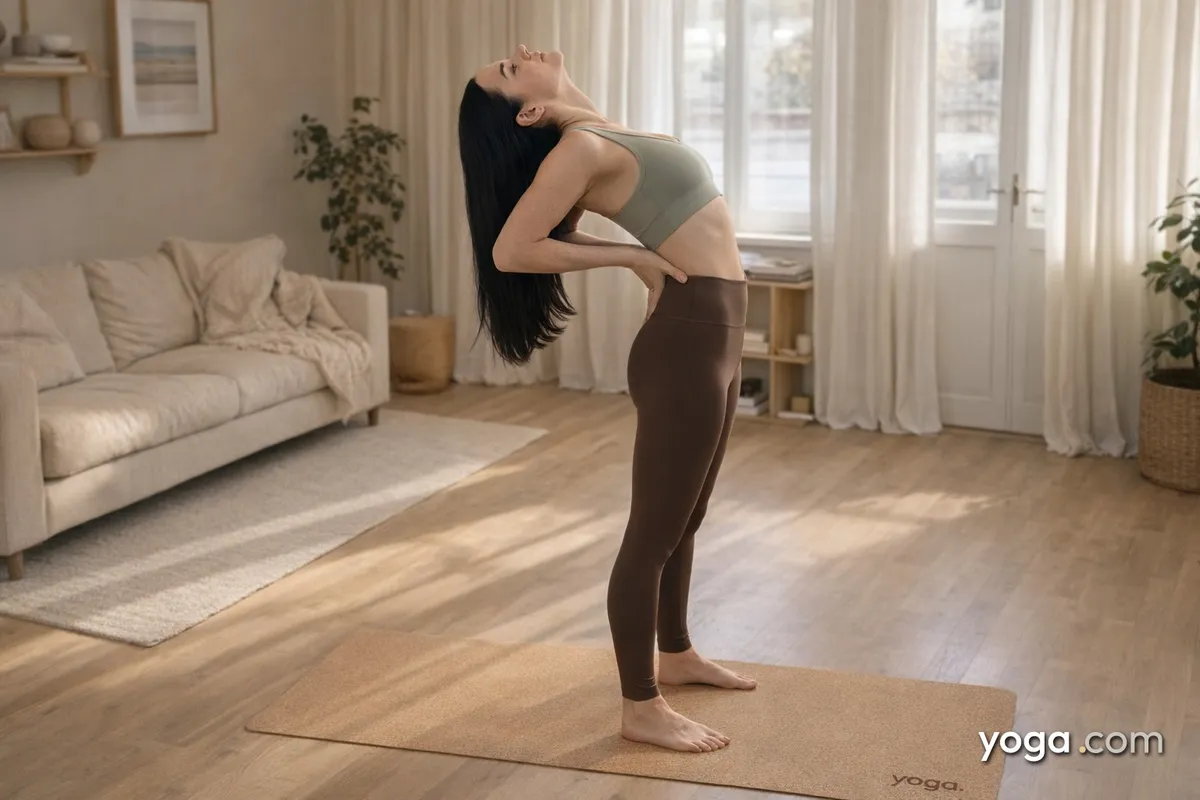
Half Wheel Pose (Ardha Cakrāsana - literally "half wheel") is a standing backbend that arches the spine gently into a partial wheel shape while you remain upright. It offers many of the benefits of deeper backbends without requiring you to come to the floor, making it an approachable and practical pose. You'll often find it early in a standing sequence or as a warm-up for more demanding backbends later in practice.
At a Glance
- Level: Beginner
- Type: Backbend
- Targets: Thoracic and lumbar spine, hip flexors, chest and shoulders, abdominals
- Good for: Building spinal extension, opening the front body, countering the effects of prolonged sitting
How to Do Half Wheel Pose
- Stand in Mountain Pose with your feet hip-width apart and your arms by your sides. Root evenly through all four corners of each foot.
- Place your hands on your lower back - fingers pointing downward, palms flat against the sacrum and lumbar spine - to support and protect the low back throughout the pose.
- On an inhale, lift your sternum and broaden across your collarbones. Draw your shoulder blades gently toward each other and down your back.
- On your next inhale, begin to arc the upper spine backward. Lead with the chest, not the chin. Let the head follow only after the upper back has begun to move.
- Continue to extend the arc, pressing your hips forward slightly to keep the thighs vertical. Engage your legs - the quadriceps firm gently to stabilize the knees.
- Hold for 3-5 steady breaths, keeping your neck long and your gaze directed upward or slightly behind you (avoid cranking the chin aggressively toward the ceiling).
- To come out: On an inhale, engage your core and use that support to lift your chest back to vertical - lead with the sternum, not the head.
- Return to Mountain Pose, take a breath in neutral, and notice the effects before moving on.
Benefits
- Stretches the hip flexors and the entire front of the torso, including the abdominals and intercostals.
- Strengthens the erector spinae and other paraspinal muscles as they control the spinal extension.
- Improves thoracic mobility, which tends to stiffen from desk work and forward-rounding habits.
- Builds shoulder stability and opens the pectoral muscles across the chest.
- Trains the postural muscles to support an upright, extended spine in a weight-bearing position.
Common Mistakes and Alignment Cues
- Collapsing into the lower back. Rather than hinging sharply at the lumbar spine, spread the arch evenly from tailbone to neck. Think of lengthening before bending.
- Letting the knees drift forward. Keep the shins vertical and press the hips forward to maintain the line of the thighs perpendicular to the floor.
- Dropping the head back first. Let the cervical spine be the last section to extend. The head travels with the arc of the upper back, not ahead of it.
- Holding the breath. The pose shortens when you brace. Keep the breath full and even - each inhale naturally lifts and lengthens; each exhale lets you settle a little deeper.
- Squeezing the glutes aggressively. Gripping the buttocks can compress the sacroiliac joint. Keep the glutes relatively soft; rely on the legs and core instead.
Modifications and Props
- Hands on a wall: Stand facing away from a wall, place your palms on it at waist height, and walk them down as you arch back. The wall gives clear tactile feedback about how the hands support the spine.
- Block between the thighs: Squeezing a block lightly between the upper thighs cues the legs to stay engaged and the knees to track parallel throughout the pose.
- Deeper variation - fingertips on a chair: Place a sturdy chair behind you and reach the hands back to rest on the chair seat, allowing a slightly larger range of spinal extension with support.
- Reduced range: Stop the backbend at a comfortable mid-point - even a small arch is effective. Prioritize even distribution of the curve over depth.
Cautions
- Avoid this pose or work with a very modest range if you have acute low-back pain or recent spinal injury.
- Those with neck injury or cervical disc issues should keep the gaze forward rather than dropping the head back.
- If you feel dizziness or light-headedness in the full backbend position, come out slowly and avoid letting the head drop below the heart.
- Proceed carefully during pregnancy - favor a very small range of motion and stop if there is any discomfort in the abdomen or low back.
If you're working with an injury or a medical condition, check with a qualified professional before practicing.
Related Poses
- Cat Pose - a gentle warm-up that mobilizes the spine in both directions before backbending.
- Cobra Pose - a floor-based backbend that targets similar spinal extensors and chest opening.
- Bridge Pose - a supine backbend that naturally follows Half Wheel in a balanced sequence.
- Upward Bow Pose - the natural next progression once the spine is comfortable in shallower backbends.
Put this pose to work in practice: A Gentle Yoga Routine for Tired, Low-Energy Days or explore accessible movement in A 10-Move Chair Yoga Sequence for a Midday Reset.