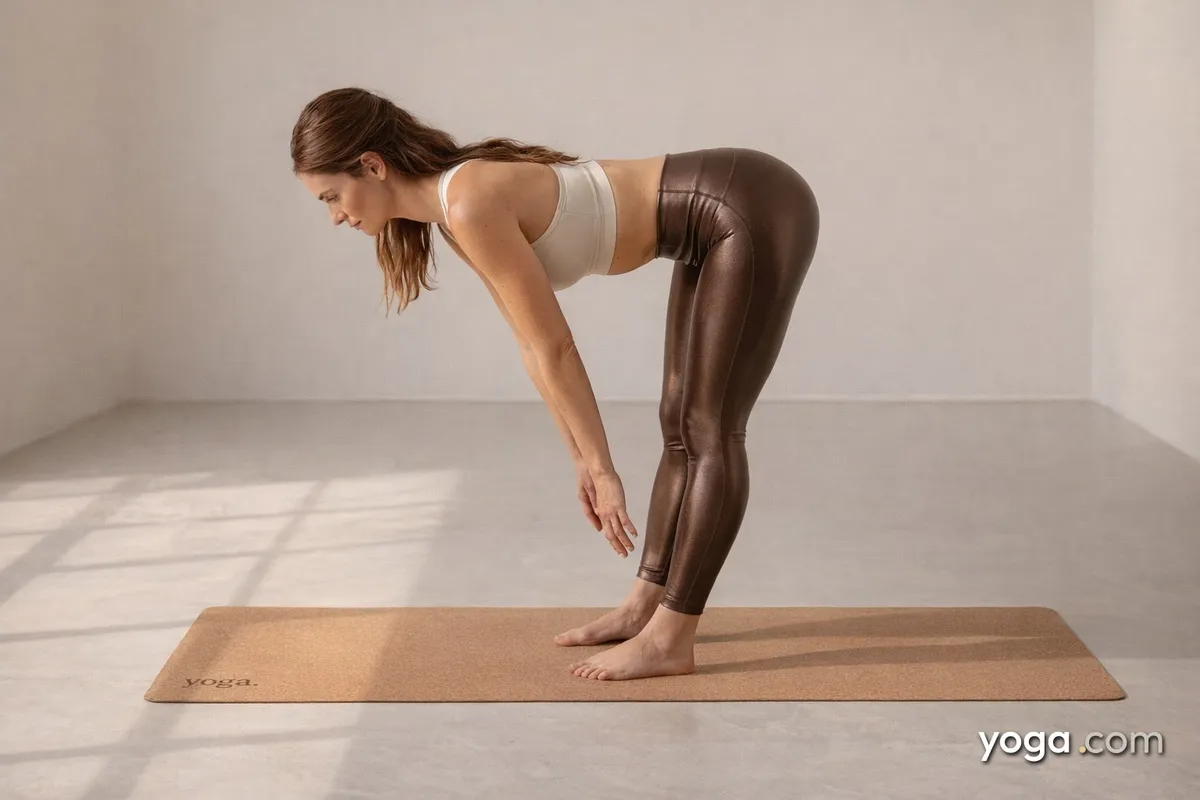
Standing Half Forward Bend (Ardha Uttānāsana - literally "half intense stretch pose") is a standing pose that brings the torso parallel to the floor, spine long, halfway between upright and a full forward fold. It appears in nearly every Sun Salutation sequence, where it serves as the transitional lift between a full forward bend and a standing position, making it one of the most frequently practiced shapes in modern yoga.
At a Glance
- Level: Beginner
- Type: Forward Bend
- Targets: Hamstrings, spinal extensors, core, shoulders
- Good for: Building spinal extension awareness, lengthening the posterior chain, establishing a neutral spine habit
How to Do Standing Half Forward Bend
- Begin in Mountain Pose (Tāḍāsana), feet hip-width apart, arms alongside your body, weight even across both feet.
- On an exhale, hinge forward from the hips into a Standing Forward Bend, letting your hands rest on the floor, your shins, or a pair of blocks.
- On your next inhale, press down through all four corners of your feet and draw your torso away from your thighs, lifting your chest and flattening your back.
- Place your fingertips on your shins, the tops of your feet, the floor, or on blocks beside your feet - wherever you can keep your arms straight and your spine long.
- Draw the crown of your head forward and your tailbone back, so your torso is roughly parallel to the floor. Your back should feel like a tabletop, not rounded.
- Engage your lower belly lightly, firm the front thighs, and keep a micro-bend in the knees if your hamstrings are tight - the goal is length in the spine, not straight legs.
- Hold for 2-5 breaths, gazing at the floor a few inches in front of your feet (or slightly forward if your neck is comfortable).
- To come out, exhale and fold fully back into Standing Forward Bend, or inhale and sweep the arms wide as you rise all the way back to Mountain Pose.
Benefits
- Stretches the hamstrings and calves through an active, lengthened position rather than passive hanging.
- Strengthens the spinal extensor muscles (erector spinae) as they work to hold the torso parallel to the floor.
- Trains axial length - the ability to find a neutral spine - which carries over into seated postures and daily movement.
- Engages the core muscles isometrically to stabilize the lumbar spine during the forward-hinged position.
- Opens the chest and anterior shoulders, counteracting a rounded upper back.
Common Mistakes and Alignment Cues
- Rounding the upper back: If your thoracic spine domes toward the ceiling, bend your knees generously and place hands higher (on blocks or shins) until you can feel your chest genuinely lift.
- Compressing the lower back: Actively send your tailbone straight back and up, away from the back of your waist - think of lengthening your lower spine rather than arching it.
- Collapsing the neck: Keep your neck a natural extension of the spine; gaze at the floor rather than craning the head up to look forward.
- Locking the knees: A soft, microbend in the knees protects the joint and actually allows the hamstrings to lengthen more effectively than hyperextension does.
- Weight shifting into the heels: Press evenly through the ball of the foot and the heel so the legs are active and the hips stay stacked over the ankles.
Modifications and Props
- Yoga blocks: Place two blocks (any height) directly below your shoulders. Resting your fingertips on the blocks raises the floor to meet your hands, making it far easier to lengthen the spine.
- Hands on shins: If blocks aren't available, press your palms firmly into your shins - this gives you the resistance to actively pull your chest forward and open.
- Wall variation: Stand facing a wall, arms-length away. Press your palms flat on the wall at hip height and walk your feet back until your torso is parallel to the floor. This is ideal when you need more support or want to work on spinal length without any hamstring loading.
- Chair variation: Rest your forearms or palms on the seat of a chair in front of you. This is especially accessible for practitioners with significant hamstring tightness or balance considerations.
Cautions
- Lower back sensitivity: Keep a generous bend in the knees and focus on hinging at the hips rather than flexing the lumbar spine. Stop if you feel pinching or sharp sensation in the lower back.
- Hamstring strain or tear: Avoid pressing into the end range of the stretch; work with blocks so the spine can extend without pulling on healing tissue.
- Osteoporosis: Forward bending poses require care; focus on a tall, supported spine and avoid any rounding through the thoracic vertebrae.
- Balance concerns: Use the wall or chair variation to keep the shape stable and reduce fall risk.
If you're working with an injury or a medical condition, check with a qualified professional before practicing.
Related Poses
- Mountain Pose - the starting point from which this pose unfolds; building awareness here sets up the hip hinge.
- Standing Forward Bend - the deeper fold this pose prepares for and transitions into throughout Sun Salutation.
- Downward-Facing Dog Pose - shares the same goal of spinal length and active hamstring stretch; a natural next progression.
- Seated Forward Bend - applies the same posterior-chain lengthening in a supported, seated context.
See this pose in context in A Gentle Yoga Routine for Tired, Low-Energy Days and A 10-Move Chair Yoga Sequence for a Midday Reset.