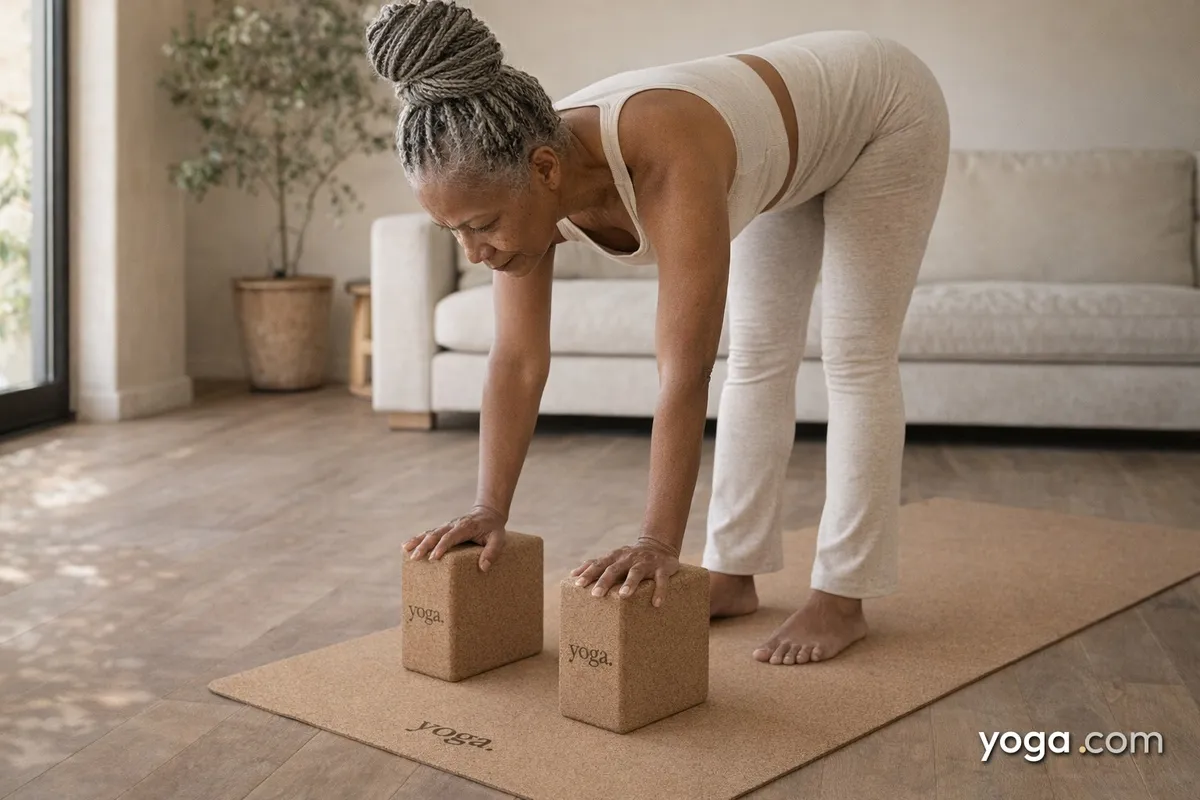
Standing Half Forward Bend with Blocks is a standing forward-fold variation in which the hands rest on yoga blocks rather than the floor, keeping the spine long and the torso parallel - or nearly parallel - to the ground. Its Sanskrit name, Ardha Uttānāsana (with blocks), translates roughly as "half intense stretch pose," with ardha meaning half, ut meaning intense, and tān meaning to stretch. You'll find it as a standard transition in Sun Salutations and as a standalone shape that teaches beginners how a forward bend should feel from the inside out.
At a Glance
- Level: Beginner
- Type: Forward Bend
- Targets: Hamstrings, spinal extensors, hip flexors, shoulders
- Good for: Establishing a neutral spine in forward folds, developing hamstring length, building postural awareness in the back body
How to Do Standing Half Forward Bend with Blocks
- Stand in Mountain Pose with your feet hip-distance apart. Place two blocks on the mat just in front of your feet - start with the blocks on their highest setting.
- On an exhale, hinge forward from your hips (not your waist), bending your knees generously as you bring your palms to the blocks. Let the blocks carry your weight.
- Press your palms evenly into the blocks and draw your shoulders away from your ears, broadening across the collarbones.
- On an inhale, lift your chest and gaze slightly forward - not sharply up - so the back of your neck stays long. Your torso should feel as though it could balance a tray of water.
- Straighten your legs as much as your hamstrings allow without rounding your lower back. A soft bend at the knees is always preferable to a curved spine.
- Hold for three to five breaths, actively reaching the crown of your head forward and your tailbone back, creating length along your entire spine.
- To come out, bend your knees, press the blocks into the floor, and on an inhale roll up one vertebra at a time - or hinge back upright from the hips - to return to Mountain Pose.
Benefits
- Stretches the hamstrings and calves through a functional range of motion.
- Strengthens and lengthens the spinal extensor muscles along the back body.
- Opens the hip flexors as the femurs descend toward parallel with the floor.
- Builds shoulder stability and scapular awareness as you press into the blocks.
- Trains the proprioceptive habit of hinging at the hip joint rather than rounding at the lumbar spine - a foundation skill for all forward bends.
- Prepares the spine for deeper folding in poses like Standing Forward Bend.
Common Mistakes and Alignment Cues
- Rounding the lower back: If your lumbar spine curves, raise the blocks to a taller setting, bend your knees more deeply, or both - length in the spine matters more than straight legs.
- Collapsing into the wrists: Spread your fingers wide and press the full palm into the block surface; distribute weight evenly rather than dumping it into the heel of the hand.
- Craning the neck sharply: Keep the gaze at a slight forward angle so the back of the neck mirrors the length of the rest of the spine; do not lift the chin toward the ceiling.
- Shoulders creeping toward the ears: Actively slide the shoulder blades down the back and draw them slightly toward each other to keep the chest broad.
- Locking the knees: Maintain a micro-bend - or a generous bend - in both knees to protect the joint and allow the pelvis to tip forward freely.
Modifications and Props
- Blocks on highest setting: If your hamstrings are particularly tight, use the blocks at their tallest height (about nine inches) so you can reach them without rounding your back at all.
- Blocks against a wall: Place the blocks against a baseboard and rest your fingertips on them with your heels a foot from the wall; the wall gives feedback when you push the sitting bones back.
- Chair variation: Rest your hands on the seat of a sturdy, non-rolling chair instead of blocks for extra height and stability - useful if balance is a concern.
- Strap around thighs: Loop a strap around both mid-thighs (just above the knee) and press outward; this activates the outer hips and discourages the knees from caving inward.
Cautions
- Hamstring injury: Keep a generous bend in the knees and work at a range that does not create sharp pulling sensation at the sit bones or behind the knee.
- Lower-back sensitivity: Use blocks at their tallest height and prioritize spinal length over any depth in the fold; avoid this shape during acute flare-ups.
- Wrist discomfort: Make fists on the blocks instead of spreading the fingers flat, or fold a blanket over the block surface to cushion the palms.
- Dizziness or blood pressure concerns: Rise from the fold slowly and pause in a gentle standing position before fully upright.
If you're working with an injury or a medical condition, check with a qualified professional before practicing.
Related Poses
- Mountain Pose - the starting point; establishes the grounded stance you carry into the fold.
- Standing Forward Bend - the natural next progression once the half-fold feels stable.
- Downward-Facing Dog Pose - shares the same long-spine, hip-hinge principle and is a common companion in Sun Salutations.
- Seated Forward Bend - a floor-based forward fold that deepens hamstring length developed in this pose.
Find this pose in context: A Gentle Yoga Routine for Tired, Low-Energy Days and A 10-Move Chair Yoga Sequence for a Midday Reset.