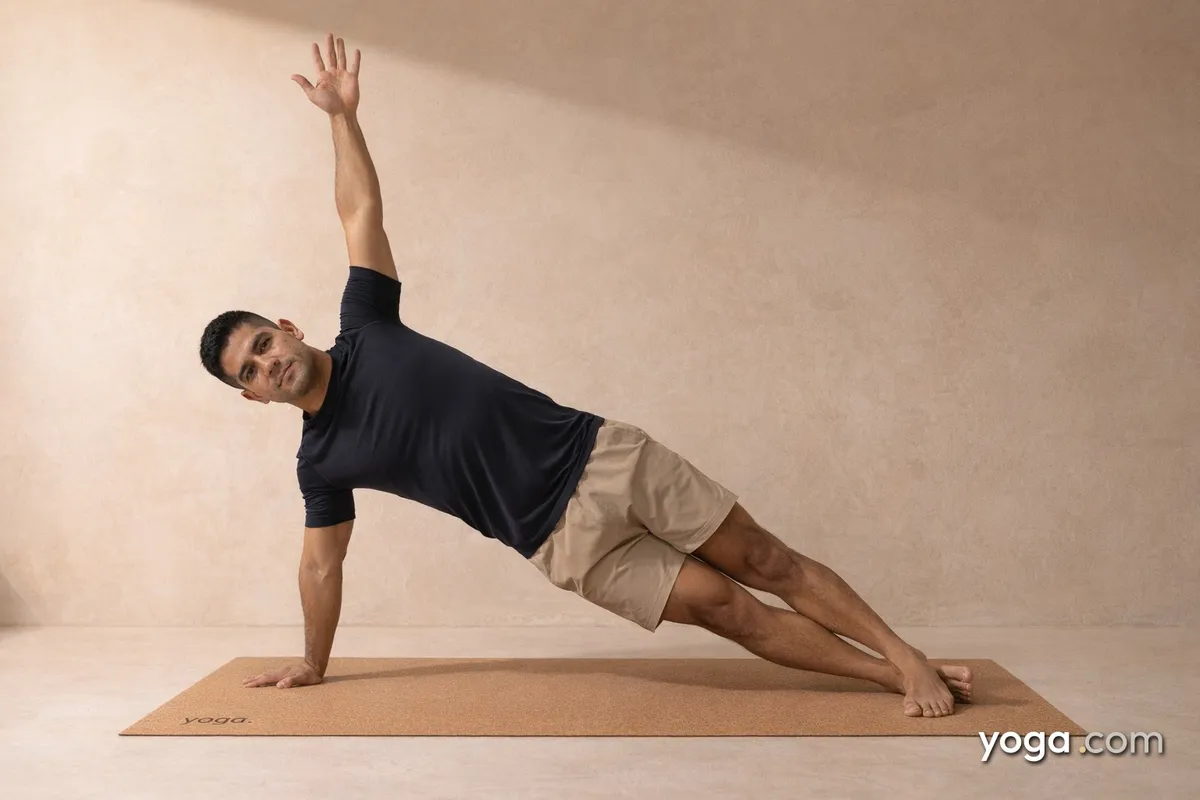
Half Side Plank Pose on Right Hand with Legs Crossed is a supported lateral arm balance that places the right hand and the outer edge of the right foot on the mat while the legs are crossed at the ankles, lowering the overall lever demand compared to the full expression. Its Sanskrit name is Vasiṣṭhāsana (half, right hand, legs crossed) - named for the revered sage Vasiṣṭha, whose name translates loosely as "most excellent" or "best." It typically appears mid-sequence, after a standing or core-focused section, as a bridge toward full Side Plank.
At a Glance
- Level: Intermediate
- Type: Arm Balance
- Targets: Lateral core (obliques), shoulder girdle, wrist and forearm, hip abductors
- Good for: Building lateral body strength, developing single-arm weight-bearing stability, improving wrist conditioning
How to Do Half Side Plank Pose on Right Hand with Legs Crossed
- Begin in Plank Pose with your hands shoulder-width apart and your body in one long line from crown to heels. Spread your right-hand fingers wide, pressing evenly through the base knuckles.
- Shift your weight onto your right hand and rotate your entire body to the left, stacking your left hip above the right. Keep your right arm straight and your elbow unlocked but firm.
- Cross your left ankle over your right ankle, so both feet rest on their outer edges on the mat. The crossed legs reduce the lever arm and give you a more stable base than the full pose.
- Press the outer edge of your right foot and the outer edge of your left foot firmly downward. Engage your right hip abductors to prevent the right hip from sinking toward the floor.
- Stack your left shoulder directly above the right or slightly behind it. Extend your left arm straight up toward the ceiling, palm facing forward, to counterbalance.
- Draw your lower ribs in and up - resist letting your waist collapse toward the mat. Keep your neck long and gaze forward or, if your neck is comfortable, turn to look up at your left hand.
- Hold for 3-5 breaths, maintaining even, controlled breathing throughout.
- To come out, lower your left hand back to the mat, return to Plank Pose, and either take a breath in Plank before switching sides or move through a vinyasa.
Benefits
- Strengthens the obliques and lateral abdominal wall through sustained isometric contraction.
- Builds shoulder girdle stability, particularly in the serratus anterior and rotator cuff muscles of the right shoulder.
- Conditions the wrists and forearms against single-arm compressive load.
- Strengthens the right hip abductors and outer thigh as they work to lift and hold the pelvis level.
- Develops proprioceptive awareness of lateral alignment, training you to feel and correct side-body collapse.
Common Mistakes and Alignment Cues
- Right hip sagging toward the floor. Press the outer right foot down and fire the right hip abductors actively to lift the pelvis back into line with shoulders and heels.
- Locking or hyperextending the right elbow. Maintain a microbend in the elbow and actively push the mat away to engage the shoulder stabilizers, not just the joint.
- Collapsing through the waist. Imagine a hand pressing up under your right side body; draw the lower ribs away from the mat on every exhale.
- Right hand placed too far forward or behind the shoulder. Stack the right wrist directly below the right shoulder - not ahead of it - so the load transfers efficiently through the arm.
- Holding the breath. Gripping through tension is common; soften the jaw, keep the exhales steady, and let the breath guide your time in the pose.
Modifications and Props
- Right knee down: Keep the right knee on the mat instead of balancing on the foot. This dramatically reduces load on the wrist and shoulder while still training the lateral core.
- Block under the right hand: Place a block at its lowest height beneath the right palm to reduce wrist extension and make the position more comfortable for sensitive wrists.
- Wall support: Practice near a wall and lightly rest the outer edge of the right foot against the baseboard for balance feedback without full weight-bearing.
- Forearm variation: Lower onto the right forearm (Half Vasisthasana on the forearm) to remove wrist load entirely while keeping the same lateral training effect.
Cautions
- Wrist discomfort or injury: Avoid full weight-bearing on the right hand; use the forearm variation or keep the right knee down until wrist strength and mobility improve.
- Shoulder instability or rotator cuff issues: Approach carefully; prioritize seating the right shoulder in its socket before taking any weight. Skip this pose if pain is present.
- Elbow hypermobility: Keep a firm microbend in the supporting arm at all times; do not press the joint into full extension.
- Neck tension or cervical issues: Keep your gaze forward rather than rotating your head to look upward, so the cervical spine stays in a neutral position.
If you're working with an injury or a medical condition, check with a qualified professional before practicing.
Related Poses
- Plank Pose - the ideal starting position and a key preparation for any side plank variation.
- Downward-Facing Dog Pose - a natural transition and shoulder-warming counter-pose before or after this balance.
- Side Plank Pose on Left Hand, Legs Together - practice the opposite side and the more challenging full expression together to balance training.
- Upward-Facing Dog Pose - an effective counter-pose that opens the chest and anterior shoulder after lateral-core work.
Looking to fit this pose into a broader practice? See A Gentle Yoga Routine for Tired, Low-Energy Days and A 10-Move Chair Yoga Sequence for a Midday Reset.