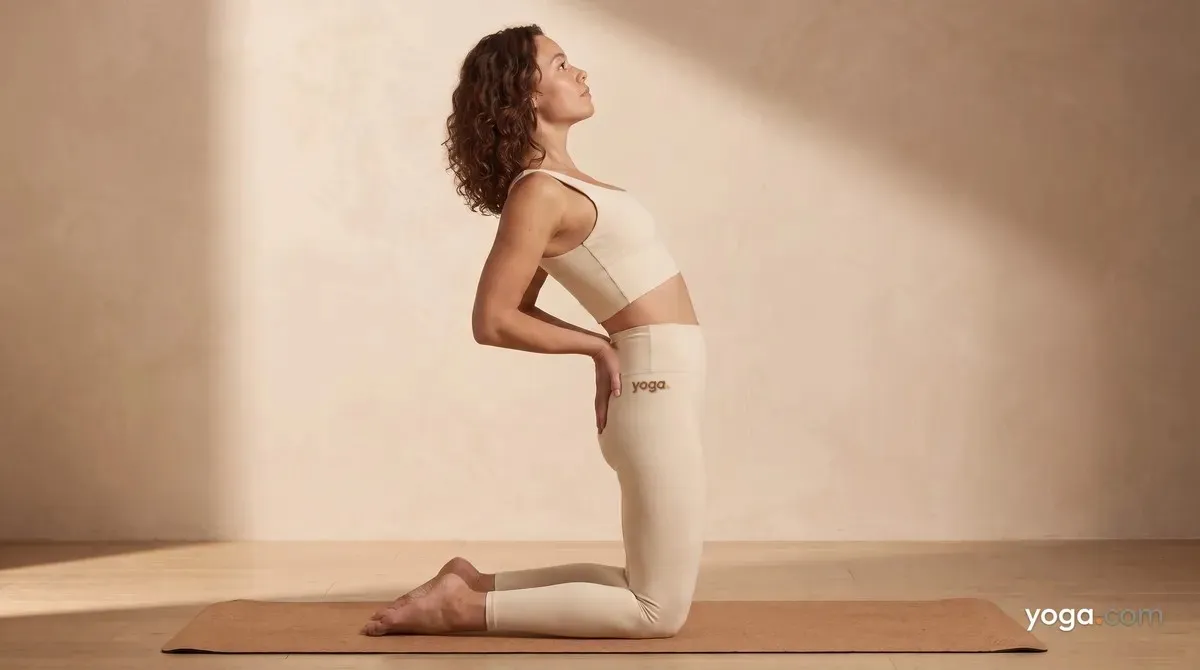
Easy Camel Pose with Palms Against Back is a supported backbend performed kneeling, where you press your palms firmly into your lower back and sacrum rather than reaching all the way down to your heels. Its Sanskrit name is Uṣṭrāsana (palms against back) - uṣṭra meaning camel and āsana meaning seat or posture. This accessible variation belongs naturally in the middle of a backbend sequence, making full Camel Pose available to you before your spine and hip flexors have developed the openness for the deeper expression.
At a Glance
- Level: Beginner
- Type: Backbend
- Targets: Thoracic spine, hip flexors, chest and shoulders, quadriceps
- Good for: Building spinal extension, lengthening the front body, strengthening the muscles along the back of the spine
How to Do Easy Camel Pose with Palms Against Back
- Kneel on a folded blanket or your mat with your knees hip-width apart and the tops of your feet flat on the floor, toes pointing straight back.
- Press your shins and the tops of your feet evenly into the mat. Draw your inner thighs slightly back and apart to create a stable foundation through your pelvis.
- Place your palms on your lower back and sacrum, fingers pointing either up toward your waist or down toward your tailbone - whichever feels more supportive. Keep your elbows drawing toward each other behind you.
- On an inhale, lift tall through the crown of your head and lengthen the front of your torso upward.
- Begin to lean back slowly, using your hands as a shelf for your lumbar spine. Push your hips forward over your knees so your thighs stay roughly vertical - this protects the lower back from compression.
- Lift your sternum toward the ceiling and broaden your collarbones. Let your head follow the natural arc of your spine - you may drop it back gently if that feels comfortable, or keep your chin slightly tucked if you have any neck sensitivity.
- Hold for 5-8 breaths, continuing to breathe into the front of your chest.
- To come out, bring your chin toward your chest, engage your core gently, and use your hands against your back to support yourself as you rise slowly upright on an inhale. Rest in Child's Pose for several breaths to neutralize the spine.
Benefits
- Stretches the hip flexors and quadriceps through a controlled kneeling extension.
- Increases mobility in the thoracic spine by encouraging extension through the mid and upper back.
- Stretches the anterior chest, shoulders, and the intercostal muscles between the ribs.
- Strengthens the erector spinae and the muscles along the posterior spine that support and control the backbend.
- Builds the muscular engagement and postural awareness needed to progress toward the full expression of Camel Pose.
Common Mistakes and Alignment Cues
- Hips drifting back behind the knees: Keep pushing your hips forward so your thighs remain perpendicular to the floor - this distributes load evenly rather than dumping it into the lumbar vertebrae.
- Collapsing into the lower back: Think of lifting your chest up and over an imaginary ball rather than crunching backward. The extension should feel long, not compressed.
- Elbows splaying wide: Draw your elbows toward each other behind you to open the front of the shoulders and create more support for the hands.
- Holding the breath: Keep breathing fully into the front ribs and chest - a shallow or held breath signals you have gone deeper than your body is ready for.
- Knees wider than hip-width: Align your knees directly under your hip joints so that your foundation stays stable and your inner thighs can engage effectively.
Modifications and Props
- Blanket under knees: If kneeling on the mat is uncomfortable, fold a thick blanket beneath your knees and shins for cushioning.
- Toes tucked under: Curl your toes under so your heels rise slightly. This raises the floor and makes it easier to keep the thighs vertical, a helpful option if you feel significant strain in the lower back.
- Block against the sacrum: Hold a block flat against your sacrum with both hands to give your palms a firmer, wider surface to press into as you lean back.
- Wall support: Kneel facing away from a wall with your buttocks and the back of your thighs lightly touching it to sense your hip position, keeping your palms on your sacrum as you lean back. This provides external feedback to guide hip alignment and prevent the hips from swaying back.
Cautions
- Approach carefully if you have a recent or chronic lower back injury; keep the backbend shallow and prioritize the lift through the chest over depth.
- If you have a neck injury or cervical instability, keep your chin toward your chest throughout rather than dropping the head back.
- Those with knee pain should pad the knees generously or skip this pose until discomfort is assessed.
- Avoid practicing on a full stomach - the compression of the abdomen in a deep backbend can be uncomfortable.
If you're working with an injury or a medical condition, check with a qualified professional before practicing.
Related Poses
- Cobra Pose - a gentler prone backbend that warms up the spine before kneeling extensions.
- Bridge Pose - a supine backbend that prepares the thoracic spine and activates the posterior chain.
- Camel Pose with Palms Set Against Feet - the natural next progression once your hip flexors and thoracic spine have gained more openness.
- Upward-Facing Dog Pose - builds similar chest-opening and spinal extension in a different orientation.
For accessible sequences that include gentle backbends, see A Gentle Yoga Routine for Tired, Low-Energy Days and A 10-Move Chair Yoga Sequence for a Midday Reset.