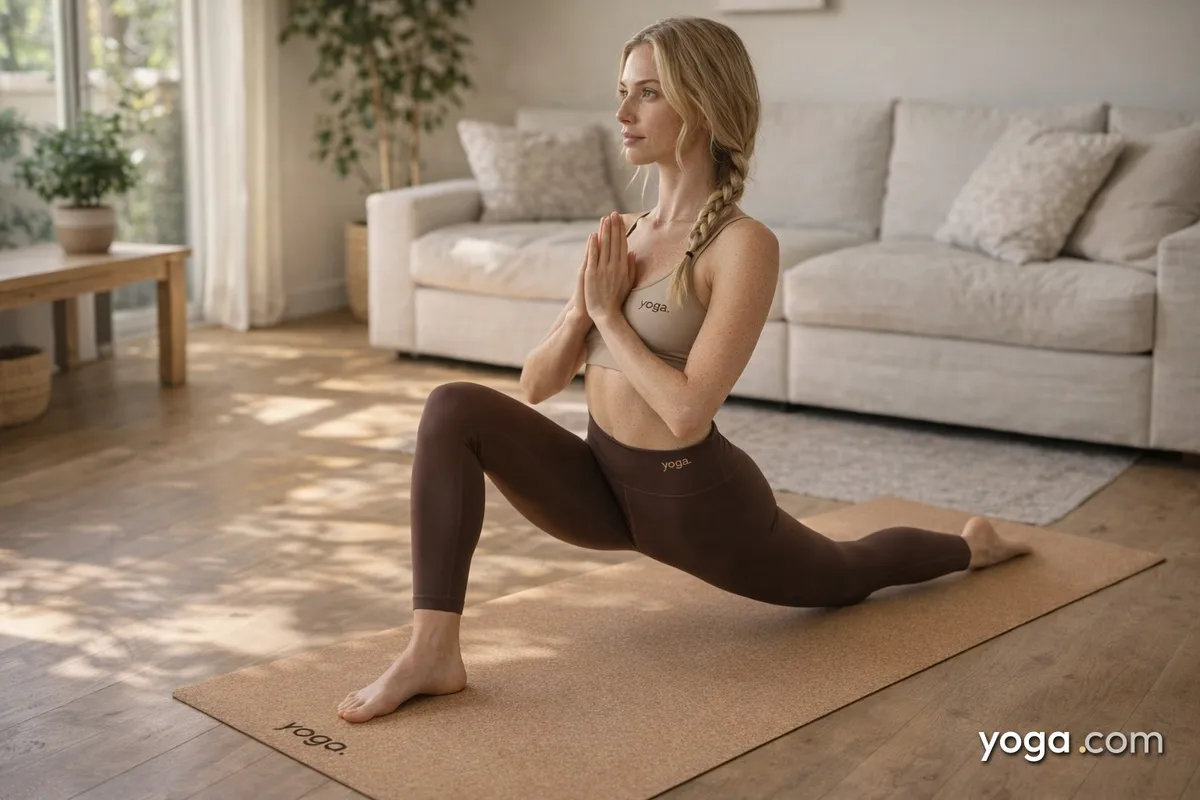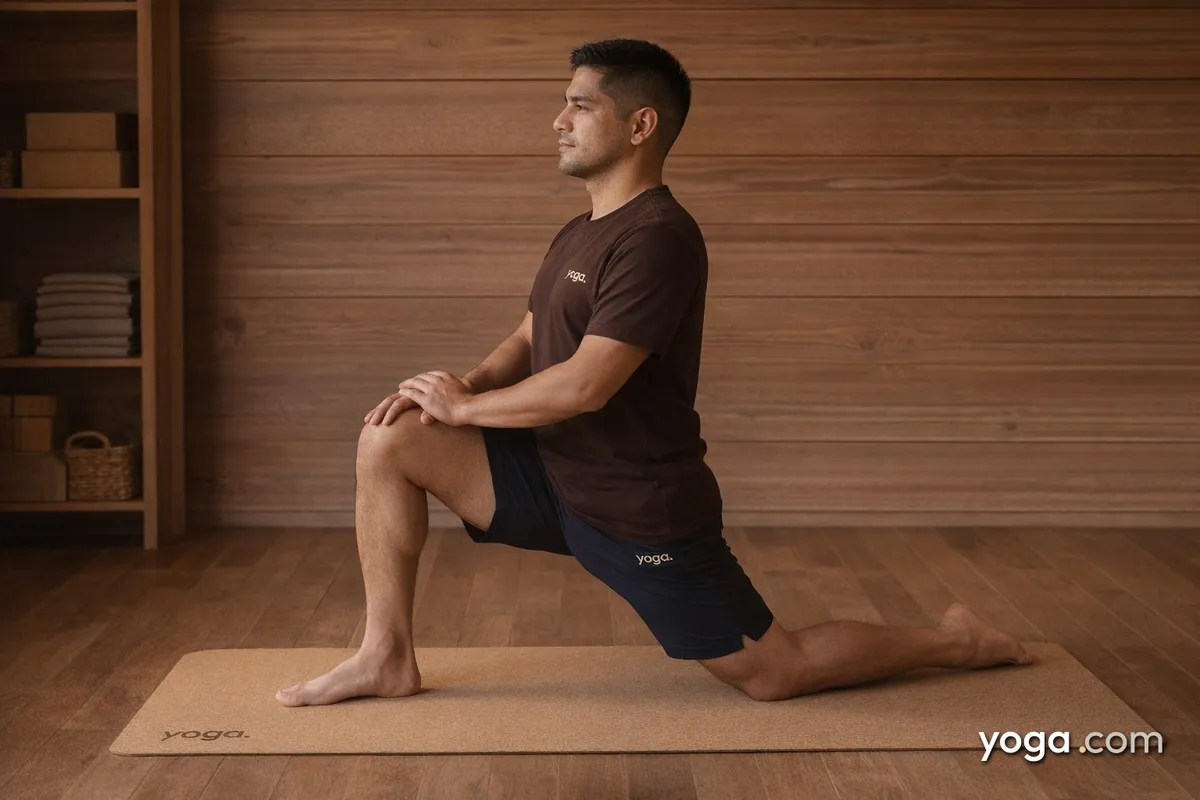
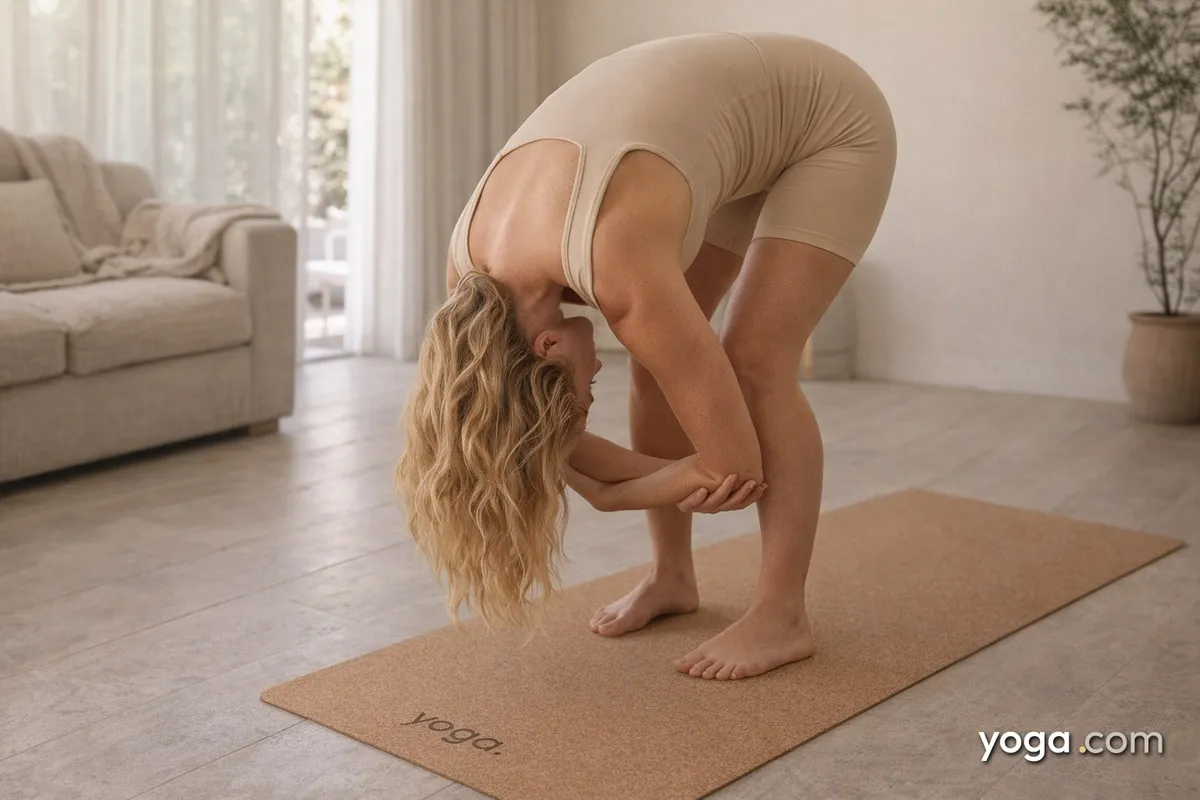
Easy Forward Bend Pose with Legs Half Bent is a standing forward fold practiced with a generous bend in both knees, making the full descent of the torso toward the legs accessible to students at any level. Its Sanskrit name is Uttānāsana (legs half bent) - ut meaning intense, tān meaning stretch, and āsana meaning pose - though the bent-knee variation softens the intensity considerably. It fits naturally at the start of a standing sequence, as a transition between poses, or as a gentle reset after more demanding work.
At a Glance
- Level: Beginner
- Type: Forward Bend
- Targets: Hamstrings, lumbar spine, hip flexors, upper back
- Good for: Lengthening the spine, building body awareness in forward folds, easing tension in the lower back
How to Do Easy Forward Bend Pose with Legs Half Bent
- Begin in Mountain Pose, standing with your feet hip-width apart, weight evenly distributed across both feet, arms at your sides.
- Inhale to lengthen your spine, lifting the crown of your head toward the ceiling and drawing the shoulders gently back and down.
- On your exhale, bend both knees generously - aim for roughly a 45-degree bend, or as much as feels comfortable - keeping your feet flat on the floor.
- Hinge forward from your hips (not your waist), allowing your torso to drape toward your thighs. Let your chest rest lightly on or near your thighs if it reaches easily.
- Release your hands toward the floor, letting them rest on your shins, a block, or the mat. Keep your neck long and relaxed, gaze soft toward the floor behind your heels.
- With each inhale, create a small lengthening in your spine; with each exhale, allow the torso to settle a little heavier toward the legs. Stay for 5-10 breaths.
- To come out, place your hands on your thighs. On an inhale, press through your feet and use your leg strength to rise slowly back to standing. Roll up through the spine vertebra by vertebra, bringing your head up last.
- Return to Mountain Pose and take one full breath before moving on.
Benefits
- Stretches the hamstrings and calves in a load-appropriate range for beginners and students with tight posterior chains.
- Lengthens the lumbar spine and decompresses the lower vertebrae when the knees are bent and the torso is fully released.
- Strengthens the quadriceps, which must work isometrically to hold the bent-knee position.
- Gently mobilizes the thoracic spine as the upper back rounds and releases toward the floor.
- Encourages diaphragmatic breathing by compressing the abdomen lightly against the thighs.
- Builds the foundational hip-hinge pattern needed for full Standing Forward Bend and deeper forward folds.
Common Mistakes and Alignment Cues
- Rounding from the waist instead of hinging at the hips: Before you fold, place your hands on your hip creases and feel the hips tipping forward - the fold initiates there, not at the lower back.
- Letting the knees collapse inward: Track your knees directly over your second and third toes throughout the pose; press the outer edges of your feet into the mat to encourage that alignment.
- Gripping the neck or jutting the chin forward: Let your head hang heavy; if your chin pokes forward, tuck it slightly so the back of your neck stays long.
- Locking the arms or pulling on the legs to force depth: Your hands are there for light support only - avoid yanking yourself deeper; let gravity and breath do the work.
- Rising too quickly: Always use your hands on your thighs for support as you stand, and move up slowly to avoid a head rush.
Modifications and Props
- Blocks under hands: Place two blocks at their highest height on either side of your feet. This raises the floor and removes any strain from reaching, letting you focus fully on releasing the spine.
- Hands on shins: If the floor or blocks feel far away, simply rest both palms on your shins. This gives you a stable base without collapsing the chest.
- Wall support: Stand with your back heels a foot from a wall. As you fold, let your hips press back toward the wall - this teaches the hip-hinge action and gives you proprioceptive feedback.
- Deeper knee bend: If your hamstrings are very tight or your lower back is sensitive, bend your knees more deeply - even into a squat-like position - so the torso can fully rest on the thighs without strain.
Cautions
- Recent or acute lower back injury: The forward fold position places load on the lumbar spine; move slowly, keep the knees well bent, and come out at the first sign of sharp or radiating discomfort.
- Knee sensitivity or injury: Avoid deep bending if you feel pinching or pain in the knee joint; a shallower bend - just enough to soften the hamstrings - is sufficient.
- High blood pressure or glaucoma: Inverted or semi-inverted positions cause a temporary increase in blood pressure and intraocular pressure; hold for shorter durations and rise very slowly.
- Dizziness or vertigo: Keep your gaze toward the floor rather than looking back between your legs, and come out of the pose at the first sign of lightheadedness.
If you're working with an injury or a medical condition, check with a qualified professional before practicing.
Related Poses
- Mountain Pose - the natural starting point and counterpose for this fold.
- Standing Forward Bend - the full expression of this pose with straight legs; practice here first to build confidence.
- Downward-Facing Dog Pose - shares the same hip-hinge and hamstring lengthening action in a different plane.
- Seated Forward Bend - a seated progression that deepens hamstring and spinal lengthening once you're comfortable folding forward.
You'll also find this pose woven into A Gentle Yoga Routine for Tired, Low-Energy Days and A 10-Move Chair Yoga Sequence for a Midday Reset.