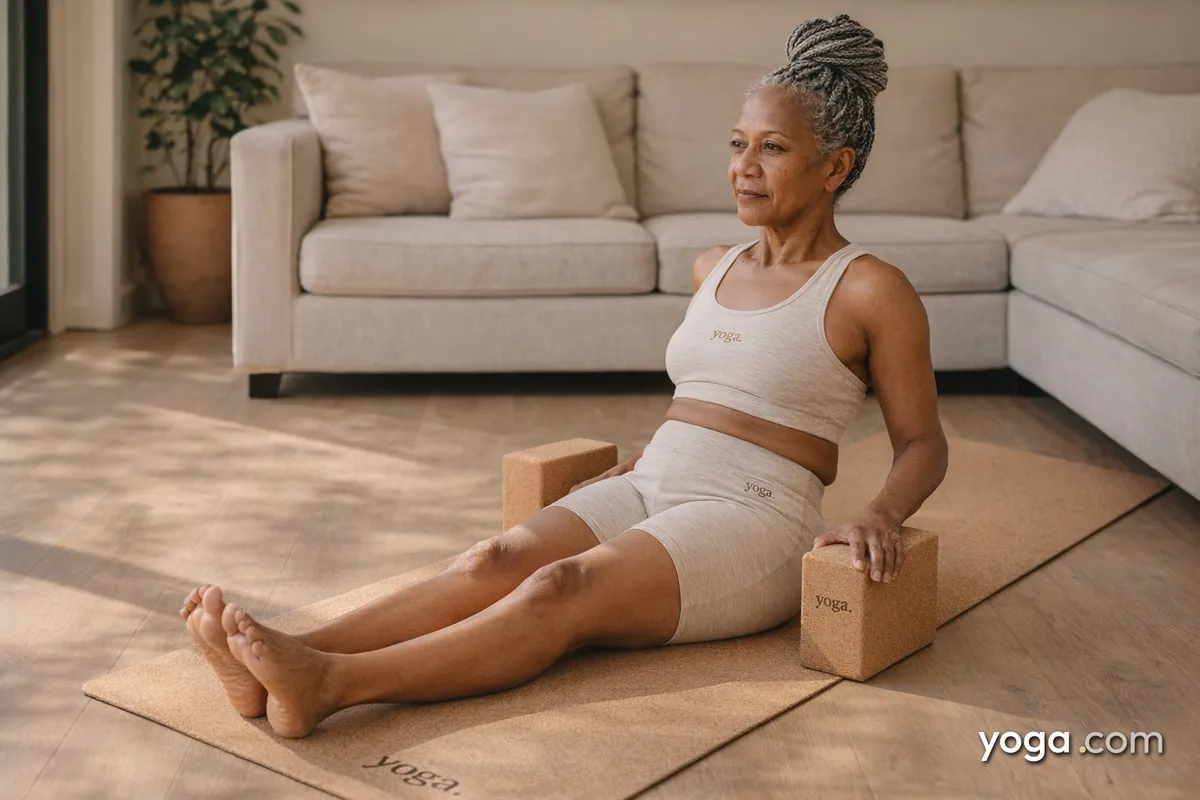
Easy Staff Pose, Daṇḍāsana (easy variation) - from the Sanskrit daṇḍa, meaning "staff" or "stick," and āsana, meaning "seat" - is a supported seated foundation pose that establishes upright spinal alignment with both legs extended forward. Unlike the full expression of Daṇḍāsana, which demands significant hamstring flexibility and active spinal extension, this variation welcomes practitioners who need extra support through props or a gentle knee bend to sit tall without strain. It appears near the beginning of seated sequences as a grounding posture and a point of reference for spinal integrity throughout practice.
At a Glance
- Level: Beginner
- Type: Seated
- Targets: Spine, hamstrings, hip flexors, core
- Good for: Building postural awareness, lengthening the posterior chain, establishing seated stability
How to Do Easy Staff Pose
- Sit on your mat with both legs extended in front of you. If your lower back rounds immediately or your pelvis tilts back, place a folded blanket or firm block under your sitting bones so the pelvis can tilt slightly forward.
- Allow a soft, comfortable bend in both knees - enough that your lower back can lengthen without effort. This is the key adaptation of the easy variation.
- Press your sitting bones evenly into the support beneath you and feel the pelvis settle into a neutral position: neither tucked under nor exaggerated in its curve.
- Place your palms flat on the mat (or on blocks) alongside your hips, fingers pointing toward your feet. Press down through your hands to create gentle traction along the sides of your spine.
- Draw the lower belly inward and upward with a light engagement - enough to support the lumbar spine without gripping.
- Roll your shoulders up, back, and down, broadening across the collarbones. Let the crown of your head float toward the ceiling, and soften your chin parallel to the floor.
- Gaze softly forward or at a fixed point on the mat ahead of you. Breathe steadily for 5-10 breaths, maintaining length through the spine without rigidity.
- To come out, bend both knees and draw them toward your chest, or simply transition to any comfortable seated position.
Benefits
- Strengthens the erector spinae and deep postural muscles that support an upright spine.
- Stretches the hamstrings progressively, particularly with gradual straightening of the legs over time.
- Trains neutral pelvis alignment, an essential skill for all seated and standing poses.
- Builds shoulder stability and awareness through the grounded hand position.
- Activates the deep core muscles in a low-demand, accessible way.
- Develops body-awareness and breath control as a transition or preparation pose.
Common Mistakes and Alignment Cues
- Lower back rounds and collapses: Raise your seat height with a folded blanket or block, or bend the knees more, until the spine can lengthen without effort.
- Shoulders creeping toward the ears: Roll the shoulders back and down deliberately; think of drawing the shoulder blades toward each other and then letting them settle low on the back.
- Hands pressing so hard the shoulders bunch: Use just enough pressure through the palms to feel a gentle lift - not a shrug. If blocks raise your hands to hip height, this becomes much easier.
- Chin jutting forward: Gently draw the chin back so the ears stack over the shoulders; imagine lengthening the back of the neck rather than compressing the front.
- Holding the breath: The pose should feel stable enough that natural, even breathing continues throughout - ease the knees or raise the seat if breathing feels strained.
Modifications and Props
- Blanket or block under the hips: The single most effective modification. Raising the seat allows the pelvis to tilt forward and the spine to lengthen without fighting tight hamstrings.
- Blocks under the hands: If the floor feels far away when your arms are straight, place a block on each side of your hips at a comfortable height so the arms can work without the shoulders collapsing.
- Strap around the feet: Loop a strap around the balls of both feet and hold the ends, allowing a gentle active hamstring stretch while keeping the spine tall - useful as you gradually work toward straighter legs.
- Wall support: Sit with your back a few inches from a wall and, on an inhale, lengthen the spine to lightly touch the wall with your mid-back and shoulder blades - use the wall as feedback for upright posture without leaning into it.
Cautions
- Hamstring or lower back discomfort: Keep a generous bend in the knees and lift the hips; never force the legs straight if the lower back is rounding or there is sharp sensation behind the knees.
- Wrist sensitivity: If pressing through flat palms irritates the wrists, make soft fists or use blocks to reduce wrist extension.
- Sciatica or sacral discomfort: Experiment with seat height and knee position; discontinue if symptoms increase.
- Recent abdominal surgery: Approach core engagement gently; avoid any bracing that increases intra-abdominal pressure.
- If you're working with an injury or a medical condition, check with a qualified professional before practicing.
Related Poses
- Mountain Pose - the standing counterpart to Staff Pose's upright spinal alignment; practice both to understand axial extension in different orientations.
- Bound Angle Pose - a natural complement that opens the inner groins and hips after the hamstring focus of Staff Pose.
- Half Boat Pose - a logical next step that takes the seated foundation of Daṇḍāsana into active core work.
- Downward-Facing Dog Pose - a counter-pose that decompresses the spine and continues lengthening the posterior chain established here.
See Easy Staff Pose in context in A Gentle Yoga Routine for Tired, Low-Energy Days and A 10-Move Chair Yoga Sequence for a Midday Reset.