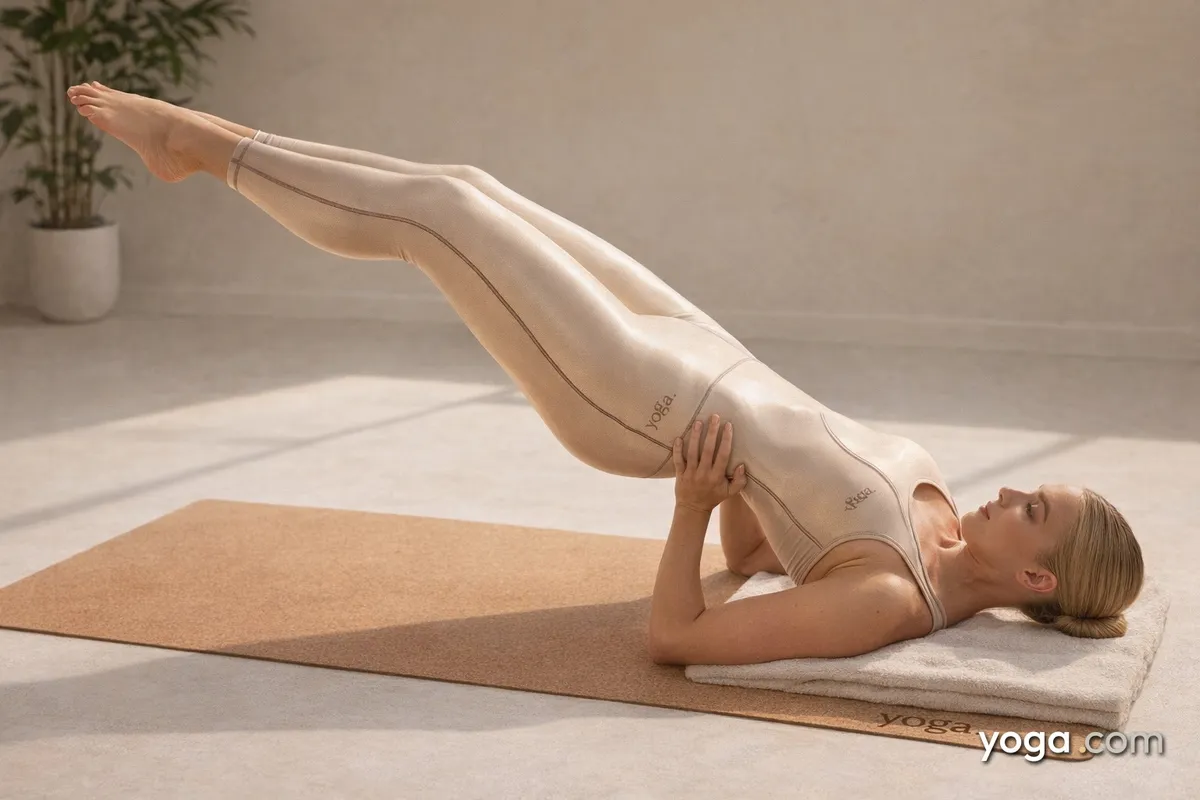
Easy Supported Shoulderstand with Tilted Legs is a gentle entry point into the shoulderstand family, practiced with the hands supporting the lower back and the legs angled away from vertical rather than stacked straight overhead. Its Sanskrit name is Sālamba Sarvāṅgāsana (tilted legs) - sālamba meaning "with support," sarva meaning "all," and aṅga meaning "limb" - reflecting the tradition of a full-body inversion. The tilted-leg variation reduces the demand on core and neck strength, making it an approachable way to experience inversion at the end of a practice.
At a Glance
- Level: Beginner
- Type: Inversion
- Targets: Cervical and thoracic spine, shoulders, hamstrings, core
- Good for: Building shoulder stability, lengthening the posterior chain, practicing spinal decompression in a supported position
How to Do Easy Supported Shoulderstand with Tilted Legs
- Lie on your back with a folded blanket (or two) under your shoulders so your head rests on the mat and your neck has a slight natural curve - never flattened against the floor.
- Bend your knees, plant your feet flat, and on an exhale draw your knees toward your chest, then swing your hips up and overhead, coming onto the backs of your shoulders and upper arms.
- Place your palms firmly on your lower back, fingers pointing toward the spine, elbows shoulder-width apart and pressing into the mat.
- Extend your legs upward at a comfortable diagonal - angled 30 to 45 degrees away from vertical rather than perpendicular to the floor. This is your tilted-leg position.
- Check that your weight rests on the tops of your shoulders and the backs of your upper arms, not on your neck. Your gaze travels toward your chest or the ceiling - keep your head still and do not turn it.
- Firm your thighs, flex your feet, and breathe steadily. Hold for 5-15 breaths, gradually extending the duration over weeks of practice.
- To come out, bend your knees toward your forehead, place your hands on the mat, and roll down one vertebra at a time, controlling the descent. Rest in Corpse Pose for several breaths.
Benefits
- Builds isometric strength in the shoulders and upper arms as they bear the body's weight.
- Stretches the posterior neck and upper trapezius through the chin-to-chest position.
- Lengthens the hamstrings and calves as the legs reach away from the torso.
- Trains the deep spinal extensors to maintain the lumbar curve against gravity.
- Develops body awareness and proprioception in an inverted orientation, preparing you for fuller inversions.
- Encourages diaphragmatic breathing under mild load, building respiratory efficiency.
Common Mistakes and Alignment Cues
- Collapsing onto the neck: Press firmly through the elbows and upper arms so the cervical spine floats free - no body weight should land on the neck itself.
- Elbows splaying wide: Walk the elbows toward each other until they are roughly shoulder-width; wider elbows reduce the support your hands can provide to the back.
- Legs fully vertical from the start: Keep the legs in their tilted diagonal - this is intentional in this variation and reduces strain on an unsupported neck and lumbar spine.
- Turning the head in the pose: Once you are inverted, your head must stay still; turning can compress the cervical vertebrae unevenly. Set your gaze before you go up and hold it.
- Rolling down too quickly: Use your hands to brake the descent, peeling the spine down bone by bone rather than dropping the hips.
Modifications and Props
- Folded blankets under the shoulders: Stack one to three firm blankets so the edge aligns with the top of your shoulders. This elevation protects the natural cervical curve - use them every time until your neck and shoulder strength is well established.
- Wall support: Place your mat perpendicular to a wall. Once inverted, rest the soles of your feet lightly on the wall at a low height, giving you a stable reference point while you find your balance.
- Strap around the upper arms: Loop a strap just above the elbows to keep them from splaying, freeing your attention from the arms so you can focus on the back and legs.
- Chair-supported variation: Rest your sacrum on the seat of a folding chair, walk your shoulders to the floor, and extend the legs up at a diagonal from the chair - a fully passive version suitable when arm strength is limited.
Cautions
- Avoid this pose if you have a neck injury, cervical disc issues, or unmanaged high blood pressure.
- Practiced during menstruation is a personal choice - many teachers suggest skipping strong inversions during the first days of the cycle.
- Glaucoma or detached retina are contraindications for inversions; the increased intraocular pressure in any shoulderstand position may be inappropriate.
- If you feel any compression, tingling, or sharp sensation in the neck, come down immediately and rest.
- If you're working with an injury or a medical condition, check with a qualified professional before practicing.
Related Poses
- Bridge Pose - a strong preparatory backbend that opens the chest and activates the legs before you go overhead.
- Easy Plow Pose - a natural progression from shoulderstand that deepens the spinal flexion with the legs lowered toward the floor.
- Ear Pressure Pose - an advanced follow-on that takes the legs further, compressing the ears between the knees.
- Corpse Pose - the essential counter-pose for any inversion, allowing the spine to return to neutral and the nervous system to settle.
Work shoulderstand into a full sequence: A Gentle Yoga Routine for Tired, Low-Energy Days or find standing and seated balance first with A 10-Move Chair Yoga Sequence for a Midday Reset.