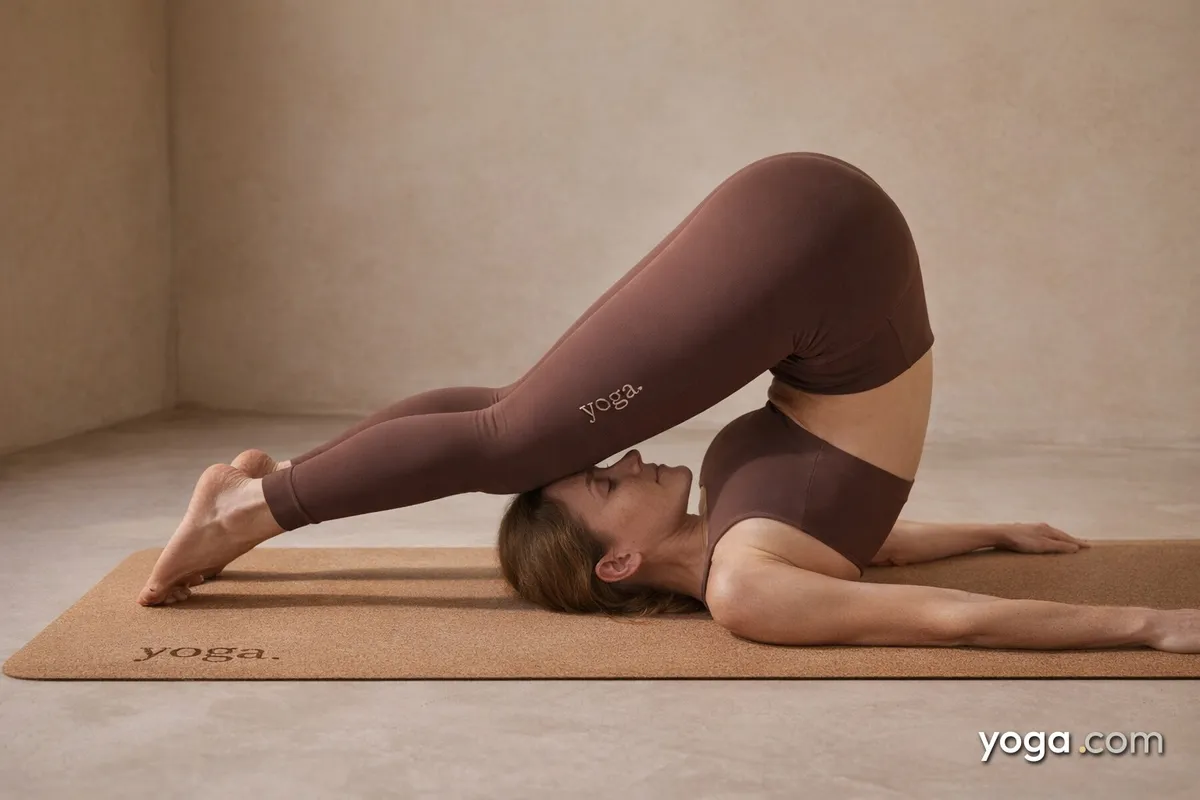
Ear Pressure Pose is a deep spinal flexion inversion in which the knees fold down past the head to press gently against the ears. Its Sanskrit name, Karṇapīḍāsana, translates literally as "ear pressure pose" (karṇa = ear, pīḍā = pressure). It typically appears toward the end of a practice, following Plow Pose, as the spine reaches its fullest safe flexion before the body is lowered into rest.
At a Glance
- Level: Intermediate
- Type: Inversion
- Targets: Cervical and thoracic spine, hamstrings, glutes, inner thighs
- Good for: Deepening spinal flexion range, building posterior-chain length, quieting external sensory input
How to Do Ear Pressure Pose
- Begin in Plow Pose: lie on your back, swing both legs overhead, and rest the tops of your feet on the floor behind your head with legs straight. Support your lower back with your hands, elbows pressing into the mat shoulder-width apart.
- Once your hips are stacked above your shoulders and your spine feels steady, begin to bend both knees simultaneously.
- Draw your knees toward the floor beside your ears, aiming to place them as close to your ears as your flexibility allows - ideally resting lightly on the mat, framing your head.
- If the knees reach the floor, you may release your hands from your back and extend both arms along the mat behind you, or wrap them around the backs of your thighs for support.
- Soften your jaw, your throat, and the backs of your eyes. Keep a natural breath moving - the chest will be compressed, so breathe into your back ribs.
- Hold for 5-10 slow breaths, maintaining gentle engagement through your core so the weight of your hips does not collapse into your neck.
- To exit: Place your hands back on your lower back, straighten your legs into Plow Pose, then slowly roll your spine down one vertebra at a time, controlling the descent with your abdominals. Arrive on your back and pause for several breaths before sitting up.
Benefits
- Stretches the entire posterior chain from the cervical spine through the thoracic and lumbar regions
- Lengthens the thoracic erectors and rhomboids, which carry much of the load from desk posture and overhead work
- Strengthens the deep abdominals, which must remain active to protect the neck from excess compression
- Develops hamstring and inner-thigh flexibility as the thighs draw toward the torso
- Creates a gentle traction effect through the lumbar spine when the pelvis is elevated and stable
- The closed, muffled position around the ears can support a brief withdrawal of external sensory stimulation (pratyahara)
Common Mistakes and Alignment Cues
- Mistake: Letting the weight dump into the neck. Cue: Keep your hands on your lower back until your knees are fully settled; the weight should rest across the tops of your shoulders, not on your cervical vertebrae.
- Mistake: Turning the head to one side while in the pose. Cue: Once you are in position, commit to stillness - any rotation when the neck is loaded puts asymmetrical stress on the cervical discs.
- Mistake: Holding the breath due to chest compression. Cue: Redirect the breath into the back and sides of the ribcage; keep the exhale long and steady to stay calm in the enclosed shape.
- Mistake: Forcing the knees to the floor before the spine is ready. Cue: Let gravity do the work; if the knees float well above the ears, stay there and continue supporting the back with your hands.
- Mistake: Rolling out of the pose quickly. Cue: Use a slow, controlled descent - unrolling the spine vertebra by vertebra protects the neck and trains the eccentric strength of your core.
Modifications and Props
- Blanket under the shoulders: Fold two firm blankets and place them under your shoulders (not your neck) to create a small lift. This keeps the cervical curve natural and reduces compression at the neck - the single most important prop for any shoulder-stand family pose.
- Hands remain on the back: If your knees do not reach the floor, keep your hands supporting your lower back throughout the hold. This is a complete expression of the pose for many practitioners.
- Easy Plow Pose as preparation: If bending the knees feels inaccessible today, simply stay in Easy Plow Pose with bent knees resting on a chair or blocks placed behind your head, and work on spinal lengthening there first.
- Wall variation: Practice with your back close to a wall and allow your feet to rest on the wall behind you in Plow, then slide your knees down the wall as they bend - the wall provides feedback and limits how far the knees travel.
Cautions
- Avoid this pose if you have a neck injury, cervical disc issues, or any condition that limits safe spinal flexion under load.
- Skip Ear Pressure Pose during menstruation if your teacher or personal experience suggests inversions are not appropriate at that time.
- Glaucoma, high blood pressure, or a detached retina are reasons to avoid head-down inversions of this depth.
- Do not practice if you feel tingling, sharp pain, or numbness in the arms, hands, or neck at any point - come out slowly and rest.
- If you're working with an injury or a medical condition, check with a qualified professional before practicing.
Related Poses
- Plow Pose - the direct preparatory pose; Ear Pressure Pose is entered from here.
- Easy Plow Pose - a supported variation that helps you build the posterior-chain length needed to fold the knees fully.
- Bridge Pose - an accessible counter-pose that gently opens the front of the spine after deep flexion and reestablishes a neutral lumbar curve.
- Supported Headstand - the natural next progression in the inversion family, building greater overhead stability and body awareness.
If you're building toward or recovering from deeper inversions, you may find useful sequencing ideas in A Gentle Yoga Routine for Tired, Low-Energy Days and A 10-Move Chair Yoga Sequence for a Midday Reset.