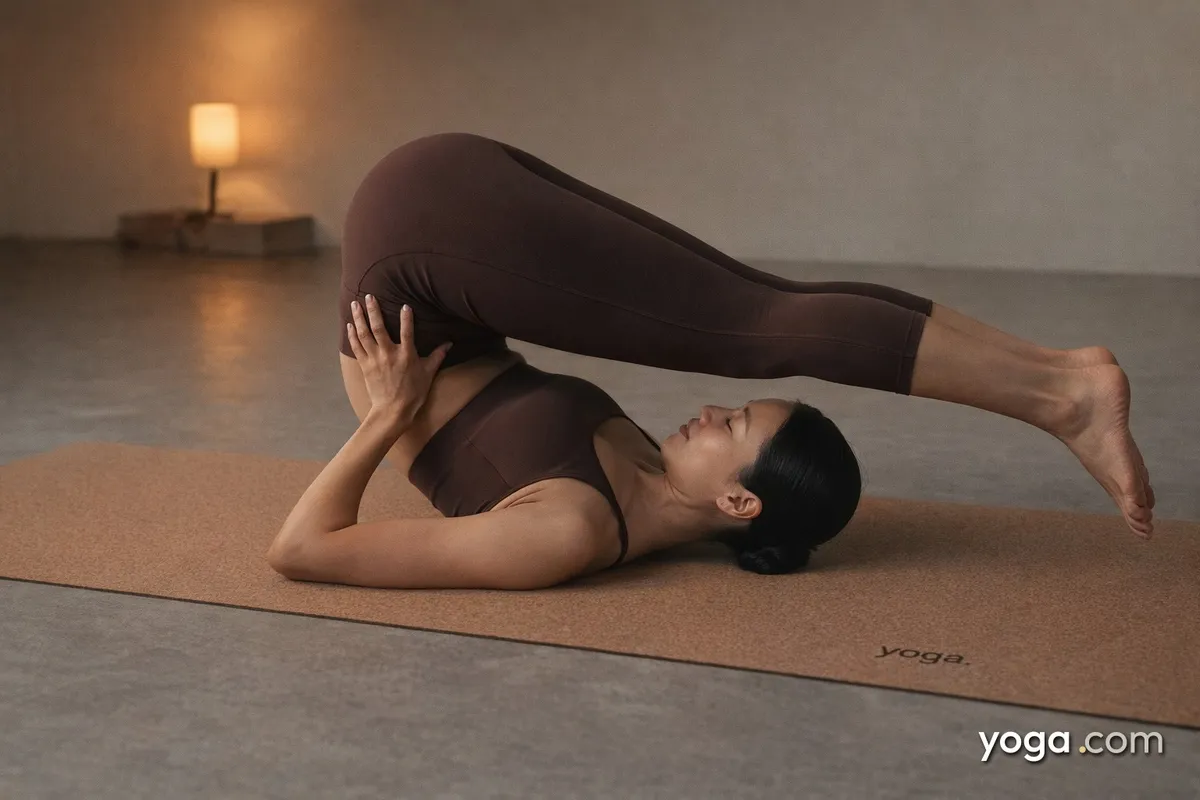
Easy Plow Pose - Sanskrit Halāsana (easy variation), from hala (plough) and āsana (seat) - is an accessible entry into the plow family of inversions. Rather than reaching both feet all the way to the floor behind the head, this variation keeps the legs bent or supported so the spine can decompress and the shoulders can settle without strain. It works well near the end of a practice, after the body is warm and the nervous system is ready to turn inward.
At a Glance
- Level: Beginner
- Type: Inversion
- Targets: Cervical and thoracic spine, hamstrings, shoulders, upper back
- Good for: Lengthening the posterior chain, building spinal mobility, calming the breath
How to Do Easy Plow Pose
- Start on your back. Lie flat with your arms alongside your body, palms pressing down, legs extended. Take a breath to settle.
- Draw your knees to your chest. On an exhale, hug both knees in, engaging the core gently to protect the lower back.
- Lift the hips. Press through your palms and swing your legs up and over, bringing your hips off the mat and your knees toward your forehead. Keep your chin slightly away from your chest - there should be a small natural curve at the neck, not a crunch.
- Support the back. Bend your elbows and place both hands on your mid-to-lower back, fingers pointing toward the ceiling, to create a firm shelf. This is the easy variation - you stay supported here rather than releasing the arms flat.
- Find your stopping point. Let your knees rest toward or lightly on the floor behind your head if that is available, or simply let them hover near your forehead with the feet dangling. Do not force the legs down. The spine should feel long, not compressed.
- Hold and breathe. Stay for 5-10 slow breaths. Let the weight of the legs create gentle traction rather than pulling or pushing.
- Come out with control. To exit, tuck the chin slightly, firm the core, and slowly roll the spine back down vertebra by vertebra, using your hands on the back as a guide. Keep the movement smooth - avoid dropping the hips with a thud.
- Rest in Corpse Pose. Extend both legs long, release the arms, and let the nervous system settle for at least 5 breaths before moving on.
Benefits
- Stretches the hamstrings and calves along the entire posterior chain.
- Lengthens the cervical and thoracic spine, counteracting prolonged forward-head posture.
- Strengthens the upper back and the muscles around the shoulder blades as they draw together to support the torso.
- Encourages diaphragmatic breathing by gently compressing the abdomen.
- Builds the shoulder stability and body awareness needed for deeper inversions.
Common Mistakes and Alignment Cues
- Mistake: Rolling onto the neck. Cue: Keep your weight distributed across the tops of the shoulders, not the cervical vertebrae. If you feel pressure in your neck, raise your hips higher and reduce the angle of your legs.
- Mistake: Forcing the feet to the floor. Cue: Let the legs stop where they stop. Gravity does the work over time; pushing creates compression, not length.
- Mistake: Holding the breath. Cue: Soften the jaw, relax the tongue, and keep the exhale long and steady - the breath is your guide to how far the pose is working.
- Mistake: Dropping out of the pose quickly. Cue: The descent is as important as the ascent. Roll down one vertebra at a time, using the core to control speed.
- Mistake: Letting the elbows splay wide. Cue: Draw the elbows toward each other to build a stable base for the back, which also opens the chest.
Modifications and Props
- Blanket under the shoulders: Fold one or two firm blankets and place them under your shoulders (not your neck) to give the cervical spine a few extra centimetres of clearance. This is the most common and most helpful adjustment for beginners.
- Chair behind the head: Position a chair seat-height behind you so the shins can rest on the seat rather than the feet reaching the floor. This fully supports the legs and removes all strain from the hamstrings and spine.
- Knees bent throughout: If hamstring tightness prevents any comfortable leg extension, keep the knees bent the entire time, shins parallel to the floor. The spinal and shoulder benefits remain intact.
- Wall support: Practice near a wall so the feet can press lightly against it at whatever height is comfortable, giving you a stable reference point and reducing the sense of being ungrounded.
Cautions
- Neck issues: Avoid this pose if you have a cervical herniation, acute neck pain, or any instability in the upper spine. The blanket modification (described above) is not a substitute for medical clearance in these cases.
- Glaucoma or high blood pressure: Inversions increase intra-ocular and intracranial pressure; skip this pose or practice only with guidance from a qualified teacher and your health-care provider.
- Pregnancy: Inversions and strong abdominal compression are not appropriate in most stages of pregnancy. Consult your provider and a prenatal-trained teacher.
- Recent abdominal surgery: Wait until your surgeon has cleared you for forward bends and compression before attempting any plow variation.
If you're working with an injury or a medical condition, check with a qualified professional before practicing.
Related Poses
- Bridge Pose - a gentle preparation that warms the spine and opens the chest before you tip into the inversion.
- Plow Pose - the full expression of this shape, with legs extended and feet on the floor.
- Ear Pressure Pose - the natural next step from full Plow, deepening the spinal flexion.
- Corpse Pose - the essential counter-pose to practice immediately after coming down from any inversion.
Easy Plow also fits naturally into a winding-down sequence - see A Gentle Yoga Routine for Tired, Low-Energy Days for context, or explore gentler inversion options in A 10-Move Chair Yoga Sequence for a Midday Reset.