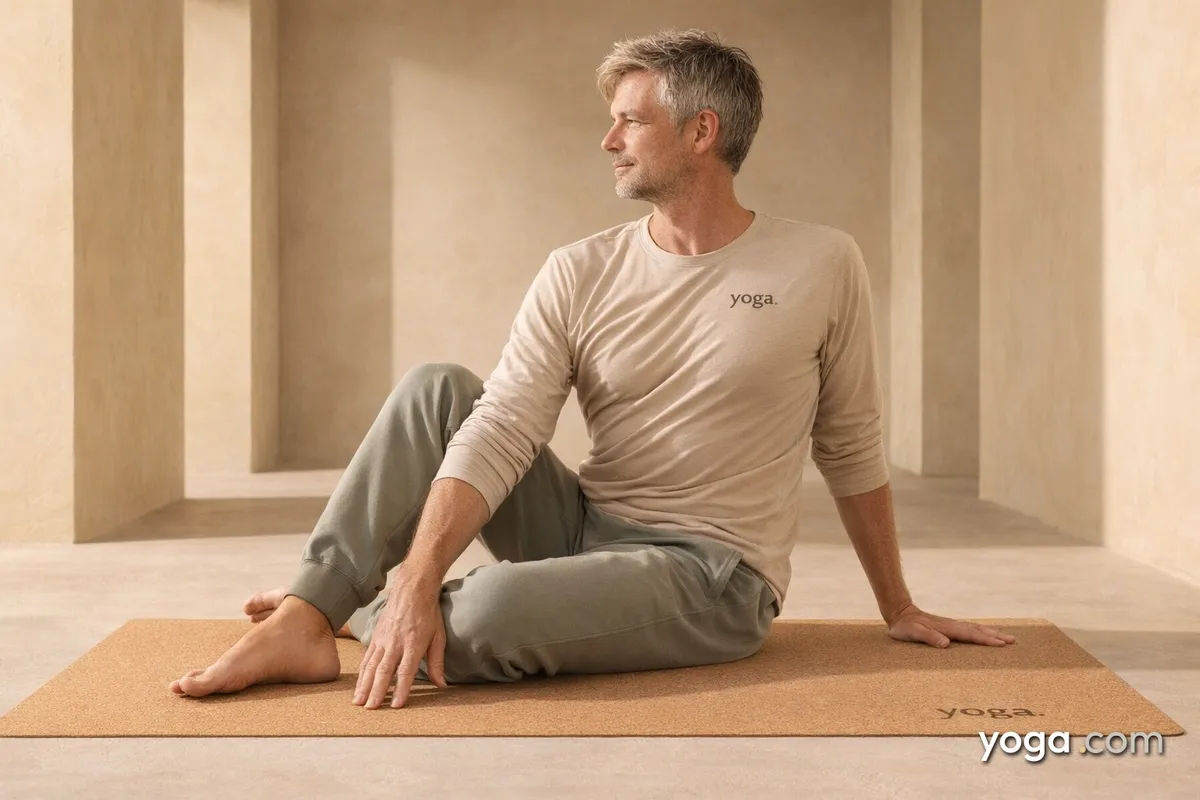
Sage Twist (Right) - Bharadvājāsana, from the Sanskrit bharadvāja (the name of a revered Vedic sage) and āsana (seat or posture) - is a seated spinal rotation named in honor of one of the seven great seers of ancient India. Where many twists demand open hips or flexible hamstrings as a prerequisite, this pose folds the legs to one side and lets the pelvis settle so the spine can rotate with relative ease, making it a genuinely accessible entry point into the twist family for intermediate practitioners.
At a Glance
- Level: Intermediate
- Type: Twist
- Targets: Thoracic and lumbar spine (rotation right), left hip external rotators, right shoulder and chest (opener), obliques
- Good for: Building rotational mobility, counteracting prolonged sitting, warming the spine before deeper backbends or twists
How to Do Sage Twist (Right)
Begin seated at the center of your mat with your legs extended in front of you.
- Set your foundation. Bend both knees and fold your legs to the left, so the outer edge of your left foot rests on the floor and your right foot nestles on top of - or just beside - your left inner thigh. Your left shin points roughly back along the left side of your mat. Both sit bones should be as close to the floor as your hips allow.
- Level the pelvis. Press down evenly through both sitting bones. If the right hip lifts significantly, sit on a folded blanket until the pelvis feels stable and even.
- Lengthen the spine. On an inhale, grow tall through the crown of your head - imagine lifting each vertebra away from the one below it. Draw the lower belly gently in and up so the lumbar spine does not collapse into a deep arch.
- Begin the twist. On an exhale, rotate your entire torso to the right. Lead with the sternum rather than the chin - the head follows last, not first.
- Place the hands. Bring your right hand to the floor (or a block) just behind your right hip. Take your left hand to the outside of your right knee or thigh. Use the left hand as a gentle lever - press the knee away to deepen the twist without forcing the lumbar spine.
- Open the chest. Roll the right shoulder back and down, away from the right ear. Let the collarbones broaden as the chest turns to face the right wall.
- Hold and breathe. Stay for 5-8 full breaths. With each inhale, re-establish length in the spine; with each exhale, allow - do not force - a small deepening of the rotation.
- Come out. On an inhale, unwind the torso back to center. Extend both legs long, shake them out, then set up on the opposite side if practicing symmetrically.
Benefits
- Thoracic mobility: Repeated rotation through the mid-back counters the forward-rounding pattern that builds up from desk work and driving.
- Oblique and paraspinal activation: The muscles that produce and resist spinal rotation are loaded through their functional range, building coordinated trunk strength.
- Hip-flexor lengthening: With the legs folded to the left, the right hip flexors move into a mild stretch as the pelvis stabilizes and the torso rotates away.
- Shoulder and chest opening: Drawing the right shoulder back stretches the anterior deltoid and pectoral fibers on that side.
- Proprioceptive grounding: The asymmetrical leg position challenges the nervous system to maintain balance and spatial awareness from a novel base, sharpening body sense.
Common Mistakes and Alignment Cues
Collapsing the lumbar spine before rotating Lengthen up first on every inhale. Think of the twist as wringing a tall column, not a crumpled one. Pulling hard with the left hand to force depth The hand on the knee is a guide, not a lever bar. Keep the pressure soft enough that your breath stays full and unrestricted. Right sit bone lifting off the floor Sit on a folded blanket to raise the floor to meet you rather than chasing depth at the cost of your base. Leading the twist with the chin Rotate the sternum and ribs first; the head arrives last. The cervical spine follows thoracic rotation - it does not lead it. Gripping the right shoulder up toward the ear Actively release the right shoulder blade down the back. Width across the collarbones signals that the chest is genuinely open rather than just turned.
Modifications and Props
- Blanket under the sit bones: If either hip lifts when the legs fold left, sit on one or two firm folded blankets. A level pelvis makes a safe, effective twist possible.
- Block behind the back hand: Place a block at any height under the right hand so the arm is not fully loaded and the shoulder stays relaxed.
- Strap around the right knee: If the left hand cannot comfortably reach the right knee, loop a strap around the knee and hold the strap instead.
- Chair variation: Sit sideways on a chair with the chair back to your right. Hold the back of the chair with both hands and use it to guide the twist - ideal when floor mobility is limited.
- Deeper variation: Experienced practitioners can bind by threading the left arm under the right knee and clasping the right wrist behind the back, expanding the chest further.
Cautions
- Approach carefully if you have recent or acute injury to the lumbar discs, sacroiliac joints, or sacrum - deep rotation under load can aggravate these structures.
- During pregnancy, particularly in the second and third trimesters, favor open twists that do not compress the abdomen; consult your care provider before practicing closed twists.
- If the knee or ankle of the top (right) foot is uncomfortable in the folded position, place a folded blanket under it or come out of the pose.
- Avoid forcing end-range rotation if you feel sharp or shooting sensation anywhere along the spine.
If you’re working with an injury or a medical condition, check with a qualified professional before practicing.
Related Poses
- Right Twist with Right Leg Bent - a close cousin that isolates a single bent leg and deepens the same rightward rotation pattern.
- Left Twist with Left Leg Bent - the mirror-side counterpart; practice both to build balanced rotational mobility.
- Rotation Pose with Legs to the Right - explores a supine version of legs-to-one-side rotation, a useful preparatory or cool-down shape.
- Bend to Left Leg with Rotation - combines a lateral fold with rotation, reinforcing the thoracic mobility that Sage Twist develops.