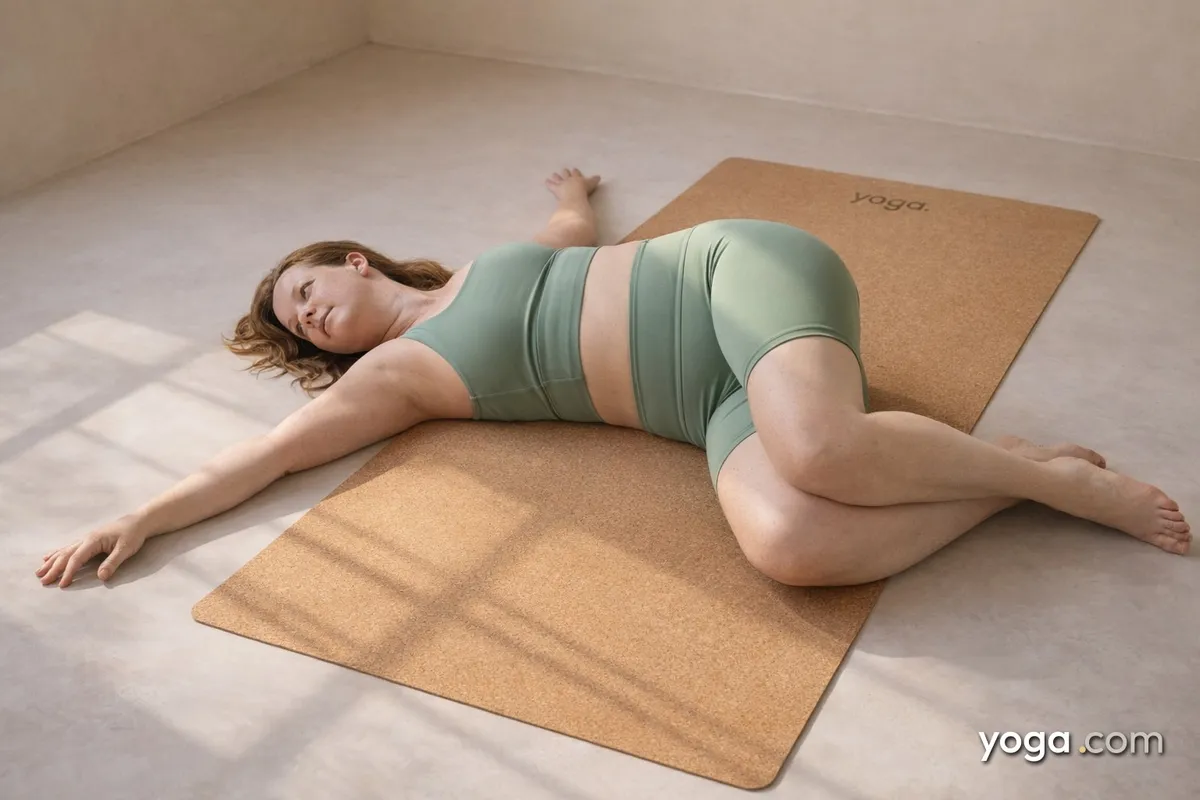
Rotation Pose with Legs to the Right is a supine spinal twist that brings both knees to the right side of the body while the torso stays grounded. Its Sanskrit name, Jāṭhara Parivartanāsana (right side), translates roughly as "stomach-turning pose" - jāṭhara meaning abdomen and parivartana meaning revolving or turning. Accessible to beginners, it appears naturally at the close of a practice as a gentle transition toward Śavāsana.
At a Glance
- Level: Beginner
- Type: Twist
- Targets: Thoracic and lumbar spine, obliques, hip rotators, chest
- Good for: Increasing rotational range of motion in the spine, lengthening the side body, releasing tension in the hip external rotators
How to Do Rotation Pose with Legs to the Right
- Lie on your back with your knees bent and feet flat on the mat, hip-width apart. Extend your arms out to either side at shoulder height, palms facing up.
- Draw both knees toward your chest so your shins are roughly parallel to the floor.
- On an exhale, lower both knees together toward the right, letting them rest on the mat or on a folded blanket if they don't reach the floor comfortably.
- Keep the left shoulder blade in contact with the mat. If it lifts, reduce how far you take the knees toward the floor.
- Turn your gaze to the left, away from the knees, to extend the rotation through the cervical spine - or keep the head neutral if that feels better for your neck.
- Breathe evenly for 5-10 breaths, allowing the weight of the legs to deepen the rotation naturally without forcing.
- To come out, engage the core gently and use an inhale to draw the knees back to center.
- Hug the knees briefly to the chest to neutralize the spine, then repeat on the left side or transition to your next pose.
Benefits
- Rotates the thoracic and lumbar vertebrae, maintaining mobility through the full length of the spine.
- Stretches the obliques and the outer left hip as the legs drop right.
- Lengthens the chest and anterior shoulder of the left arm as the torso stays open.
- Activates and gently contracts the right-side obliques, building rotational awareness in the core.
- Encourages diaphragmatic breathing by creating space between the ribs on the left side.
Common Mistakes and Alignment Cues
- Left shoulder lifting off the mat: Raise the knees slightly higher - stack them closer to hip height rather than dropping them all the way to the floor until your range allows it.
- Knees separating: Press the inner thighs together so the legs move as one unit; this keeps the twist evenly distributed through the spine rather than collapsing into the lower back.
- Forcing the twist with the hand: Avoid pressing the knees down with your left hand. Let gravity and your breath do the work; the pose deepens over time, not through pressure.
- Holding the breath: Each exhale is an invitation - lengthen the spine on the inhale and soften a little further into the rotation on the exhale.
- Head cranked too far: The cervical gaze should feel like an extension of the twist, not a strain. Back off if there is any pinching or discomfort in the neck.
Modifications and Props
- Blanket under the knees: If the knees hang in the air above the mat, place a folded blanket or block beneath them. This removes the strain of gravity pulling on the lower back before your range is ready.
- Strap around the thighs: Loop a strap loosely around both thighs to keep them stacked and together throughout the hold, helpful if the knees keep drifting apart.
- Feet flat, one at a time: For a gentler entry, keep the right foot flat on the mat and simply let the left knee cross over the right thigh toward the floor - a half-reclined twist that reduces the load on the lumbar spine.
- Bolster support: Rest a bolster lengthwise along the right side of the mat and lower the knees onto it for a fully supported, restorative version.
Cautions
- Spinal disc issues: Rotational loading on a compromised disc can be uncomfortable; keep the range of motion small and stop if you feel any radiating sensation.
- Recent abdominal surgery or pregnancy: Avoid deep compression of the abdomen; consult your care provider before practicing twists.
- Sacroiliac (SI) joint sensitivity: Keep both knees stacked and move slowly; an asymmetrical drop can aggravate the SI joint.
- Neck injury: Keep the gaze neutral - eyes toward the ceiling - rather than turning the head to the opposite side.
If you're working with an injury or a medical condition, check with a qualified professional before practicing.
Related Poses
- Right Twist with Right Leg Bent - a single-leg variation that prepares the same rotational direction with less demand.
- Left Twist with Left Leg Bent - the mirror-side complement; practice together to balance the spine.
- Sage Twist (Right) - a seated progression that builds on the rotational awareness developed here.
- Corpse Pose - the natural counter-pose and resting state after supine twists.
See this pose in context: A Gentle Yoga Routine for Tired, Low-Energy Days and A 10-Move Chair Yoga Sequence for a Midday Reset.