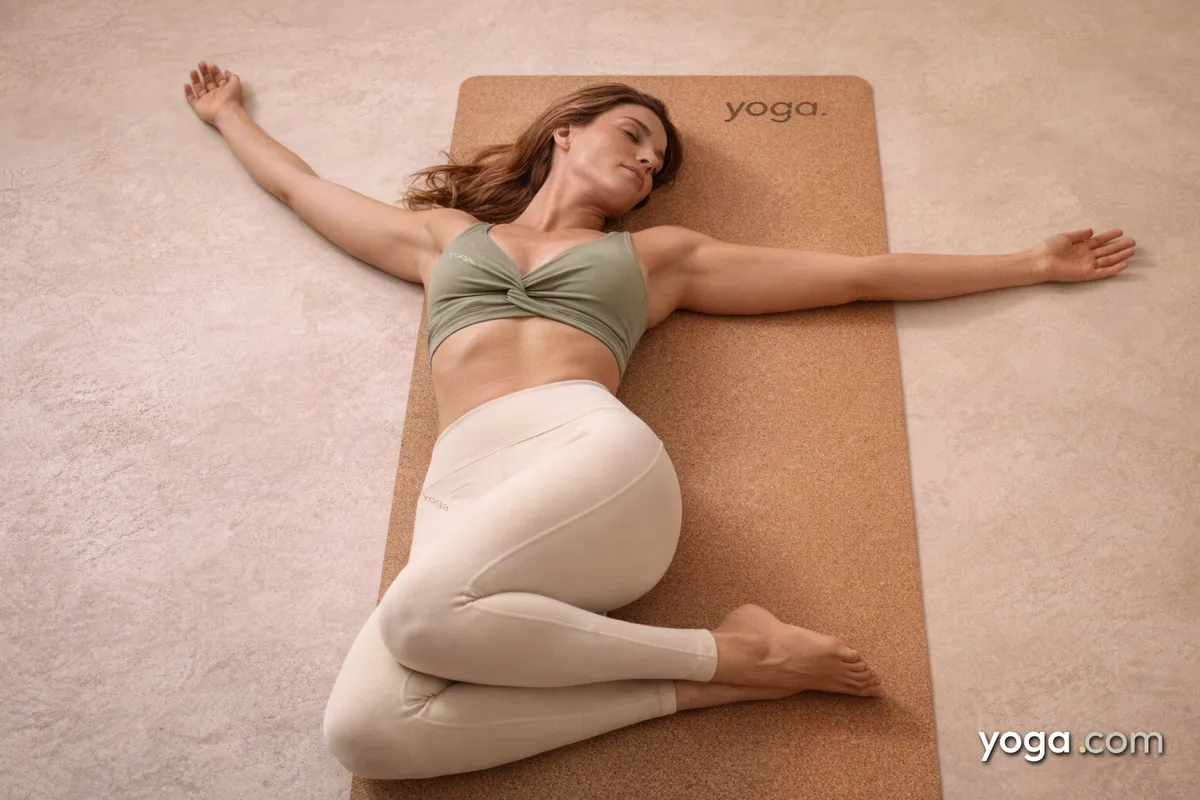
Spinal Bend Pose with Legs to the Right is a supine spinal twist in which both legs drop toward the right side of the mat while the torso and shoulders remain grounded. Its Sanskrit name is Jathara Parivartanāsana (spinal bend, legs right) - jathara meaning "stomach" or "abdomen," parivartana meaning "turning" or "revolving," and āsana meaning "pose." It appears naturally at the close of a practice as a gentle transition into Corpse Pose, or as an accessible reset between more demanding sequences.
At a Glance
- Level: Beginner
- Type: Supine
- Targets: Spinal rotators, obliques, hip flexors, chest and shoulders
- Good for: Lengthening the lateral torso, building spinal rotational mobility, grounding the nervous system at the end of practice
How to Do Spinal Bend Pose with Legs to the Right
- Lie flat on your back with your legs extended and arms resting alongside your body. Take a breath to settle into the mat.
- Draw both knees toward your chest, keeping your feet together and your lower back long on the floor.
- Extend your arms out to either side at shoulder height, palms facing up, forming a T-shape with your torso.
- On an exhale, slowly lower both knees together to the right, stacking them if you can, aiming to bring the outer right knee and the outer right ankle toward the mat.
- Turn your gaze to the left, allowing your left shoulder to stay heavy on the floor and your left arm to anchor you.
- Breathe steadily here for 5-10 breaths. With each inhale, feel your chest expand; with each exhale, allow the left shoulder to soften down without forcing it.
- To come out, engage your core gently and use an inhale to draw both knees back to center, returning them to your chest.
- Extend your legs back to the mat and rest for a breath before moving to the left-side variation or transitioning to Corpse Pose.
Benefits
- Stretches the spinal rotator muscles and obliques through their full rotational range.
- Lengthens the left hip flexors and the outer left hip as the legs lower to the right.
- Opens the chest and the front of the left shoulder when the gaze turns left and the arm remains grounded.
- Activates the deep spinal stabilizers through controlled, gravity-assisted rotation.
- Encourages diaphragmatic breathing by releasing tension in the intercostal muscles along the left side of the rib cage.
Common Mistakes and Alignment Cues
- Mistake: Left shoulder lifts off the mat. Cue: Keep both arms heavy and wide. If the shoulder rises, raise your knees higher (closer to your chest) before lowering them - a shallower angle makes grounding the shoulder easier.
- Mistake: Knees splay apart as they lower. Cue: Press the inner knees and inner ankles toward each other. Think of your legs as one unit moving as a single block to the right.
- Mistake: Forcing the knees all the way to the floor. Cue: Let gravity do the work over time. The knees can hover; depth comes with breath, not effort.
- Mistake: Holding the breath or bracing the belly. Cue: Soften the abdomen and breathe fully. The twist deepens on each natural exhale.
- Mistake: Gaze stays at the ceiling instead of turning left. Cue: Turn your head slowly to look past your left fingertips, which completes the rotational chain from head to heel.
Modifications and Props
- Bolster or folded blanket under the knees: If your knees hover far from the floor and the lower back feels strained, rest both knees on a bolster placed to the right. This supports the twist at a comfortable depth.
- Block between the knees: Squeezing a block between the knees keeps the legs stacked and encourages inner-thigh engagement, making it easier to control the descent.
- Strap around the thighs: Loop a strap loosely around both thighs just above the knees to prevent them from separating if inner-leg strength is limited.
- Feet flat, knees bent (bent-knee variation): If drawing knees to chest feels uncomfortable, keep feet flat on the mat with knees bent and let them fall together to the right - a lower-demand entry into the same rotation.
Cautions
- Move slowly if you have any history of disc herniation or acute lower back pain; stop if you feel sharp or radiating sensations.
- Approach with care if you have recent hip or sacroiliac joint irritation - keep the range of motion small and supported.
- Avoid pulling the knees aggressively toward the floor with the hand; passive gravity and breath are sufficient in this pose.
- If you are in the later stages of pregnancy, consult your care provider before practicing supine twists.
If you're working with an injury or a medical condition, check with a qualified professional before practicing.
Related Poses
- Knee Press Both Legs - a useful preparation that draws the knees to the chest and releases the lower back before the twist.
- Right Leg Wind Freeing Pose - prepares the hip and lower back on the right side before combining both legs in the twist.
- Left Leg Wind Freeing Pose - balances the hip preparation on the left before or after the legs-right variation.
- Corpse Pose - the natural counter and closing pose; follow Spinal Bend Pose with Legs to the Right here once you have practiced both sides.
Practice this pose as part of a wind-down sequence: A Gentle Yoga Routine for Tired, Low-Energy Days or try it in a seated and supine format in A 10-Move Chair Yoga Sequence for a Midday Reset.