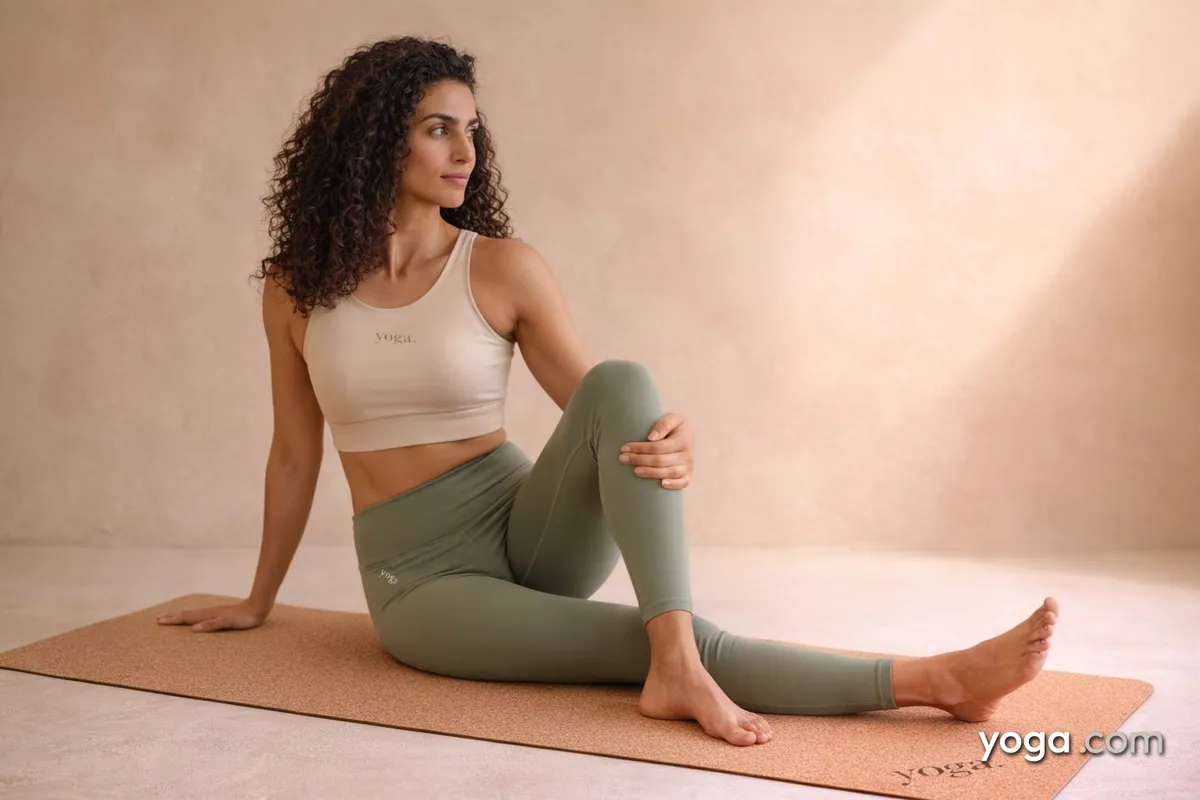
Sitting Left Twist is a classic seated spinal rotation that brings the torso to the left while one knee is crossed over the opposite leg. Its Sanskrit name, Ardha Matsyendrāsana (left side), translates roughly as "Half Lord of the Fishes Pose" - a reference to the sage Matsyendra, a legendary master of yoga. The pose fits naturally in the middle or closing section of a practice, after the hips and spine have had time to warm up.
At a Glance
- Level: Beginner
- Type: Twist
- Targets: Thoracic and lumbar spine, outer hips (glutes and piriformis), obliques, shoulders
- Good for: Building spinal rotation range of motion, lengthening the muscles along the side body, improving postural awareness in the torso
How to Do Sitting Left Twist
- Start in Staff Pose. Sit on your mat with both legs straight in front of you. Root your sitting bones evenly and sit tall, stacking your head over your pelvis.
- Set up the left leg. Bend your left knee and place your left foot flat on the floor on the outside of your right thigh, close to the right knee. Your left knee points straight up toward the ceiling.
- Position the right leg. Keep the right leg extended and active - flex the right foot and press the back of the right thigh toward the mat. You may also bend the right knee and tuck the right foot toward your left hip if that is more comfortable.
- Lengthen before you rotate. On an inhale, reach the crown of your head upward and lift through the entire spine. Resist the urge to start twisting before you have this length - a tall spine makes space for a safe, deeper rotation.
- Rotate to the left. On an exhale, turn your torso to the left. Bring your right arm to the outside of your left knee, elbow bent and pressing gently against the knee. Place your left hand on the mat behind your left hip, fingertips pointing away from you.
- Refine the twist. With each inhale, re-establish the length in your spine. With each exhale, see if the rotation deepens slightly - lead the movement from the mid and upper back rather than forcing it from the lower back. Keep both sitting bones grounded.
- Set your gaze. Look over your left shoulder if your neck is comfortable, or keep the gaze forward if you feel any strain in the cervical spine.
- Come out mindfully. On an inhale, release the twist by unwinding the torso back to center. Straighten the left leg, shake out both legs gently, and pause in Staff Pose before moving to the right side or your next pose.
Benefits
- Stretches the external rotators of the left hip, including the piriformis and gluteus medius.
- Mobilizes the thoracic spine and builds rotational range of motion through the vertebral joints.
- Lengthens the oblique muscles and the muscles along the right side of the torso.
- Strengthens the deep spinal muscles that support upright posture.
- Encourages awareness of uneven movement patterns between the left and right sides of the body.
Common Mistakes and Alignment Cues
- Rounding the lower back: If the low back collapses into a C-curve, sit on a folded blanket to lift the hips and make it easier to tilt the pelvis to a neutral position before twisting.
- Forcing the twist from the neck: The cervical spine follows the thoracic spine - rotate from your mid-back first, then allow the head to turn. Do not crank the neck independently to look further behind you.
- Using the arm as a lever to wrench deeper: The right arm at the left knee is a gentle anchor, not a crowbar. Ease off the pressure and let the breath drive the rotation instead.
- Lifted or uneven sitting bones: Ground both sitting bones equally throughout. If one lifts off the mat, reduce the depth of the twist.
- Holding the breath: A twist compresses the torso; shallow breathing is a sign you have gone too far. Back off enough to breathe fully and smoothly.
Modifications and Props
- Blanket under the hips: Sit on one or two folded blankets to help tilt the pelvis forward and straighten the spine, especially if tight hamstrings pull the lower back into a curve.
- Bent bottom leg: If keeping the right leg straight is uncomfortable or your pelvis tips back significantly, bend the right knee and place the right foot near your left hip. This reduces the hamstring demand and makes it easier to ground the pelvis.
- Hand on a block: Place a block behind your left hip instead of the floor if your shoulder is rounding or your arm is too short to reach comfortably. The block raises the floor to meet you.
- Chair variation: Sit sideways on a chair with the left side of the body facing the chair back. Hold the back of the chair with both hands and use it as a stable point to rotate the torso to the left - useful if floor sitting is not accessible.
Cautions
- Spinal disc issues: Rotational load on the lumbar spine can aggravate herniated or bulging discs. Practice with minimal range of motion and stop if you feel any radiating sensation.
- Recent abdominal surgery: Compression of the abdomen in this pose may be uncomfortable or contraindicated in the weeks following surgery. Wait for clearance from your healthcare provider.
- Sacroiliac (SI) joint sensitivity: Uneven loading of the pelvis during deep twists can aggravate the SI joint. Keep the twist moderate and ensure both sitting bones remain in contact with the mat.
- Pregnancy: Closed twists that compress the abdomen are generally avoided after the first trimester. Opt for open twists or check with a prenatal yoga specialist.
If you're working with an injury or a medical condition, check with a qualified professional before practicing.
Related Poses
- Left Twist with Left Leg Bent - a preparatory variation that simplifies the leg position and makes the twist accessible to beginners.
- Bend to Left Leg with Rotation - combines a forward fold and rotation to warm up the hamstrings and spine before the full twist.
- Sage Twist (Right) - the complementary opposite-side twist; practice after the left to balance the spine.
- Cat Pose - a gentle counter-pose that neutralizes the spine and releases any remaining tension in the back after twisting.
See this pose in context: A Gentle Yoga Routine for Tired, Low-Energy Days and A 10-Move Chair Yoga Sequence for a Midday Reset.