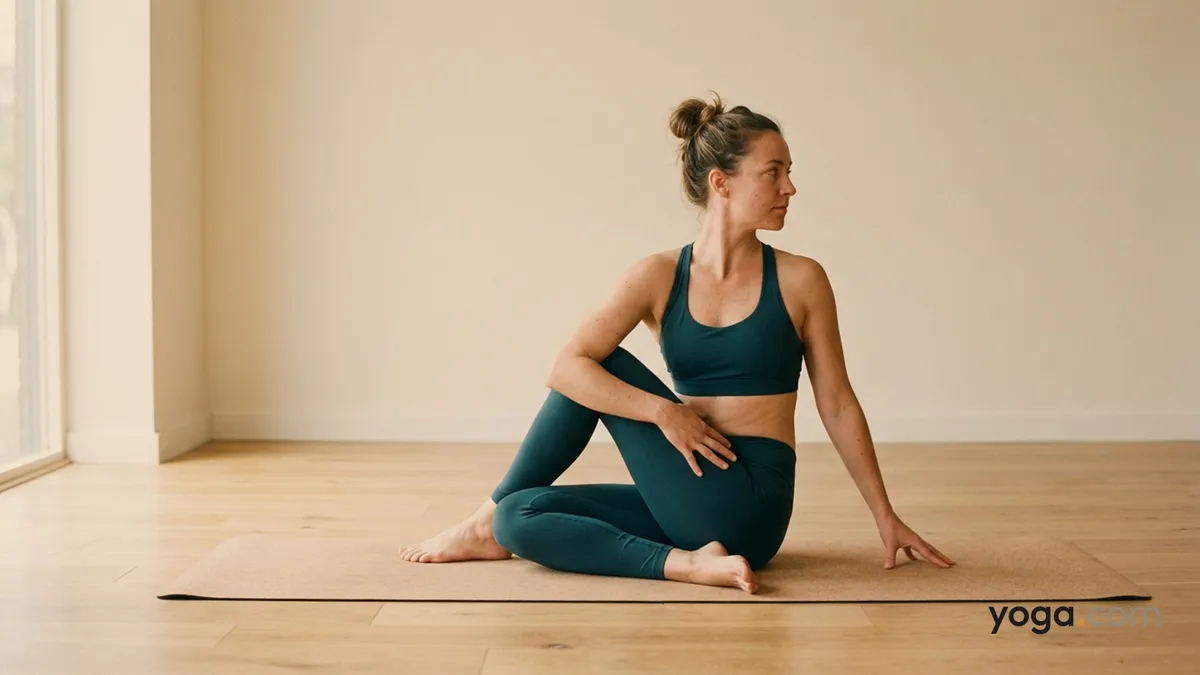
Sitting Right Twist is a classic seated spinal rotation that brings the torso to the right, grounding the lower body while mobilizing the thoracic spine and stretching the outer right hip. Its Sanskrit name, Ardha Matsyendrāsana (right side), translates roughly as "Half Lord of the Fishes Pose" — a reference to the legendary yogi Matsyendra — and this right-side variation is typically practiced first in a pair, followed by the left. It fits naturally in the middle or closing section of a floor sequence, after the spine is already warmed.
At a Glance
Level: BeginnerType: TwistTargets: Thoracic spine, outer hips (piriformis/glutes), obliques, spinal rotatorsGood for: Improving spinal rotation range of motion, lengthening the side body, building postural awareness in a seated positionHow to Do Sitting Right Twist
Start in Dandasana. Sit on the floor with both legs extended straight in front of you, spine tall, hands on the floor beside your hips.Set up the right foot. Bend your right knee and step the right foot flat on the floor to the outside of the left thigh, as close to the left knee as comfortable. The right shin is roughly vertical.Position the left leg. Keep the left leg extended and active — flex the left foot, pressing through the heel. You may also bend the left knee and tuck the left foot toward the right hip if that feels more stable.Lengthen before you rotate. Inhale, press both sitting bones down, and draw the crown of your head up to create full length through the spine. Avoid collapsing in the lower back.Rotate to the right. Exhale and turn your entire torso to the right. Wrap your left arm around the outside of the right knee, or hook the left elbow to the outside of the right knee with the forearm pointing up. Place your right fingertips or palm on the floor behind your right hip for support.Set your gaze. Turn your head to look over your right shoulder, keeping the neck in line with the thoracic rotation rather than cranking it independently.Breathe and hold. Stay for 5–8 breaths. With each inhale, re-establish length; with each exhale, allow the rotation to deepen organically — do not force it.Come out carefully. Exhale, release the arms, and turn the torso back to center on an inhale. Extend the right leg and pause in Dandasana for a breath before switching sides.Benefits
Mobilizes the thoracic and lumbar vertebrae through their rotational range of motion.Stretches the external rotators of the right hip, including the piriformis and posterior gluteal muscles.Strengthens the obliques and deep spinal rotators on the side driving the twist.Lengthens the muscles of the outer right thigh and IT band when the knee is held in position.Develops body awareness of pelvic stability versus upper-body mobility — a key postural skill.Engages the muscles along the spine that support upright seated posture.Common Mistakes and Alignment Cues
Rounding the lower back to twist deeper. Keep both sitting bones grounded and re-lengthen the spine before rotating. The quality of the twist matters more than its degree.Using the arm to wrench the knee inward. The left arm on the right knee is a lever to encourage rotation, not a handle to pull. Keep the knee stable and use your core to rotate.Collapsing the chest. Draw the shoulder blades gently toward each other and lift the sternum as you twist. The chest should feel open, not compressed.Turning only the head instead of the whole torso. Initiate the rotation from the navel, then the ribcage, then the shoulders, and finally the neck. The head follows the spine.Right shoulder creeping toward the ear. Soften the right shoulder down and keep the supporting arm long rather than crunching into it.Modifications and Props
Sit on a folded blanket or block. If your lower back rounds heavily in Dandasana, elevate the hips so the pelvis can tilt forward and the lumbar curve is restored before you rotate.Keep the left leg bent. Tucking the left foot toward the right hip lowers the difficulty and makes the base more stable — a good option if the extended-leg position pulls the pelvis out of neutral.Use the hand instead of the elbow. Rather than hooking the left elbow outside the right knee, simply press the left hand against the right knee. This gives more control over pressure.Practice in a chair. Sit sideways near the right edge of a chair, feet flat on the floor, and rotate to the right, holding the chair back with both hands. This version is accessible for those who find floor sitting uncomfortable.Cautions
Disc injuries or acute back pain: Rotational loading on a compromised disc can increase discomfort. Keep the twist very gentle or avoid it until cleared by a professional.Recent abdominal or spinal surgery: Avoid deep twists until your healthcare provider confirms it is safe to do so.Pregnancy: Closed twists that compress the abdomen are generally avoided; an open-arm variation or a gentle supine twist may be more appropriate.Knee pain: If bearing the right foot beside the left thigh compresses the right knee, move the foot further away or place a rolled blanket under the knee for support.If you're working with an injury or a medical condition, check with a qualified professional before practicing.
Related Poses
Left Twist with Left Leg Bent — the natural counter-pose; practice on the opposite side after this one.Sage Twist (Right) — a close sibling pose with a slightly different arm and leg arrangement; good next progression.Rotation Pose with Legs to the Right — a supine twist that prepares the spine for seated rotation.Cat Pose — warm up the spine through flexion before moving into this seated twist.You'll find seated twists in context in A Gentle Yoga Routine for Tired, Low-Energy Days and A 10-Move Chair Yoga Sequence for a Midday Reset.